Nobel Economics 2026: Hall and Woodford win for macroeconomic stability models
Synopsis
The 2026 Nobel Prize in Economics goes to two Americans — Robert E. Hall of Stanford and Michael Woodford of Columbia — whose forward-looking macroeconomic models rebuilt the theoretical foundation that central banks and governments now routinely rely on to manage booms, recessions, and external shocks. Their work emerged from the wreckage of 1970s stagflation and has since become the global policy standard.
Key Takeaways
The 2026 Nobel Prize in Economics was awarded to Robert E.
Hall (Stanford) and Michael Woodford (Columbia) on 13 October 2026 .
They were recognised for developing macroeconomic models grounded in microeconomic behaviour, enabling better economic stabilisation policy.
A core insight of their work is forward-looking behaviour — households and firms factor in future conditions, so policy signals from central banks can shape expectations and economic outcomes.
Their models are now widely used by central banks and governments worldwide , including in responses to energy crises and consumption shocks.
The prize carries 12 million Swedish kronor , shared equally between the two laureates.
Both laureates hold PhDs from MIT — Hall in 1967 , Woodford in 1983 .
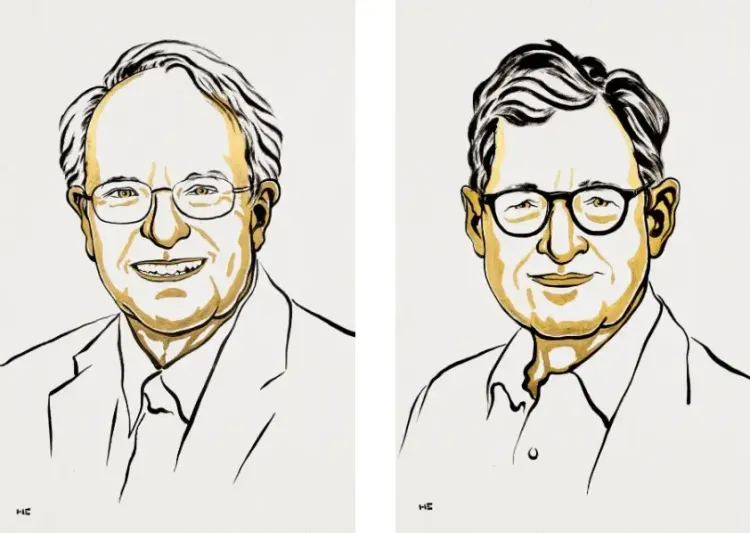
The Royal Swedish Academy of Sciences on Monday, 13 October 2026, awarded the 2026 Sveriges Riksbank Prize in Economic Sciences in Memory of Alfred Nobel — commonly known as the Nobel Prize in Economics — to American economists Robert E. Hall of Stanford University and Michael Woodford of Columbia University. The two laureates were recognised for developing macroeconomic models that have substantially strengthened policymakers' capacity to stabilise economies during both booms and recessions.
What the Laureates' Work Covers
According to the Nobel Committee, Hall and Woodford rebuilt macroeconomic models on microeconomic foundations, centering their frameworks on how individual households and businesses make decisions — and how those decisions collectively shape broader economic outcomes. A defining feature of their research is the concept of forward-looking behaviour: the idea that consumers and firms factor future economic conditions into present choices on spending, saving, investment, and pricing.
This insight carries a direct policy implication — signals from governments and central banks can shape expectations and, by extension, steer economic activity before a crisis fully materialises. The academy noted that this forward-looking dimension restored theoretical confidence in stabilisation policy at a time when it was badly needed.
Why This Research Emerged When It Did
The work of both economists gained relevance against the backdrop of a deep intellectual crisis in mainstream economics. Their research emerged amid widespread criticism of traditional Keynesian models following the oil shocks of the 1970s, when several advanced economies simultaneously experienced high inflation, sluggish growth, and rising unemployment — a combination those older frameworks struggled to explain or prescribe for.
By rebuilding macroeconomic models from the ground up on microeconomic behaviour, Hall and Woodford provided a more rigorous theoretical base that could accommodate such real-world complications. This is the kind of foundational shift that typically takes decades to filter into policy practice — but in this case, it did.
Global Adoption by Central Banks and Governments
The academy noted that the frameworks developed by the two economists are now widely used by central banks and governments worldwide, and have proved especially valuable in responding to economic downturns and external shocks such as energy crises and abrupt changes in household consumption patterns.
John Hassler, Chair of the Committee for the Prize in Economic Sciences, said: 'The Laureates' work has provided us with a stable theoretical foundation for the models that are now used by central banks and governments around the world.' He added that the models have meaningfully improved policymakers' ability to respond to disruptions ranging from energy crises to sudden shifts in household spending.
About the Laureates
Robert E. Hall, born in 1943 in Palo Alto, California, earned his PhD from the Massachusetts Institute of Technology (MIT) in 1967 and is currently a professor at Stanford University. Michael Woodford, born in 1955 in Chicopee, Massachusetts, received his PhD from MIT in 1983 and is a professor at Columbia University in New York.
Prize Details
The prize carries a monetary award of 12 million Swedish kronor, which will be shared equally between the two laureates. The Nobel Prize in Economics is the only Nobel category not established in Alfred Nobel's original 1895 will; it was created by Sweden's central bank in 1968 and first awarded in 1969. With the 2026 award, the prize continues its tradition of recognising economists whose theoretical contributions have reshaped how real-world policy is conducted.
Point of View
At its core, a validation of the intellectual project that replaced Keynesian consensus after the 1970s stagflation crisis — and a reminder that the models now humming inside every major central bank were born from a period of policy failure, not success. What mainstream coverage tends to miss is how much of modern monetary policy communication — from the Fed's forward guidance to the RBI's inflation targeting — rests directly on the forward-expectations framework that Hall and Woodford formalised. The prize also quietly signals that the academic establishment considers this paradigm settled, even as heterodox economists argue these very models failed to anticipate the 2008 financial crisis and the post-pandemic inflation surge. The real question the Nobel does not answer is whether models built on rational, forward-looking agents remain adequate for an era of persistent supply-side shocks and geopolitical fragmentation.
NationPress
12 Oct 2026
Frequently Asked Questions
Who won the Nobel Prize in Economics in 2026?
American economists Robert E. Hall of Stanford University and Michael Woodford of Columbia University won the 2026 Nobel Prize in Economics. They were jointly awarded the prize for developing macroeconomic models that have improved governments' and central banks' ability to stabilise economies during booms and recessions.
What did Hall and Woodford discover or develop?
Hall and Woodford rebuilt macroeconomic models on microeconomic foundations, showing how forward-looking behaviour by households and firms shapes economic outcomes at a national level. This framework demonstrated that policy signals from central banks and governments can influence expectations and help guide economic activity — a theoretical advance that is now embedded in how modern monetary policy is designed and communicated.
Why does this Nobel Prize matter for monetary policy?
The models developed by Hall and Woodford are now standard tools used by central banks and governments worldwide to manage economic fluctuations and respond to external shocks such as energy crises. Their work provided the theoretical basis for practices like forward guidance — where central banks signal future interest rate intentions to steer current behaviour — which has become central to policy frameworks globally, including India's inflation-targeting regime.
What is the prize money for the 2026 Nobel Economics award?
The 2026 prize carries a monetary award of 12 million Swedish kronor, which will be shared equally between Robert E. Hall and Michael Woodford.
What is the background of the two Nobel laureates?
Robert E. Hall was born in 1943 in Palo Alto, California, earned his PhD from MIT in 1967, and is a professor at Stanford University. Michael Woodford was born in 1955 in Chicopee, Massachusetts, received his PhD from MIT in 1983, and is a professor at Columbia University in New York.