DUSU poll study: NSUI vote share crash signals fading Congress pull on campus
Synopsis
A new study on DUSU elections from 2023 to 2026 reveals that NSUI's vote share collapsed from 35.79% to 23.39% — ending in a complete washout in 2026 — while ABVP won three seats but also saw its own support erode by nearly 7 percentage points. The findings suggest Delhi University's campus electorate is fragmenting, with no single force commanding a clear majority.
Key Takeaways
The Dr Syama Prasad Mookerjee Research Foundation released a comparative study of DUSU elections from 2023 to 2026 on 21 September 2026 .
NSUI 's vote share fell sharply from 35.79% to 23.39% in two years, and the outfit won zero central-panel seats in 2026.
ABVP won 3 out of 4 DUSU central-panel posts in 2026, but its own vote share dropped by 6.88% — from 39.66% in 2025 to 32.78% in 2026.
AAP 's student outfit rebranded as ASAP for its return to DUSU elections in 2026 after staying away through 2024.
The study warns that growing support for independents and alternative groups signals a fragmented campus electorate at Delhi University .
A comparative study of Delhi University Student Union (DUSU) elections from 2023 to 2026 has concluded that the National Students' Union of India (NSUI) — the student wing of the Indian National Congress (INC) — suffered a near-total collapse in campus support, failing to win even a single seat on the central panel in 2026 while recording a steep decline in vote share. The study was released on Monday, 21 September 2026, by the Dr Syama Prasad Mookerjee Research Foundation.
NSUI's Dramatic Slide in Numbers
The study, titled 'Delhi University Student Union Election Comparative Study 2023 to 2026', tracked central panel performance, voter trends, alliances, and external impacts across four election cycles. It found that NSUI's vote share declined sharply from 35.79% to 23.39% within two years — a drop of more than 12 percentage points.
According to the study, after winning two seats and the presidency in 2024, the Congress student outfit suffered what it termed a 'complete washout in 2026', failing to secure even one of the four central-panel posts. The foundation argued that this trajectory indicates 'the Congress ecosystem has struggled to maintain lasting influence among Delhi's student population.'
ABVP Sweeps — But With Its Own Warning Signs
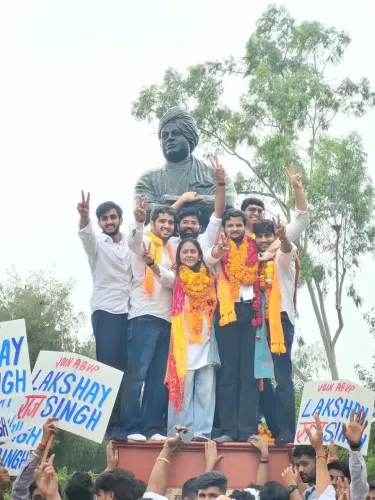
The Akhil Bharatiya Vidyarthi Parishad (ABVP), backed by the Rashtriya Swayamsevak Sangh (RSS) and the Bharatiya Janata Party (BJP), won three out of four DUSU central-panel seats in 2026. However, the study cautioned against complacency, noting that ABVP's own vote share fell by approximately 6.88% — from 39.66% in 2025 to 32.78% in 2026.
'Despite continuing to win the majority of seats, this decline should not be dismissed,' the study noted. It attributed the erosion to a growing appetite among DU students for independents and other groups, and urged the ABVP to 'actively address this trend rather than ignoring it.'
AAP's Rebranded Re-entry Under the Microscope
The study also examined the return of the Aam Aadmi Party (AAP)'s student presence to campus politics in 2026. AAP's student outfit — previously known as Chhatra Yuva Sangharsh Samiti (CYSS) — rebranded as the Association of Students for Alternative Politics (ASAP) after staying away from DUSU elections through 2024.
According to the study, this 'delayed and rebranded debut suggests an attempt to reinvent its campus identity in order to regain relevance and secure a place on the ballot.' The study pointed to what it described as a 'total rejection' of AAP National Convenor Arvind Kejriwal and the party's student ecosystem at Delhi University.
Broader Implications for Student Politics
The study's findings arrive at a moment when student union elections at premier universities are increasingly read as proxies for broader political sentiment among young voters. Notably, this is the fourth consecutive year in which ABVP has dominated DUSU, though the shrinking vote-share margin signals that its hold, while structurally intact, is under incremental pressure.
The erosion on both the Congress and AAP sides, combined with ABVP's own vote-share dip, points to a fragmented campus electorate where no single force commands an outright ideological majority — a dynamic the foundation's study says deserves attention beyond the headline seat count. How the three organisations respond to these trends will likely shape DUSU's electoral landscape heading into the next cycle.
Point of View
But its characterisation of ABVP's ideology is advocacy, not neutral analysis. What the numbers do objectively show is that DUSU's electorate is fragmenting: ABVP is winning seats while losing votes, and no Left-Congress combine has presented a credible campus alternative. AAP's rebrand as ASAP is a tactical admission of failure, not a reset. The larger story here is not NSUI's loss — it is that Delhi University students appear to be drifting toward a post-party politics where independents and newer formations could eventually crack the ABVP monopoly, without necessarily restoring Congress or AAP. That is a dynamic all three national parties should be watching.
NationPress
21 Sept 2026
Frequently Asked Questions
What did the DUSU election comparative study find about NSUI?
The study found that NSUI's vote share fell sharply from 35.79% to 23.39% between 2024 and 2026, and the outfit failed to win even a single central-panel seat in the 2026 DUSU elections — a complete reversal from 2024, when it had won two seats including the presidency.
How did ABVP perform in the 2026 DUSU elections?
ABVP won three out of four central-panel seats in 2026, maintaining its dominant position at Delhi University. However, the study cautioned that the organisation's vote share dropped by approximately 6.88 percentage points — from 39.66% in 2025 to 32.78% in 2026 — and urged it not to dismiss the decline.
Who conducted the DUSU election comparative study released on 21 September 2026?
The study was conducted by the Dr Syama Prasad Mookerjee Research Foundation, which is associated with the RSS-BJP ecosystem. It compared central panel performance, voter trends, alliances, and external impacts on DUSU election outcomes from 2023 to 2026.
What happened to AAP's student outfit at DUSU in 2026?
AAP's student outfit, previously known as CYSS, rebranded as ASAP (Association of Students for Alternative Politics) and re-entered DUSU elections in 2026 after staying away through 2024. The study described the move as an attempt to reinvent its campus identity and cited a 'total rejection' of AAP's campus ecosystem by Delhi University students.
What does the DUSU vote-share trend mean for national student politics?
The study suggests that while ABVP retains structural dominance at Delhi University, the combined erosion of NSUI, AAP's student wing, and ABVP's own vote share points to a growing independent and non-aligned student bloc. This fragmentation could reshape DUSU electoral dynamics over the next one to two election cycles.