DUSU elections 2023-2026: ABVP wins 11 of 16 seats, vote share slides to 32.78%
Synopsis
A four-election comparative study reveals ABVP's structural grip on DUSU is real but thinning — its vote share hit a four-year low of 32.78% in 2026 even as it swept three of four posts. With an independent winning the VP seat on 30,000-plus votes and new entrants like ASAP joining the field, the ABVP-NSUI duopoly at Delhi University is showing its first meaningful cracks.
Key Takeaways
ABVP won 11 of 16 DUSU central-panel seats across the 2023–2026 election cycles, per the Dr Syama Prasad Mookerjee Research Foundation study.
ABVP's aggregate vote share fell to a four-year low of 32.78% in 2026 , down from 43.19% in 2023 .
In the 2026 contest, ABVP won 3-0 over NSUI on party-contested posts; independent Deepanshu Shokeen won the Vice President post with 30,615 votes .
Voter turnout recovered to 40.46% in 2026 after hitting a reported decade-low of 29.70% in 2024 .
The Left bloc (AISA-SFI) has failed to win a single central-panel seat in four years; two of its 2026 candidates polled below NOTA .
New entrant ASAP (AAP-linked) and an SP-linked independent joined the 2026 field, signalling a broadening beyond the traditional ABVP-NSUI-Left contest.
The Akhil Bharatiya Vidyarthi Parishad (ABVP) has maintained organisational dominance at the top of the Delhi University Students' Union (DUSU) across four consecutive election cycles from 2023 to 2026, even as its aggregate vote share fell to a four-year low of 32.78% in the most recent contest, according to a comparative study released on 21 September 2026. The study, however, noted that headline seat wins masked considerable turbulence beneath the surface.
Key Findings of the Study
The study titled 'Delhi University Student Union Election Comparative Study 2023 to 2026', conducted by the Dr Syama Prasad Mookerjee Research Foundation, analysed central-panel performance, voter trends, alliances, and external impacts across all four DUSU election cycles. It found that ABVP secured 11 of the 16 central-panel seats contested between 2023 and 2026, while the Congress-backed National Students' Union of India (NSUI) won four. An independent candidate claimed one seat — the 2026 Vice President post.
The study noted that ABVP dominated three of the four election cycles, with only the 2024 contest producing an even two-two split between ABVP and NSUI on the central panel.
ABVP Vote Share Trends: A Declining Curve
Despite its consistent seat tally, ABVP's aggregate vote share has trended downward. According to the study's methodology — which adds a party's candidate votes across the four central-panel contests and divides by total votes recorded — ABVP moved from 43.19% in 2023 to 36.86% in 2024, partially recovered to 39.66% in 2025, and dropped sharply to 32.78% in 2026. The NSUI similarly declined, moving from 31.99% in 2023 to 35.79% in 2024, then to 31.51% in 2025, and further down to 23.39% in 2026.
The study attributed much of the 2026 drop for both major organisations to an unusually high independent and smaller-group vote. Notably, independent candidate Deepanshu Shokeen polled 30,615 votes for Vice President and won the seat outright, while another independent, Vishesh Yadav, garnered 15,778 votes for Joint Secretary.
2026 Results: ABVP 3-0, Independent VP
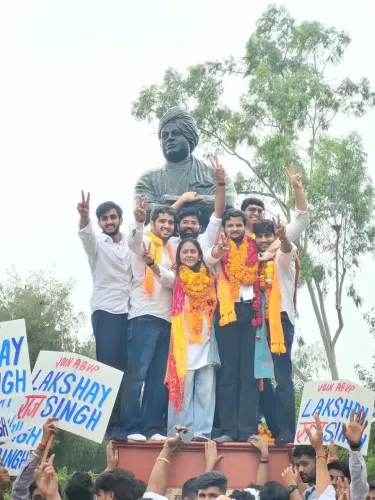
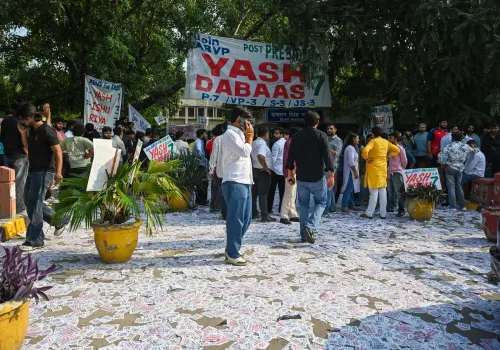
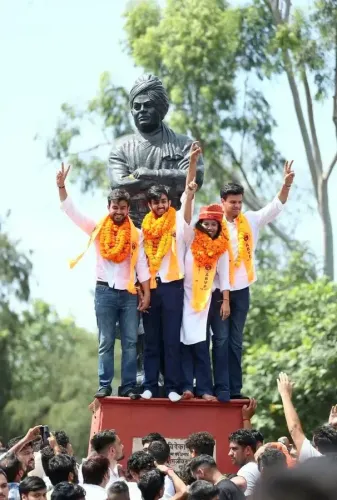
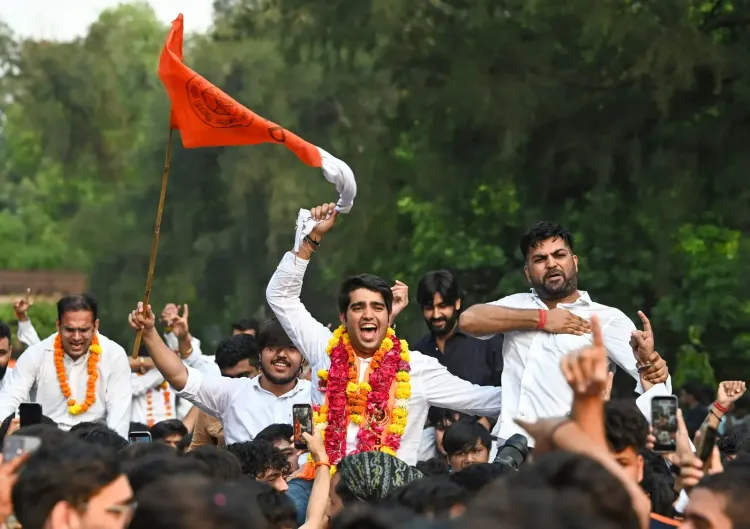
In the just-concluded 2026 DUSU elections, ABVP beat NSUI 3-0 on the three party-contested posts. Yash Dabas won the President's post, Riya Chhawadi won Secretary, and Lakshya Raj Singh won Joint Secretary — all on the ABVP ticket. Independent candidate Deepanshu Shokeen clinched the Vice President's post, becoming the only non-ABVP winner outside NSUI in the four-cycle period.
Voter Turnout Rebounds After 2024 Low
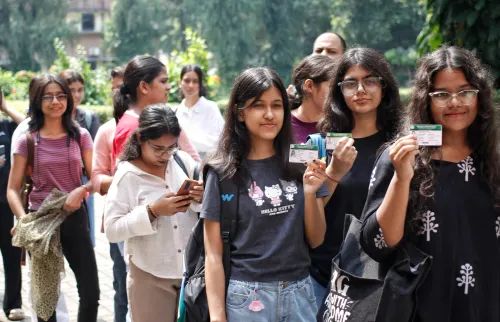
Turnout showed a volatile pattern over the four cycles. It stood at 42% in 2023, before crashing to a reported decade-low of 29.70% in 2024. It then recovered to 39.45% in 2025 and climbed further to 40.46% in 2026. The study used the average of four post totals as a ballot-volume proxy, noting that official result sheets record votes separately per post rather than as a consolidated unique-voter count.
Left Struggles, New Entrants Widen the Field
The Left bloc — represented by the All India Students' Association (AISA) and Students' Federation of India (SFI) — fielded separate panels in 2023 before forming a joint slate in 2024. Their combined aggregate vote share has remained range-bound: 12.99% in 2023, 9.75% in 2024, 11.48% in 2025, and 9.18% in 2026. The study pointed out that in 2026, two Left candidates received fewer votes than NOTA in their respective contests, and the alliance has failed to win a single central-panel seat over the entire four-year stretch.
The study also noted a modest broadening of the electoral field in 2026-27. A new AAP-linked outfit, the Association of Students for Alternative Politics (ASAP) — described as a successor in spirit to AAP's earlier campus wing CYSS, which had sat out previous DUSU polls — entered the contest for the first time. Separately, a Samajwadi Chhatra Sabha (SP)-linked independent candidate finished runner-up for Joint Secretary, pointing to what the study called a 'modest widening of the field beyond the traditional ABVP-NSUI-Left triangle.'
With ABVP's vote share at its lowest in four years and independent candidates commanding significant blocs, the competitive landscape at Delhi University appears to be shifting ahead of future election cycles.
Point of View
But the vote-share trajectory tells a more cautious story: a drop from 43% to 32% in four years is not noise, it is structural erosion. The rise of a credible independent in the VP race — Deepanshu Shokeen's 30,000-plus vote bloc — suggests that a portion of Delhi University's electorate is no longer willing to default to either of the two establishment options. More consequentially for NSUI, its collapse from 36% to 23% in two cycles raises questions about whether the Congress brand still carries any campus currency in an era of Gen Z political fragmentation. The Left's inability to convert visible street mobilisation into even double-digit votes — with two candidates losing to NOTA — underscores a wider national pattern: ideological volume rarely translates to electoral outcome when the organisational machinery is absent.
NationPress
21 Sept 2026
Frequently Asked Questions
What did the DUSU elections comparative study 2023–2026 find?
The study by the Dr Syama Prasad Mookerjee Research Foundation found that ABVP won 11 of 16 DUSU central-panel seats across the four election cycles from 2023 to 2026, demonstrating organisational continuity at the top. However, ABVP's aggregate vote share declined from 43.19% in 2023 to a four-year low of 32.78% in 2026.
Who won the 2026 DUSU elections?
ABVP won three of the four central-panel posts in 2026: Yash Dabas took the President's post, Riya Chhawadi won Secretary, and Lakshya Raj Singh won Joint Secretary. Independent candidate Deepanshu Shokeen won the Vice President's post with 30,615 votes.
What happened to voter turnout in DUSU elections between 2023 and 2026?
Turnout was volatile: it stood at 42% in 2023, fell to a reported decade-low of 29.70% in 2024, then recovered to 39.45% in 2025 and 40.46% in 2026. The study used the average of four post-wise totals as a ballot-volume proxy since official sheets record votes per post rather than as a unique-voter count.
How did the Left perform in DUSU elections from 2023 to 2026?
The Left bloc — AISA and SFI, which contested separately in 2023 and as a joint slate from 2024 — has not won a single central-panel seat in four years. Its combined vote share ranged between 9.18% and 12.99%. In 2026, two of its candidates polled fewer votes than NOTA.
Are there any new political entrants in DUSU elections in 2026?
Yes. An AAP-linked outfit called the Association of Students for Alternative Politics (ASAP), seen as a successor to the earlier CYSS campus wing that had sat out previous DUSU polls, entered the contest for the first time in 2026. An SP-linked independent candidate also finished runner-up for Joint Secretary, pointing to a gradual widening of the field beyond the traditional ABVP-NSUI-Left contest.