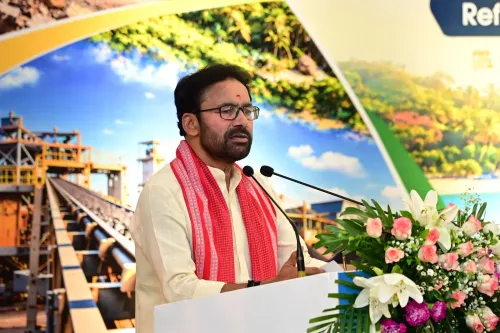
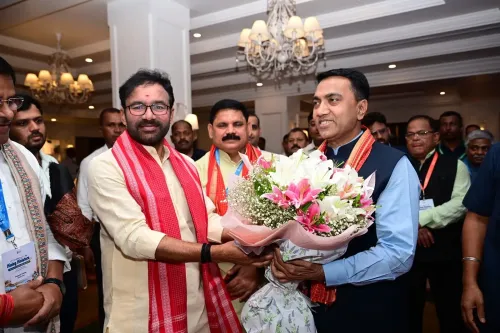
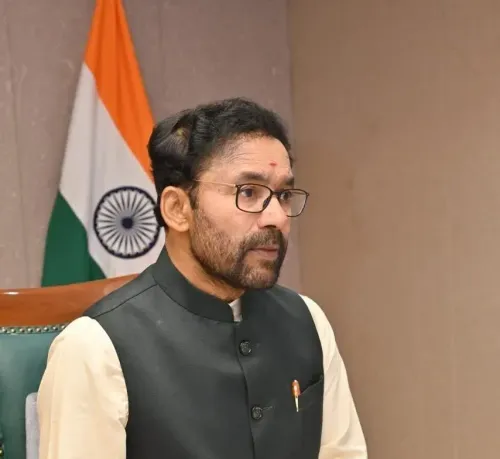
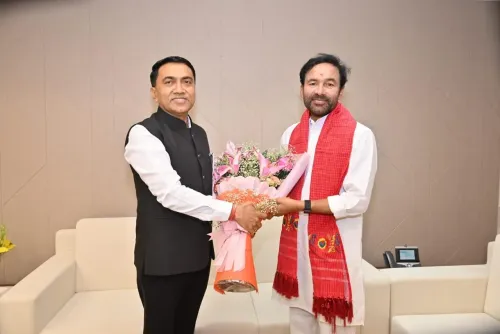
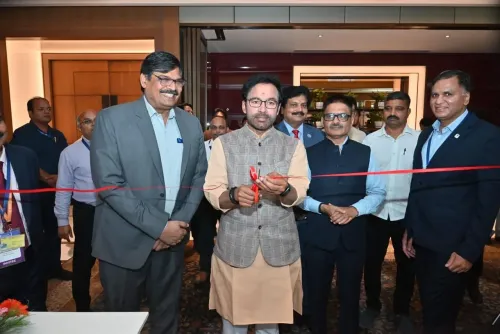
Kishan Reddy chairs Mining Ministers' Conference in Goa
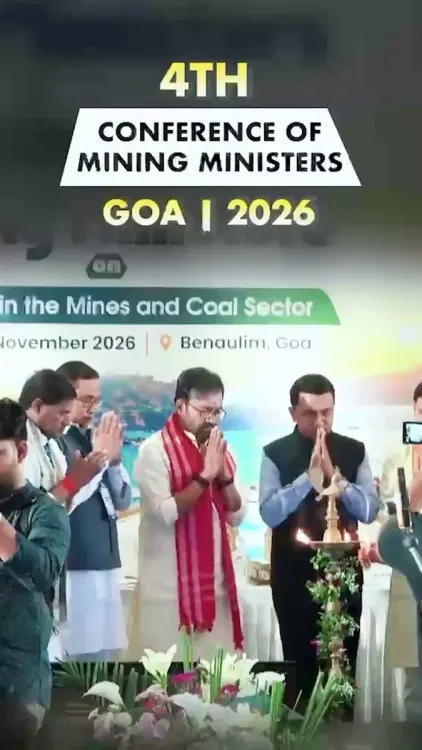
Synopsis
Union Coal and Mines Minister G. Kishan Reddy opened the 4th Conference of Mining Ministers in Goa on 5 November 2026, calling for mining reforms to be declared a National Mission to advance Aatmanirbhar Bharat and Viksit Bharat goals, with Centre-State cooperation and domestic mineral exploration at the core of Day 1 deliberations.
Key Takeaways
Kishan Reddy attended Day 1 of the 4th Conference of Mining Ministers in Goa on 5 November 2026 .
The minister called for mining reforms to be elevated to a National Mission under the Aatmanirbhar Bharat and Viksit Bharat frameworks.
The conference focused on accelerating mining reforms, Centre-State cooperation, mineral exploration and enhancing domestic capabilities.
Goa Chief Minister Pramod Sawant is the host; state ministers and key stakeholders participated.
The Mines and Minerals (Development and Regulation) Amendment Act 2021 and the National Mineral Policy 2019 provide the legislative foundation for ongoing reforms.
Follow-up outcomes on exploration targets and new Centre-State coordination mechanisms are expected before the conference concludes.
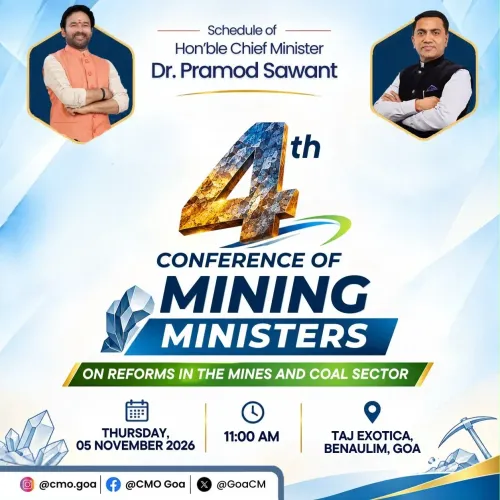
Mining reforms as a National Mission — that is the pitch Union Coal and Mines Minister G. Kishan Reddy carried to Goa on Thursday, 5 November 2026, as the 4th Conference of Mining Ministers on Reforms in the Mines and Coal Sector opened its first day with state ministers and industry stakeholders in the room.
Reddy shared glimpses from the conference, noting that it 'brought together Ministers and key stakeholders to deliberate on accelerating mining reforms, strengthening Centre–State cooperation, expanding mineral exploration and enhancing India's domestic capabilities.' The gathering, hosted in Goa under Chief Minister Pramod Sawant, is the fourth in a series designed to keep Central and State governments in lockstep on one of India's most reform-intensive sectors.
A National Mission frame for the mines sector
The minister's headline demand from Day 1 was clear: elevate mining reforms to the status of a National Mission. The framing ties the sector directly to the Aatmanirbhar Bharat self-reliance initiative — launched in 2020 — and to the longer-horizon Viksit Bharat (Developed India) goal. The logic is straightforward: India still imports significant volumes of coal and critical minerals; building domestic extraction capacity is both an energy-security play and an industrial one.
The ministry has legislative runway to work with. The Mines and Minerals (Development and Regulation) Amendment Act, 2021 introduced auction-based block allocation and eased captive-mining rules, loosening a supply bottleneck that had slowed private participation for years. The National Mineral Policy 2019, which replaced a decade-old framework, had already flagged faster exploration and private-sector entry as priorities.
Centre–State coordination at the heart of Day 1
Mining is constitutionally a concurrent subject, which makes Centre–State alignment less optional and more existential for any reform push. The ministerial conference format is precisely the mechanism successive governments have used to close that coordination gap — bringing state-level decision-makers to the table alongside Central ministries. Goa's Sawant and ministers from other mining states joined the deliberations on Day 1.
Reddy's post tagged counterparts including Satish Dubey, Jayanta Malla, and Arjun Modhwadia alongside the @CoalMinistry and @MinesMinIndia handles — signalling the breadth of state representation present. The conference spans multiple days, meaning concrete outcomes on exploration targets or new coordination mechanisms are expected to emerge before it closes.
What follows the Goa deliberations
The immediate watch-list is short but significant. Any fresh exploration timelines, Centre–State data-sharing protocols, or new auction tranches announced at the conference's close would translate the 'National Mission' rhetoric into programme commitments. With Parliament's winter session on the horizon, there is also a legislative window for rule amendments that could follow from the ministerial-level consensus built in Goa.
India's drive to cut mineral import dependence has only grown more urgent as global supply chains for critical minerals tighten. A unified Centre–State push — with reforms framed at mission scale — is the government's bet that the country's vast, under-explored mineral belt can be a strategic asset rather than a missed opportunity.
The agenda is set. The states are in the room. Now comes the hard part: turning conference consensus into ground-level extraction.
Point of View
Raising the stakes for state governments to align or explain non-compliance. For the BJP, the Goa venue also carries symbolic weight: hosting in a state the party governs signals cooperative federalism on its own terms. The push to tighten Centre-State coordination reflects a structural lesson from the 2021 amendments — legislative reform alone cannot unlock mineral blocks if state-level administrative bottlenecks persist. With India's critical-mineral import bill rising and global competition for battery-era resources intensifying, the government is under real pressure to convert conference rhetoric into measurable exploration and production numbers before the next electoral cycle.
NationPress
6 Nov 2026
Frequently Asked Questions
What is the 4th Conference of Mining Ministers about?
The 4th Conference of Mining Ministers on Reforms in the Mines and Coal Sector, held in Goa in November 2026, brings together Central and state-level ministers and stakeholders to deliberate on accelerating mining reforms, Centre-State cooperation, mineral exploration and building domestic capabilities in line with Aatmanirbhar Bharat and Viksit Bharat goals.
What did G. Kishan Reddy say at the Goa mining conference?
Union Coal and Mines Minister G. Kishan Reddy emphasised the need to make mining reforms a National Mission to build an Aatmanirbhar (self-reliant) mining sector and achieve Viksit Bharat (Developed India), calling for stronger Centre-State cooperation and expanded mineral exploration.
What is Aatmanirbhar Bharat's role in India's mining sector?
Aatmanirbhar Bharat, launched in 2020, is a national self-reliance initiative that covers critical sectors including mining. In the mining context, it aims to reduce India's dependence on imported coal and critical minerals by boosting domestic exploration and production.
What reforms has India introduced in the mining sector in recent years?
India introduced the National Mineral Policy 2019 to promote sustainable mining and private participation, and enacted the Mines and Minerals (Development and Regulation) Amendment Act 2021, which introduced auction-based block allocation and eased captive-mining rules to speed up sector liberalisation.
Where is the 4th Conference of Mining Ministers being held?
The 4th Conference of Mining Ministers on Reforms in the Mines and Coal Sector is being held in Goa, with the state's Chief Minister Pramod Sawant hosting the event alongside Union Minister G. Kishan Reddy.