Partition's eastern shadow: How episodic migration reshaped India's border states
Synopsis
While Punjab's Partition is seared into national memory, eastern India's displacement was slower, episodic, and no less brutal. From Brahmanbaria to Marichjhapi, millions fled across porous borders over three decades — reshaping Assam, Tripura, and West Bengal, and seeding the citizenship debates that still divide India today.
Key Takeaways
Displacement from East Pakistan into Assam , Tripura , and West Bengal unfolded in waves from 1946 through the 1971 Bangladesh Liberation War and beyond.
By May 1949 , Assam alone was sheltering an estimated 2,70,000 refugees , straining resources and stoking local resentment.
The 1971 war produced the largest single influx — an estimated 10 million refugees fled into India.
The 1983 Nellie Massacre killed more than 2,000 people , mostly Bengali Muslims, during the Assam Movement (1979–1985) .
At Marichjhapi Island in 1979 , Bengali Hindu Dalit refugees were evicted under the Left Front government; survivor accounts suggest fatalities of over 600 , though official figures are far lower.
The eastern Partition legacy directly shaped later policies including the Citizenship Amendment Act (CAA) and the National Register of Citizens (NRC) .
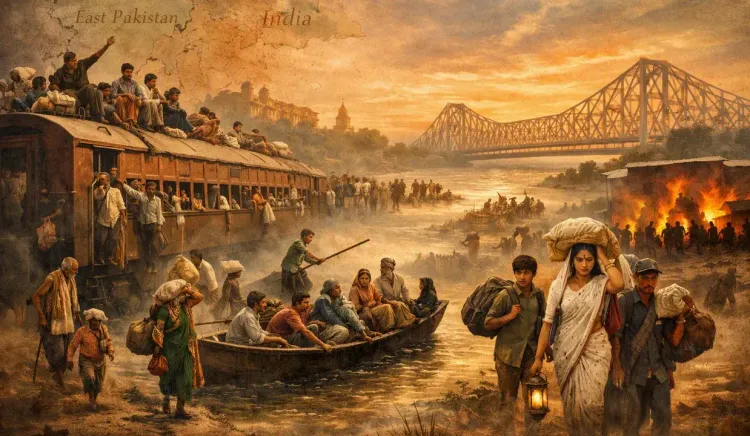
The 1947 Partition of British India did not end at the Punjab border. In East Pakistan — and later Bangladesh — displacement unfolded in slower, recurring waves that stretched from 1946 through the 1971 Bangladesh Liberation War and beyond, fundamentally altering the demography, politics, and identity of Assam, Tripura, and West Bengal. Because the eastern exodus lacked the singular, catastrophic rupture of the western Partition, it has received far less historical attention — yet its consequences are no less profound.
A Family's Flight from Brahmanbaria
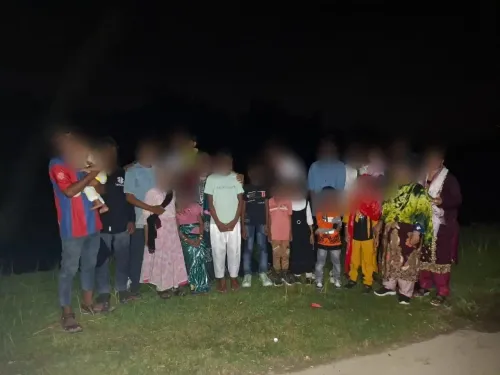
The human cost is captured in accounts like that of Ramesh Chandra and his family of eight, who found themselves barricaded inside their home in Brahmanbaria, East Pakistan, as waves of marauders descended. They reportedly held attackers at bay by pouring boiling oil, jaggery, and water from the rooftop. When food and defensive resources ran low, the family slipped out under cover of night, wading through streams, negotiating with boatmen to cross deeper water bodies, and walking until they reached Tripura. From there, they made their way to Assam, where relatives offered shelter. Two generations of the family subsequently lived with the trauma of that flight while rebuilding their lives across Indian cities.
Waves of Displacement: 1946 to 1971
Even before formal Partition, communal violence in Noakhali had displaced an estimated 50,000 Hindus. The creation of East Pakistan in 1947 converted what had been internal migration into cross-border refugee flows. By May 1949, reports indicated that Assam alone was sheltering 2,70,000 refugees, straining state resources and stoking resentment among Assamese communities. Violence in Dhaka, Barisal, and Khulna the following year drove another surge, with refugees settling in Nadia, 24 Parganas, and Kolkata, frequently in squatter colonies on the urban periphery.
In 1964, renewed targeting of Hindus in East Pakistan triggered fresh migration into border districts of Assam and Tripura, accelerating demographic shifts. The 1971 Bangladesh Liberation War produced the largest single influx — an estimated 10 million refugees fled genocide and conflict into India. Unlike Punjab's sudden, concentrated upheaval, the eastern influx was layered and episodic, making it harder to quantify and easier to overlook.
Political and Demographic Consequences
The continuous arrival of refugees reshaped electoral politics across the three border states. In West Bengal, refugee colonies around Kolkata, Nadia, and North 24 Parganas became centres of political mobilisation, with successive governments treating them as vote banks. In Assam and Tripura, the influx intensified anxieties over land, language, and cultural identity. Porous borders and dense river systems made monitoring difficult, and Bengali-speaking refugees blended into existing local populations, complicating official counts.
The cumulative pressure gave rise to the Assam Movement (1979–1985), which demanded the detection and deportation of 'foreigners.' The movement's most violent chapter was the 1983 Nellie Massacre, in which more than 2,000 people — predominantly Bengali Muslims — were killed. The Assam Accord of 1985 attempted to settle the question by fixing 1971 as the citizenship cut-off date, but disputes over implementation persist to this day.
The Marichjhapi Tragedy
In West Bengal, the contradictions of refugee policy became most visible at Marichjhapi Island in the Sundarbans. The then Left Front government, led by Chief Minister Jyoti Basu, reversed earlier resettlement commitments and in 1979 ordered the eviction of Bengali Hindu Dalit refugees who had settled on the island, classifying it as protected forest. A security blockade followed between January and May 1979, accompanied by police action. Official estimates placed fatalities in single digits; survivor testimonies and some reports suggest the death toll ran into the hundreds, with certain accounts citing more than 600 fatalities. The episode is still referred to as the Marichjhapi massacre and remains a contested chapter in the history of Partition's eastern aftermath.
Legacy: CAA, NRC, and Unresolved Identity
The decades-long influx forced India to confront foundational questions of belonging and citizenship. These tensions directly informed later policy debates, including the Citizenship Amendment Act (CAA) and the National Register of Citizens (NRC). In Tripura, the growing Bengali refugee population significantly altered the demographic balance, reshaping the state's politics and cultural identity in ways that continue to generate friction with indigenous tribal communities. The eastern Partition experience, though slower and less visible than its western counterpart, was equally transformative — and its unresolved questions remain live fault lines in Indian politics.
Point of View
In some ways, more politically corrosive — each new wave of migration reopened wounds before the previous ones had healed. The Marichjhapi eviction is the sharpest illustration of this contradiction: a left-wing government that claimed to champion the dispossessed ordered the blockade of Dalit refugees it had once promised to protect. The CAA and NRC debates cannot be honestly understood without this eastern backstory — yet mainstream coverage routinely treats them as products of contemporary Hindu nationalism alone, severing them from seven decades of unresolved displacement politics.
NationPress
29 Sept 2026
Frequently Asked Questions
Why did Partition displacement in eastern India receive less attention than in the west?
Unlike Punjab, where displacement was sudden and concentrated in a single violent rupture, the eastern influx from East Pakistan was slow, episodic, and spread over decades — from 1946 through the 1971 Bangladesh Liberation War and beyond. Porous borders and the blending of Bengali-speaking refugees into existing populations made the scale harder to document and easier to overlook.
How many refugees entered India during the 1971 Bangladesh Liberation War?
An estimated 10 million refugees fled East Pakistan into India during the 1971 Bangladesh Liberation War, escaping genocide and armed conflict. It was the largest single influx of the entire eastern displacement period.
What was the Marichjhapi massacre?
The Marichjhapi massacre refers to the forced eviction of Bengali Hindu Dalit refugees from Marichjhapi Island in the Sundarbans, West Bengal, between January and May 1979. The Left Front government under Chief Minister Jyoti Basu ordered the eviction, citing protected forest status; official fatality figures are in single digits, but survivor accounts and some reports suggest deaths numbering in the hundreds, with certain estimates exceeding 600.
What was the Assam Movement and how did it end?
The Assam Movement (1979–1985) was a mass agitation demanding the detection and deportation of 'foreigners' — primarily Bengali-speaking migrants — from Assam. It ended with the Assam Accord of 1985, which set 1971 as the cut-off date for citizenship. The movement's most violent episode was the 1983 Nellie Massacre, in which more than 2,000 people, mostly Bengali Muslims, were killed.
How did eastern Partition migration influence the Citizenship Amendment Act and NRC?
Decades of cross-border migration from East Pakistan and later Bangladesh into Assam, Tripura, and West Bengal intensified debates over who belongs and who is a citizen. These tensions directly shaped the framing of the National Register of Citizens (NRC) in Assam and the Citizenship Amendment Act (CAA), which offers a path to citizenship for non-Muslim minorities from Bangladesh, Pakistan, and Afghanistan who entered India before 31 December 2014.