Why is the Election Commission's SIR Conducted by its Own Authority and Not the Govt?
Click to start listening
Synopsis
Home Minister Amit Shah raised eyebrows over the Opposition's calls to halt the Election Commission's Special Intensive Revision of the voters' list. He stressed the importance of addressing electoral reforms instead of focusing on the SIR process. This article delves into the legal framework and the current situation surrounding voter registration in India.
Key Takeaways
- Amit Shah emphasizes the Election Commission's independence in conducting the SIR.
- The importance of electoral reforms is highlighted amidst opposition protests.
- Legal articles empower the ECI to oversee electoral processes and ensure fair elections.
- Protests from the Opposition showcase ongoing tensions regarding electoral integrity.
- Recent SIR activities in Bihar occurred without significant opposition protests.
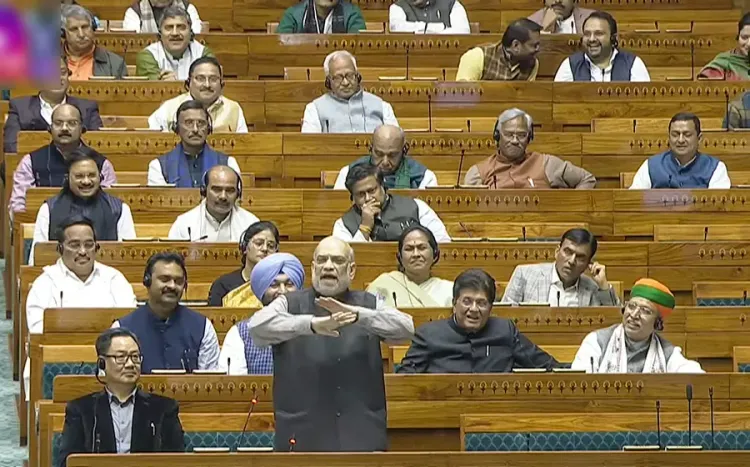
New Delhi, Dec 10 (NationPress) Home Minister Amit Shah expressed astonishment on Wednesday regarding the Opposition’s persistent calls for halting the Election Commission’s Special Intensive Revision (SIR) of the voters’ list, while ignoring the crucial discussions on electoral reforms that the Lok Sabha session was meant to address.
SIR, he argued, is an initiative carried out by the Election Commission of India (ECI), and it is the election authority that should respond to specific inquiries, rather than the government.
He highlighted that according to Article 324 (1) of the Constitution of India, the oversight, direction, and management of the electoral rolls' preparation for all elections to Parliament, State Legislatures, and the offices of the President and Vice-President are entrusted to a Commission (the ECI).
Shah also emphasized that there are legal frameworks ensuring that the poll body can validate whether an individual on the electoral roll is a citizen of India.
The Home Minister pointed out that Article 326 in the Constitution stipulates that elections to the House of the People (Lok Sabha) and State Legislative Assemblies (Vidhan Sabha) are based on adult suffrage.
He explained that this means voting rights can be exercised by individuals who are Indian citizens, at least 18 years old, and not disqualified under the Constitution or any relevant laws due to non-residence, mental unsoundness, criminal records, or corrupt practices.
“Among these prerequisites, citizenship and residence are essential for voter registration in any election,” he stated.
The Home Minister continued by noting that Article 327 of the Constitution empowers Parliament to establish regulations concerning elections to Legislatures, allowing the House to “legislate from time to time regarding all matters related to elections to either House of Parliament or to the House of either House of the State Legislature, including the preparation of electoral rolls, delimitation of constituencies, and other matters necessary for the proper constitution of such House or Houses.
Shah remarked that it was at the Opposition’s request that a discussion took place in Parliament, where MPs were expected to deliberate on electoral reforms, and with the House's agreement, to enact or amend any necessary laws to enhance the electoral process.
“However, they chose instead to reiterate concerns about the SIR process and make allegations of disenfranchising what they deem bona fide voters by the ECI to favor the government,” he stated.
The Home Minister noted that protests have occurred inside and outside Parliament regarding SIR, despite the process having been carried out nine times, largely under a Congress administration, since the first election.
“Opposition MPs even marched to the ECI office in Delhi, seeking clarifications regarding the revision process,” he mentioned.
Shah pointed out that when the ECI proposed a meeting with a delegation to express their concerns, the leaders declined, insisting that all protesters be allowed to join.
“In late November, prior to the Winter Session of Parliament, a group of MPs from the Trinamool Congress did meet directly with the Chief Election Commissioner and his team to discuss the ongoing SIR process across 12 states and union territories, including West Bengal,” he said.
Shah stated that phase one of the current SIR round has already been completed in Bihar, where Assembly elections recently took place, without any significant protests from Opposition parties regarding alleged “mass disenfranchisement” following its conclusion.
Point of View
This situation reflects ongoing tensions between the government and the Opposition regarding electoral integrity. While the demands for clarity on the SIR process are valid, they must be balanced with the need for constructive discussions on electoral reforms. It is crucial for India to maintain a transparent electoral process that upholds the democratic values of the nation.
NationPress
10/12/2025
Frequently Asked Questions
What is the SIR process?
The Special Intensive Revision (SIR) is a process conducted by the Election Commission of India to update and revise the voters' list to ensure it accurately reflects eligible voters.
Who conducts the SIR?
The SIR is conducted by the Election Commission of India, which is an independent constitutional authority responsible for overseeing elections in the country.
Why is the SIR important?
The SIR is important as it helps ensure that the electoral rolls are accurate, thereby facilitating fair and transparent elections and safeguarding the democratic process.
What legal provisions exist for the SIR?
Legal provisions under Articles 324 and 326 of the Indian Constitution empower the Election Commission to manage the electoral rolls and conduct elections based on adult suffrage.
How can one register as a voter?
To register as a voter in India, one must be a citizen, at least 18 years old, and not disqualified under any law. Registration can be done online or at designated offices.