What is the SIR snapshot of net changes in electors in Gujarat, Lakshadweep, and Puducherry?
Synopsis
Explore the recent updates shared by the Election Commission of India regarding the significant changes in the number of voters in Gujarat, Lakshadweep, and Puducherry. This article delves into the implications of these changes on electoral integrity and the ongoing process of updating voter rolls.
Key Takeaways
The SIR process has led to significant net changes in elector counts in several regions.
Ongoing verification processes are essential for maintaining the accuracy of voter lists.
Eligible citizens can continue to apply for corrections and updates to the electoral rolls.
Future SIR phases are set to encompass numerous states and UTs.
Continuous engagement with electoral processes strengthens democracy.
New Delhi, Feb 20 (NationPress) The Election Commission of India (ECI) released a snapshot detailing the net variations in the electorate numbers following the conclusion of the Special Intensive Revision (SIR) of electoral rolls in Gujarat, Lakshadweep, and Puducherry.
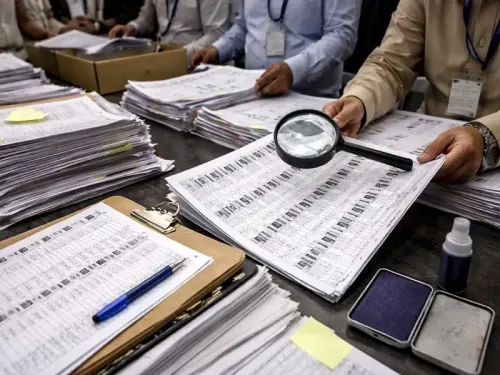
The Commission outlined the volume of deletions, attributing these alterations to routine verification procedures aimed at maintaining accurate and clean voter lists.
In Gujarat, the total count of electors prior to the SIR was 5,08,43,436. After the revision, this number dropped to 4,40,30,725, indicating a deletion of 68,12,711 names — a net change of 13.40 percent.
The Commission stated that the deletions were largely due to electors deemed ineligible for reasons such as death, permanent migration, duplicate registrations, and other statutory factors identified during field checks.
In the Union Territory of Lakshadweep, the electorate saw a slight decline from 57,813 before the SIR to 57,607 post-exercise — representing a net change of 0.36 percent.
In Puducherry, the count of electors fell from 10,21,578 prior to the revision to 9,44,211 after the SIR, reflecting a net change of 7.57 percent.
The ECI stressed that the updating of electoral rolls is an ongoing endeavor, and eligible citizens can continue to apply for corrections and changes. Form 6 can be submitted for the inclusion of new voters, Form 7 for deletions, and Form 8 for modifications or corrections.
These forms can be submitted until the last date of nomination for an election.
The Commission further noted that the SIR process in Bihar has already been finalized, while the Summary Revision (SR) for Assam has also been completed. The final electoral rolls for Andaman and Nicobar Islands, Chhattisgarh, Goa, Kerala, Madhya Pradesh, and Rajasthan are set to be published on February 21.
Earlier on Thursday, the ECI announced the initiation of the next phase of SIR in 22 States and Union Territories, including the National Capital Territory (NCT) of Delhi, which is slated to commence in April 2026.
The States and UTs included in the upcoming SIR are Andhra Pradesh, Arunachal Pradesh, Chandigarh, Dadra and Nagar Haveli and Daman and Diu, Haryana, Himachal Pradesh, Jammu and Kashmir, Jharkhand, Karnataka, Ladakh, Maharashtra, Manipur, Meghalaya, Mizoram, Nagaland, NCT of Delhi, Odisha, Punjab, Sikkim, Tripura, Telangana, and Uttarakhand.
Point of View
The adjustments to voter rolls reflect the Election Commission's commitment to upholding electoral integrity. The significant decrease in elector numbers, particularly in Gujarat, raises questions about voter engagement and eligibility verification processes. Continuous updates to electoral rolls are crucial for maintaining democracy, ensuring that every eligible citizen has a voice in the electoral process.
NationPress
3 Oct 2026
Frequently Asked Questions
What is the Special Intensive Revision (SIR)?
The SIR is a process conducted by the Election Commission to update electoral rolls, ensuring that the lists remain accurate and reflect the current electorate.
Why were so many names deleted in Gujarat?
The deletions were primarily due to ineligible electors, including those who have died, permanently migrated, or are registered multiple times.
How can citizens apply for changes in electoral rolls?
Citizens can submit Form 6 for adding new voters, Form 7 for deletions, and Form 8 for corrections, which can be filed until the last date of nomination.
When will the final electoral rolls for other regions be published?
The final electoral rolls for Andaman and Nicobar Islands, Chhattisgarh, Goa, Kerala, Madhya Pradesh, and Rajasthan are expected to be published on February 21.
What states are included in the next phase of SIR?
The next phase of SIR will cover 22 States and Union Territories, including Andhra Pradesh, Arunachal Pradesh, and the NCT of Delhi, starting in April 2026.