How does JEEViKA enable Krishna Devi to blend art with livelihood?
Synopsis
Discover how Krishna Devi, through the JEEViKA program, transformed her life by introducing Tanjore paintings to Bihar. This inspiring story highlights the power of women’s empowerment and the impact of community support. Join us in exploring her remarkable journey of creativity and resilience.
Key Takeaways
Women’s empowerment can lead to transformative change.
Community support is crucial for success in rural areas.
Tanjore paintings represent a rich cultural heritage.
Challenges can be overcome with determination and skill .
Art can serve as a sustainable livelihood .
Sheikhpura (Bihar), Jan 29 (NationPress) The journey of Krishna Devi serves as an inspiring example of women’s empowerment and self-sufficiency when provided with the right guidance and support. Together with her husband Praveen Kumar, they attribute their ability to introduce Tanjore paintings from South India to Bihar to the JEEViKA program, emphasizing that their path would have been incomplete without this assistance.
The Government of Bihar, through the Bihar Rural Livelihoods Promotion Society (BRLPS), which is an autonomous entity under the Department of Rural Development, is leading the World Bank-supported Bihar Rural Livelihoods Project (BRLP), locally referred to as JEEViKA, aimed at the social and economic empowerment of the rural underprivileged.
Furthermore, the Livelihoods Restoration and Enhancement aspect of the Bihar Kosi Flood Recovery Project (BKFRP) has also been incorporated into JEEViKA.
Krishna Devi, who completed her education up to the 8th grade in her small village of Gunhesa in Sheikhpura, Bihar, has established a distinct identity for herself by excelling in the creation of India’s traditional Tanjore paintings.
Despite facing challenges such as limited resources, minimal formal education, and societal skepticism, she has demonstrated that skill, dedication, and determination can triumph over any hurdle.
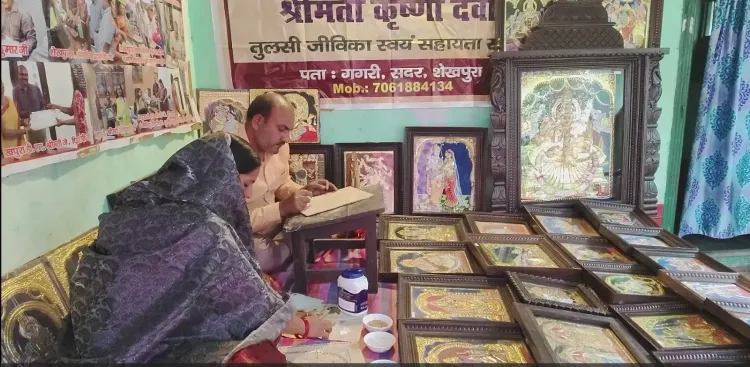
Her adventure commenced when Krishna Devi and her husband, Praveen Kumar, relocated to Tamil Nadu in search of employment, where they took a job yielding merely ₹4,000 monthly. Although life was tough, a serendipitous encounter introduced them to the renowned Tanjore paintings, an intricate art form embellished with 22-carat gold foil.
Praveen Kumar dedicated nearly a decade to mastering this craft, absorbing lessons in patience, precision, and dedication.
The COVID-19 pandemic in 2020 disrupted their lives, compelling the family to return to Bihar. With no reliable income, Krishna Devi sought assistance from JEEViKA, securing a loan to begin crafting Tanjore paintings in her village—a skill that was nearly unheard of there. She encountered skepticism from locals, who doubted the viability of art as a means of income.
In spite of these obstacles, Krishna Devi and her husband pressed on. Sourcing materials often necessitated trips back to Tamil Nadu, yet their resolve remained steadfast. Gradually, their artwork gained acclaim through government fairs and exhibitions in cities such as Patna, Bhubaneswar, Indore, Gurugram, and Haryana.
Today, Krishna Devi’s paintings are celebrated nationwide, with two pieces alone fetching ₹3.30 lakh. Larger Tanjore paintings require 5–6 months for completion, while smaller artworks can be finished in approximately 15 days.
Beyond their visual splendor, these works hold deep spiritual significance, frequently portraying deities such as Krishna, Ram, Vishnu, Lakshmi, and Shiva, crafted with raised figures on wooden boards and vibrant hues of red, green, blue, and gold.
Point of View
Krishna Devi's story is a powerful reminder of the importance of community-driven initiatives like JEEViKA. It showcases how targeted support can empower women and uplift entire communities, ultimately contributing to economic growth and cultural enrichment in rural India. This narrative aligns with our commitment to highlighting stories that inspire and inform.
NationPress
20 Sept 2026
Frequently Asked Questions
What are Tanjore paintings?
Tanjore paintings are a traditional Indian art form originating from Tamil Nadu, characterized by intricate designs and the use of 22-carat gold foil.
How did JEEViKA help Krishna Devi?
The JEEViKA program provided Krishna Devi with the financial support and resources needed to start her Tanjore painting business in her village.
What challenges did Krishna Devi face?
Krishna Devi faced skepticism from her community, limited resources, and the impact of the COVID-19 pandemic before achieving success.
How long does it take to create a Tanjore painting?
Larger Tanjore paintings take 5–6 months to complete, while smaller pieces can be finished in about 15 days.
What themes are depicted in Tanjore paintings?
Tanjore paintings often depict spiritual themes, showcasing deities like Krishna, Ram, Vishnu, Lakshmi, and Shiva.