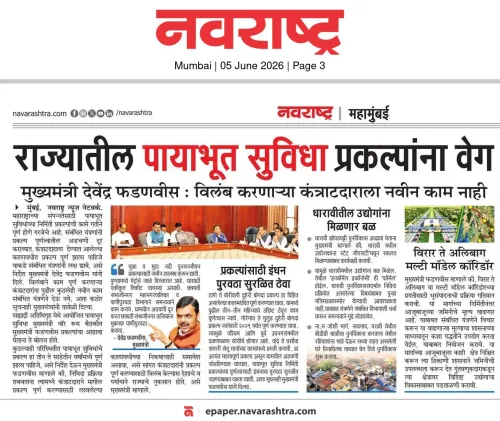
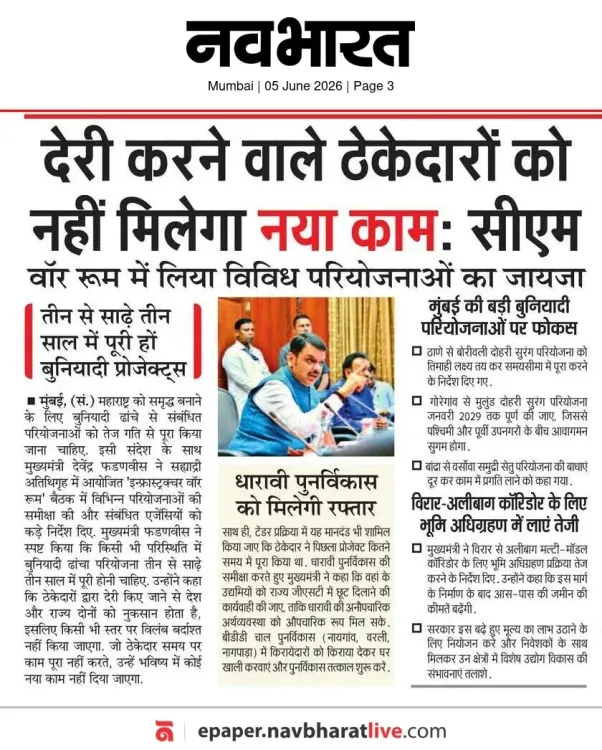
CM Fadnavis: Delayed contractors barred from new Maharashtra work
Synopsis
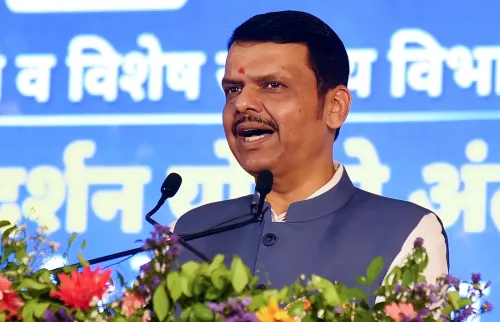
Chief Minister Devendra Fadnavis has announced that contractors who delay infrastructure projects in Maharashtra will be denied fresh government work, signalling a strict accountability drive across the state's public works programme.
Key Takeaways
The Chief Minister's Office of Maharashtra announced on June 5, 2026 that CM Devendra Fadnavis will bar delayed contractors from new government work.
The directive targets chronic project delays and cost overruns in Maharashtra's large-scale infrastructure programme covering roads, metros, and coastal projects.
The policy aligns with debarment and blacklisting mechanisms already in use in states such as Gujarat and Karnataka .
The Maharashtra Public Works Department is expected to embed the condition in future tender pre-qualification criteria.
Formal enforcement will depend on quarterly project completion audits and official amendments to procurement rules.
The Chief Minister's Office of Maharashtra announced on Friday, June 5, 2026, that Chief Minister Devendra Fadnavis has directed that contractors responsible for project delays will be denied fresh government contracts, signalling a firm accountability push across the state's infrastructure programme.
The post quoted Fadnavis directly: 'देरी करने वाले ठेकेदारों को नहीं मिलेगा नया काम' ('Contractors who cause delays will not get new work'), a terse directive that frames the policy as a zero-tolerance stance on execution failures in public works.
Context
Maharashtra is one of India's largest spenders on public infrastructure, with active projects spanning highways, metro corridors, coastal roads, and urban bridges. Chronic delays and cost overruns have long plagued these projects, drawing criticism from citizens and auditors alike. The Chief Minister's statement positions contractor accountability as a direct remedy to these recurring failures.
Policy Backdrop
The move fits a pattern Fadnavis established during his earlier term, when the state introduced monitoring clauses in expressway and connectivity contracts as early as 2014. Across India, states including Gujarat and Karnataka have adopted blacklisting and debarment mechanisms to protect public expenditure from habitual defaulters. Maharashtra's latest directive sharpens that approach by making future tender eligibility contingent on timely delivery.
The Maharashtra Public Works Department is the primary body responsible for enforcing such conditions, typically through tender pre-qualification criteria and performance-linked clauses embedded in contract agreements. A formal policy notification would be required to give the directive legal teeth in procurement processes.
Stakeholders and Impact
Infrastructure contractors — ranging from large conglomerates to mid-tier regional firms — stand to be most directly affected. Those with pending or ongoing delayed projects face the prospect of being locked out of new tenders, creating a financial incentive to accelerate current work. For citizens and commuters, faster project completion would translate into quicker access to roads, bridges, and transit links that have been stalled for years.
The directive also carries implications for the state's capital expenditure cycle. If debarment is enforced rigorously, the pool of eligible bidders could shrink in the short term, potentially affecting competition in future tenders and requiring the government to widen its approved contractor registry.
What's Next
Attention will now turn to whether the Maharashtra Public Works Department issues formal amendments to tender conditions and how quickly a list of delayed contractors is compiled and acted upon. Quarterly project completion reports are expected to serve as the primary audit mechanism. The credibility of the directive will ultimately rest on how consistently it is applied — and whether high-value, politically sensitive projects are held to the same standard as smaller ones.
Point of View
Quotable, and designed to put contractors on notice ahead of what may be a formal policy change. It fits a broader national pattern of state governments using tender eligibility as a disciplinary lever, a tool that is administratively simpler than litigation and faster than financial penalties. The real test is institutional follow-through: Maharashtra has announced accountability measures before, and the gap between announcement and enforcement has historically been wide. If the Public Works Department formalises debarment criteria with transparent, time-bound triggers, this could meaningfully shift contractor behaviour; if it remains a headline without a gazette notification, it risks becoming another symbolic gesture.
NationPress
21 Oct 2026
Frequently Asked Questions
What did CM Devendra Fadnavis say about delayed contractors in Maharashtra?
CM Fadnavis declared that contractors who delay government projects will not be awarded new work, making timely delivery a condition for future tender eligibility in Maharashtra.
Which department will enforce the ban on delayed contractors in Maharashtra?
The Maharashtra Public Works Department is the primary body responsible for enforcing such conditions through pre-qualification criteria and performance clauses in government contracts.
Can a contractor be blacklisted for project delays in Maharashtra?
Yes, Indian state governments including Maharashtra have mechanisms to debar or blacklist contractors for persistent delays, though formal notification of updated tender rules is required for enforcement.
How does Maharashtra's contractor accountability policy compare with other states?
States like Gujarat and Karnataka have adopted similar debarment frameworks. Maharashtra's latest directive aligns with this national trend of linking future tender access to on-time project delivery.
What projects are affected by Maharashtra's infrastructure delay crackdown?
The directive covers the broad range of Maharashtra's public works projects including highways, metro corridors, coastal roads, and urban infrastructure where contractor delays have been a recurring issue.