CM Fadnavis Hails Modi's Record as Longest-Serving PM
Synopsis
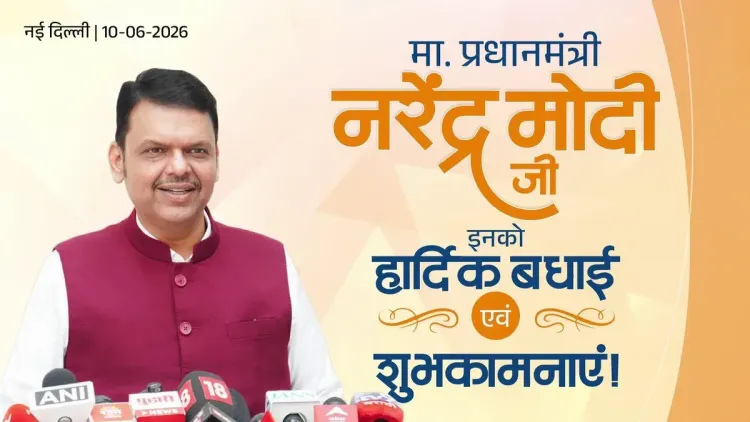
Maharashtra CM Devendra Fadnavis hailed Prime Minister Narendra Modi on 10 June 2026 for completing 4,399 days as India's longest-serving continuous Prime Minister, calling the period the 'golden era of building New India.'
Key Takeaways
Devendra Fadnavis , Chief Minister of Maharashtra, congratulated PM Narendra Modi on 10 June 2026 via a post on X.
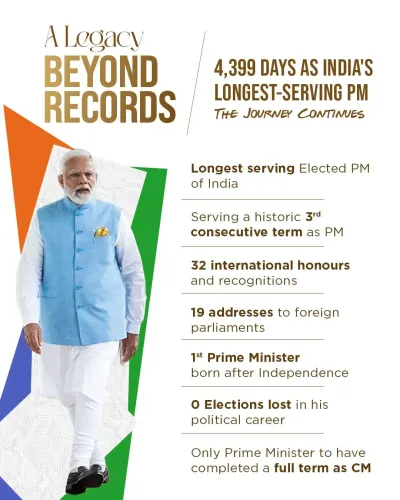
Modi has completed 4,399 continuous days as Prime Minister, making him India's longest-serving Prime Minister in an unbroken tenure.
Modi's continuous service as PM began on 26 May 2014 and has spanned three successive terms through the NDA's electoral victories in 2014, 2019, and 2024.
Fadnavis described the period as the 'golden era of building New India' , invoking the BJP's flagship 'New India' governance narrative.
The tribute is part of a broader pattern of state-level BJP leaders marking symbolic milestones tied to central leadership continuity.
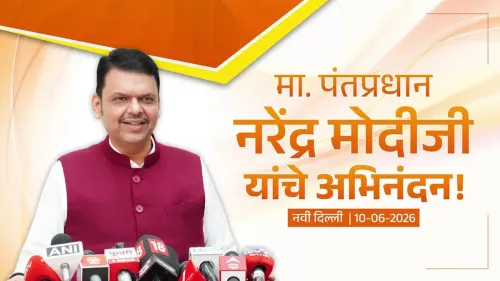
Maharashtra Chief Minister Devendra Fadnavis on Wednesday, 10 June 2026, extended congratulations to Prime Minister Narendra Modi on completing 4,399 days of continuous service as Prime Minister — a milestone Fadnavis described as a new record for the longest-serving Prime Minister in India's history.
Posting from New Delhi, Fadnavis wrote in Hindi: 'आज का दिन अत्यंत महत्वपूर्ण है' ('Today is an extremely important day'), conveying heartfelt congratulations on behalf of Maharashtra. He declared the period a 'golden era in the making of New India,' calling Modi's unbroken tenure a landmark in Indian democratic history.
Context
Narendra Modi was first sworn in as Prime Minister on 26 May 2014 following the Bharatiya Janata Party's landmark majority in the Lok Sabha elections that year. He secured a second term in 2019 and began a third consecutive term in June 2024 after the National Democratic Alliance returned to power. The 4,399-day figure cited by Fadnavis marks the point at which Modi's continuous tenure surpasses any previous Prime Minister's unbroken stretch in office.
Fadnavis, one of the BJP's most prominent state leaders, has himself served multiple terms as Chief Minister of Maharashtra, making him a significant voice within the party's federal structure. His post, tagged #LongestServingElectedPMModi and #NewDelhi, is part of a coordinated wave of acknowledgment from state-level BJP leadership marking the occasion.
Policy Backdrop
Modi's tenure since 2014 has been defined by a series of flagship programmes spanning infrastructure expansion, digital governance, and large-scale welfare delivery. Schemes ranging from direct-benefit transfers to highway and rail corridor projects have been central to the BJP's narrative of transformational governance. Fadnavis explicitly framed this period as 'navbharat ke nirmaan ka swarnima yug' — 'the golden era of building New India' — invoking the party's long-standing 'New India' vision.
State-level BJP leaders marking such milestones is a recurring pattern in the party's communication strategy, using symbolic anniversaries to reinforce themes of stable, long-term national progress and leadership continuity at the Centre.
Stakeholders and Impact
The milestone carries significance for the BJP's cadre and coalition partners, for whom longevity in office is presented as evidence of sustained public mandate. For the broader Indian electorate, the record underscores an era of single-party dominance at the Centre that has reshaped federal dynamics, economic policy, and India's international posture over more than a decade.
Opposition parties have historically contested the narrative of this period as uniformly transformative, pointing to concerns around institutional autonomy, economic inequality, and press freedom — though none of those claims are the subject of Fadnavis's post, which is celebratory in nature.
What's Next
Attention will likely turn to any official commemorative events in New Delhi or state capitals marking the milestone, as well as messaging around the remaining agenda of Modi's third term. With the NDA government's current term running through 2029, BJP leaders are expected to use this symbolic moment to restate commitments on infrastructure, welfare, and foreign policy goals that define the party's pitch for continued governance.
Point of View
Stable governance. The '4,399 days' figure functions as a political data point, translating abstract longevity into a concrete, shareable record. Framing the era as a 'golden age of New India' ties personal tribute to the party's broader ideological project, keeping the 'New India' brand alive ahead of the remaining years of Modi's third term. Such coordinated messaging from state capitals signals that the BJP views this milestone as electorally and symbolically useful well beyond the anniversary itself.
NationPress
26 Oct 2026
Frequently Asked Questions
How many days has Narendra Modi served as Prime Minister of India?
As of 10 June 2026 , Narendra Modi has completed 4,399 continuous days as Prime Minister, making him India's longest-serving Prime Minister in an unbroken tenure, according to Maharashtra CM Devendra Fadnavis.
When did Narendra Modi first become Prime Minister of India?
Narendra Modi was first sworn in as Prime Minister of India on 26 May 2014 after the BJP won a majority in the Lok Sabha elections that year.
Why did Devendra Fadnavis post about Modi's PM record?
Devendra Fadnavis posted on X to congratulate PM Modi on completing a record unbroken tenure as Prime Minister, calling it an extremely important day and describing the period as the 'golden era of building New India.'
How many terms has Narendra Modi served as Prime Minister?
Narendra Modi has served three consecutive terms as Prime Minister — beginning in 2014 , re-elected in 2019 , and beginning a third term in June 2024 after the NDA's victory in the Lok Sabha elections.
What is the 'New India' vision Fadnavis referred to?
The 'New India' vision is the BJP-led government's governance framework emphasising infrastructure development, digital public services, and large-scale welfare delivery, which has been a central theme of Modi's tenure since 2014.