CM Fadnavis Hails Modi as India's Longest-Serving Elected PM
Synopsis
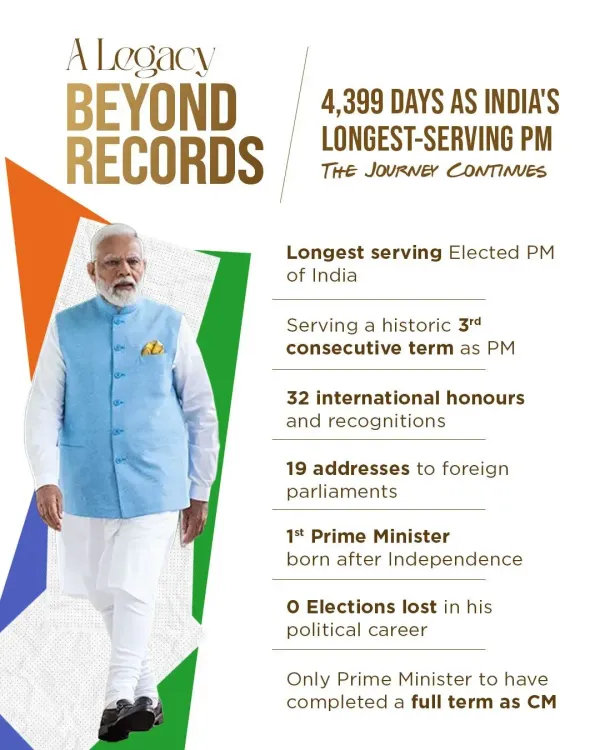
Maharashtra CM Devendra Fadnavis marked PM Narendra Modi's milestone of 4,399 days in office on 10 June 2026, hailing him as India's longest-serving elected Prime Minister and linking his tenure to landmark reforms spanning financial inclusion, digital payments, federal integration, and the Viksit Bharat 2047 vision.
Key Takeaways
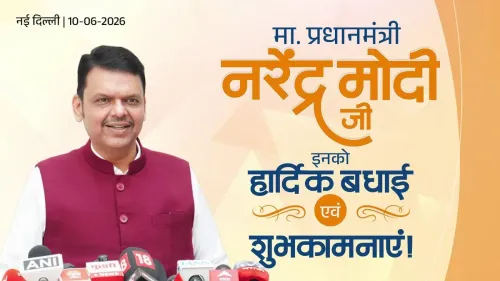
Maharashtra Chief Minister Devendra Fadnavis posted a tribute on 10 June 2026 marking PM Narendra Modi's 4,399 days as Prime Minister.
Fadnavis called Modi India's longest-serving elected Prime Minister , describing it as a historic milestone in independent India's journey.
Key achievements cited include Jan Dhan Yojana , UPI , revocation of Article 370 in August 2019, and the Ram Mandir consecration in January 2024.
Fadnavis invoked the Viksit Bharat 2047 vision framework, signalling continued alignment between Maharashtra's BJP government and the Centre's long-term development agenda.
The tribute underscores the BJP's strategy of framing Modi's tenure as a continuous, multi-domain nation-building project ahead of future electoral cycles.
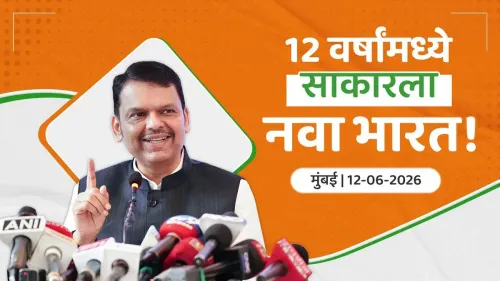
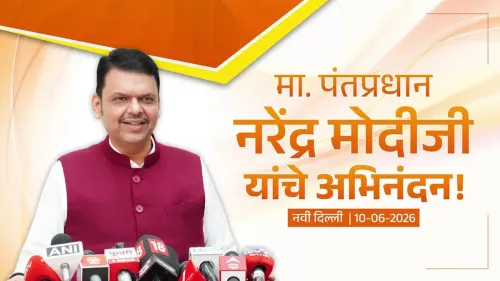
Maharashtra Chief Minister Devendra Fadnavis on Wednesday, 10 June 2026, congratulated Prime Minister Narendra Modi on surpassing 4,399 days in office, calling the milestone a historic landmark in independent India's journey and hailing Modi as the country's longest-serving elected Prime Minister.
Context
Fadnavis's post on X marked what he described as 4,399 days of service, transformation, and New India — a figure that, if accurate, would place the milestone in June 2026, more than twelve years after Modi was first sworn in on 26 May 2014. The Chief Minister framed the occasion not merely as a numerical record but as a reflection of sustained public confidence from 140 crore-plus Indians.
In his tribute, Fadnavis invoked a series of landmark events across Modi's tenure: the Pradhan Mantri Jan Dhan Yojana, the Unified Payments Interface (UPI), the revocation of Article 370 in August 2019, and the consecration of the Shri Ram Mandir in Ayodhya on 22 January 2024. Together, he argued, these have 'redefined the nation's aspirations and achievements.'
Policy Backdrop
The milestones cited by Fadnavis span multiple policy domains. The Pradhan Mantri Jan Dhan Yojana, launched on 28 August 2014, expanded banking access to millions of previously unbanked citizens across rural and urban India. UPI, scaled nationally after 2016, became a cornerstone of India's digital public infrastructure and is now among the world's largest real-time payments systems.
The abrogation of Article 370 by Parliament on 5 August 2019 ended Jammu and Kashmir's special constitutional status and remains one of the most consequential federal integration moves of the Modi era. The Ram Mandir consecration in Ayodhya followed a Supreme Court verdict of November 2019 and represented the culmination of decades of political and legal mobilisation.
Fadnavis also highlighted India's emergence as 'the world's fastest-growing major economy' under Modi's watch — a characterisation that has featured in government messaging across multiple Union Budgets and NITI Aayog planning documents.
Stakeholders and Impact
The tribute carries weight beyond ceremonial congratulation. As Maharashtra's Chief Minister and a senior BJP leader, Fadnavis is among the party's most prominent state-level voices. His framing of the milestone around Rashtra Pratham (nation first) and the Viksit Bharat 2047 vision framework signals alignment with the central government's long-term development narrative heading into the next electoral cycle.
Viksit Bharat 2047 — the official government vision aiming for a developed India by the centenary of independence — has become a recurring reference point in BJP-led government communications at both the central and state levels. Fadnavis's invocation of the framework underscores Maharashtra's positioning within that national policy arc.
What's Next
The milestone is expected to generate a wave of similar tributes from BJP leaders and allied parties across the country. Politically, the messaging reinforces the party's nation-building narrative ahead of state assembly elections and the broader road to 2029. Watchers of Indian economic policy will track the next Union Budget and updated NITI Aayog benchmarks to assess progress on Viksit Bharat 2047 targets that Fadnavis and the central leadership have publicly committed to.
Point of View
Constitutional integration, and cultural symbolism, the Maharashtra CM reinforces the BJP's preferred electoral narrative of decisive, transformative governance. The invocation of 'Rashtra Pratham' and 'Viksit Bharat 2047' in the same breath signals that the party intends to contest future elections on a continuity-and-ambition platform rather than a change agenda. For Fadnavis personally, such high-visibility alignment with the Prime Minister consolidates his standing within the BJP hierarchy at a moment when Maharashtra's political landscape remains competitive. The broader pattern — similar milestone messaging at each anniversary of the 2014 and 2019 mandates — suggests a deliberate, institutionalised communication strategy rather than a spontaneous tribute.
NationPress
26 Oct 2026
Frequently Asked Questions
Why is Narendra Modi called India's longest-serving elected Prime Minister?
PM Narendra Modi crossed 4,399 days in office in June 2026, surpassing the tenure of earlier Prime Ministers to become India's longest-serving elected Prime Minister since independence. He was first sworn in on 26 May 2014 and has led successive BJP-majority governments since then.
What is Viksit Bharat 2047?
Viksit Bharat 2047 is the Indian government's official vision framework that aims to make India a fully developed nation by 2047, the centenary of independence. It is referenced across Union Budget documents and NITI Aayog planning reports as a long-term development target.
What did Devendra Fadnavis say about PM Modi's milestone?
Maharashtra CM Devendra Fadnavis congratulated PM Modi on completing 4,399 days in office, calling it 'a historic milestone in the journey of independent India' and citing achievements including Jan Dhan, UPI, the revocation of Article 370, and the Ram Mandir consecration.
When was Article 370 revoked and what did it mean?
Article 370 was revoked by Parliament on 5 August 2019, ending Jammu and Kashmir's special constitutional status and fully integrating the region into the Indian Union. It was one of the most significant federal integration decisions of the Modi government.
When was the Ram Mandir in Ayodhya consecrated?
The Shri Ram Mandir in Ayodhya was consecrated on 22 January 2024, following a Supreme Court verdict in November 2019 that cleared the legal path for construction of the temple.