CM Fadnavis: Self-redevelopment gives Marathis bigger Mumbai homes
Synopsis
Maharashtra CM Devendra Fadnavis said the self-redevelopment scheme has given Marathi families in Mumbai spacious homes in the city itself, as class-1 conversion orders were distributed to cooperative housing societies.
Key Takeaways
Maharashtra Chief Minister Devendra Fadnavis said the self-redevelopment scheme gave Marathi residents spacious homes in Mumbai itself.
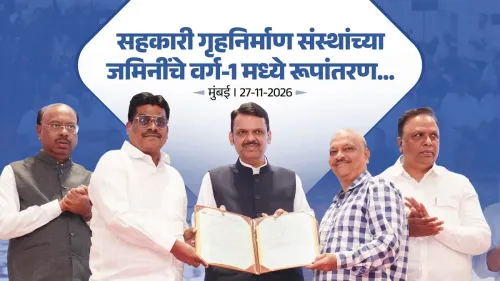
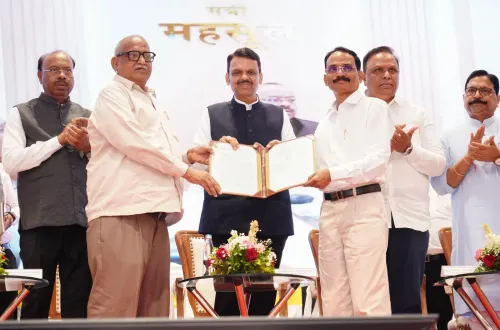
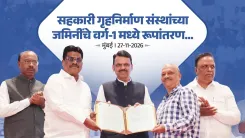
The remarks accompanied distribution of class-1 conversion orders for cooperative housing societies under the Nagari Nivara Parishad in Mumbai on 27 November 2026 .
Self-redevelopment guidelines for old and cessed Mumbai buildings were introduced in 2018-2019 so societies can rebuild without external developers.
The model is meant to keep original occupants in redeveloped properties amid high real-estate costs.
Eligible bodies are resident-managed cooperative housing societies registered under the Maharashtra Cooperative Societies Act.
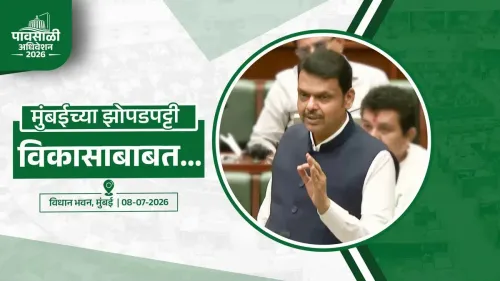
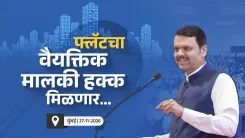
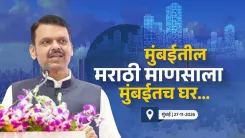
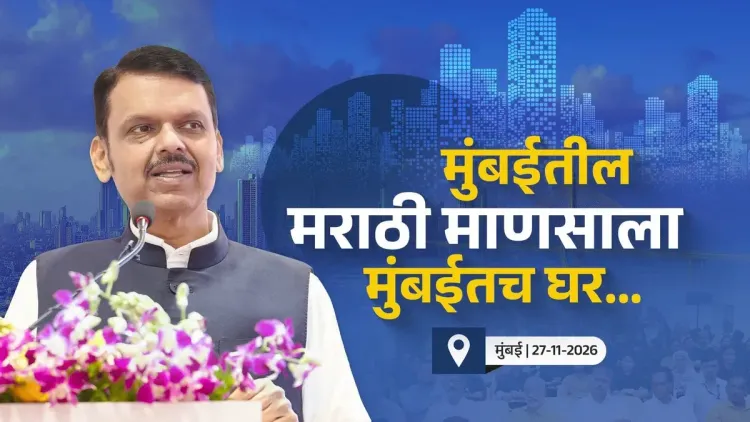
Maharashtra Chief Minister Devendra Fadnavis on 27 November 2026 said the state's self-redevelopment scheme has given Marathi residents of Mumbai spacious homes without forcing them out of the city. His remarks accompanied the distribution of class-1 conversion orders for cooperative housing societies under the Nagari Nivara Parishad in Mumbai.
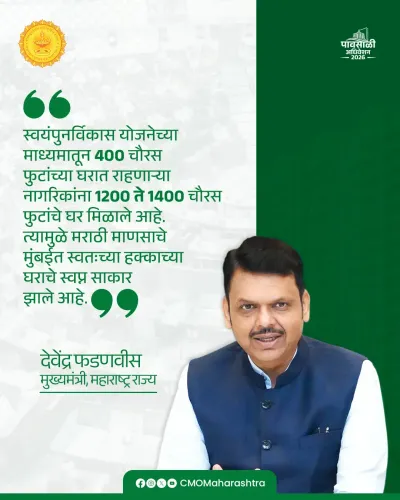
In a post on X he wrote in Marathi, स्वयंपुनर्विकास योजनेमुळे मुंबईतील मराठी माणसाला मुंबईतच प्रशस्त घर मिळाले, and in Hindi that the scheme meant Mumbai's Marathi resident got a bigger house in Mumbai itself. The note attached to the message pointed to the same-day distribution of class-1 conversion orders under the Nagari Nivara Parishad.
Self-redevelopment without private developers
Maharashtra first issued self-redevelopment guidelines for cessed and old buildings in Mumbai during 2018-2019. The model lets resident-managed cooperative housing societies rebuild aging stock on their own instead of handing the project to an external developer.
That choice is the whole point in a city where land prices routinely push original occupants out of rebuilt towers. Societies registered under the Maharashtra Cooperative Societies Act can pursue the work once they clear conversion and planning steps.
Class-1 conversion orders in Mumbai
Friday's Mumbai event centred on class-1 conversion orders for cooperative housing societies, a gateway that moves a society toward redevelopment-ready status. The Nagari Nivara Parishad, the state body overseeing urban housing schemes, handled the distribution.
The message offered no count of how many orders were issued. The claim on the table was the outcome: original Marathi households staying put, in larger homes.
Urban renewal that keeps residents in place
Mumbai's cooperative housing stock is among India's oldest and densest. Successive Maharashtra governments since the early 2000s have treated redevelopment as the main lever against crumbling buildings and a chronic shortage of liveable units.
Self-redevelopment is the latest turn in that arc. It tries to keep a larger share of extra floor space with members rather than a developer. For Marathi-speaking families who have lived in the same societies for generations, the pitch is blunt. A bigger flat, same city, same neighbourhood.
The next test is not another order on paper. It is how many of those Mumbai societies actually break ground — and whether the original residents are still living there when the new keys are handed over.
Point of View
Including Marathi-speaking households, keep more of the extra floor space that redevelopment creates. Conversion orders are a bureaucratic gateway, not a completed skyline. The policy will be judged by buildings that actually rise and by whether those same families still hold the keys.
NationPress
27 Nov 2026
Frequently Asked Questions
What is the self-redevelopment scheme in Maharashtra?
The self-redevelopment scheme lets cooperative housing societies in Mumbai rebuild old buildings themselves without appointing an external private developer. Guidelines for cessed and old buildings were introduced around 2018-2019 so members can retain a larger share of the redeveloped space.
What is Nagari Nivara Parishad?
Nagari Nivara Parishad is a Maharashtra state body that oversees urban housing policies and schemes, including conversion and redevelopment-related orders for cooperative societies. It figured in the Mumbai distribution of class-1 conversion orders highlighted by CM Devendra Fadnavis.
What are class-1 conversion orders for housing societies?
Class-1 conversion orders are official permissions that allow cooperative housing societies to change classification as a step toward redevelopment. They were being distributed in Mumbai under the Nagari Nivara Parishad.
How does self-redevelopment help original Mumbai residents?
It aims to keep original occupants in the same locality with larger homes by avoiding a developer-led model that often displaces them through high costs or sale of extra flats. CM Fadnavis framed that outcome as already reaching Marathi households in Mumbai.
Who can use Maharashtra's self-redevelopment scheme?
Resident-managed cooperative housing societies registered under the Maharashtra Cooperative Societies Act are the intended users. The focus has been on old or cessed buildings in Mumbai that need rebuilding.