CM Fadnavis Backs Cluster Model for Mumbai Slum Redevelopment
Synopsis
Chief Minister Devendra Fadnavis told the Maharashtra Vidhan Sabha on 8 July 2026 that Mumbai's slums must be redeveloped through the cluster method, signalling a policy shift from piecemeal building-level schemes toward integrated, area-wide rehabilitation backed by the Slum Rehabilitation Authority framework.
Key Takeaways
CM Devendra Fadnavis stated on 8 July 2026 in the Vidhan Sabha that Mumbai's slums must be redeveloped through the cluster method.
The cluster approach groups contiguous slum areas into single redevelopment zones, enabling holistic delivery of civic infrastructure.
The Slum Rehabilitation Authority (SRA) , set up in 1995 , is the nodal body for slum redevelopment in Maharashtra .
Cluster redevelopment provisions were first introduced in state housing policy between 2005 and 2007 .
Key stakeholders include slum dwellers seeking better housing and real estate developers whose participation is essential for project viability.
Legislative or regulatory follow-up — including revised Development Control Regulations — will determine whether the declaration translates into policy action.
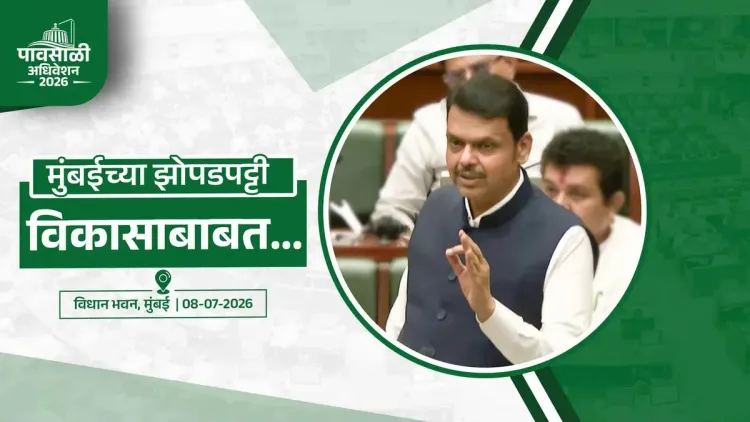
Maharashtra Chief Minister Devendra Fadnavis on Wednesday, 8 July 2026, declared that Mumbai's slums must be redeveloped through the cluster method, making the statement on the floor of the Vidhan Sabha during the ongoing Monsoon Session 2026. The remark signals the state government's intent to move away from piecemeal, building-by-building rehabilitation toward an integrated, area-level approach.
Context
Speaking in the state legislature, Fadnavis stated — 'मुंबईतील झोपडपट्ट्यांचा विकास क्लस्टर पद्धतीने करावा लागेल' ('Mumbai's slums will have to be redeveloped through the cluster method'). The statement came amid broader legislative discussions on urban housing during the monsoon session, underscoring that the administration views cluster redevelopment not as an option but as a necessity.
Mumbai, India's financial capital, has long grappled with informal settlements that occupy significant portions of the city's land. Fragmented land ownership and small plot sizes have historically made individual-building redevelopment schemes difficult to execute at scale.
Policy Backdrop
The Slum Rehabilitation Authority (SRA), constituted in 1995, has been the nodal body for incentive-based slum redevelopment in Maharashtra. Its early model relied on offering higher Floor Space Index (FSI) to private developers who agreed to rehabilitate slum dwellers in situ.
Between 2005 and 2007, the state introduced provisions for larger-scale cluster projects alongside individual building schemes, recognising that contiguous clusters could deliver better civic infrastructure — roads, water lines, drainage — than isolated towers. During Fadnavis's earlier terms as Chief Minister (2014–2019), the cluster approach was explored in assembly discussions as a way to overcome land constraint challenges, though implementation remained limited.
The cluster model aggregates multiple adjoining plots and slum pockets into a single redevelopment zone, allowing developers and the government to plan amenities holistically. It is seen as more viable in areas where individual structures are too small or too legally entangled to attract standalone developer interest.
Stakeholders and Impact
Slum dwellers stand to gain from improved housing quality and civic amenities that the cluster model is designed to deliver, but transitions during construction — temporary transit accommodation, timelines, and eligibility criteria — remain persistent concerns for affected communities. Past rehabilitation projects have drawn criticism for delays in handing over permanent tenements.
Real estate developers operating in Mumbai view cluster schemes with cautious interest: larger project footprints can improve financial viability in a high-cost land market, but coordinating with multiple landowners and clearing legal encumbrances on clustered plots adds complexity. The state's Development Control Regulations (DCR) will be central to how attractive — or burdensome — any new cluster framework proves to be.
The SRA and the Mumbai Metropolitan Region Development Authority (MMRDA) are likely to be key implementation agencies if the government moves toward formalising the cluster approach through revised regulations.
What's Next
The immediate watch point is whether the Monsoon Session 2026 produces legislative or regulatory follow-up — such as revised DCR notifications or a formal cluster redevelopment policy — or whether the statement remains a floor declaration pending detailed policy drafting. Any pilot cluster notification for specific Mumbai wards would be a concrete first signal of intent translating into action.
If the state government moves decisively on cluster redevelopment, it could reshape Mumbai's housing landscape significantly — but the gap between assembly declarations and on-ground implementation has historically been wide in Maharashtra's slum rehabilitation record.
Point of View
Reflecting the state's acknowledgment that Mumbai's fragmented land ownership has made the old building-by-building SRA model insufficient at scale. The timing — during a monsoon session with heightened attention to urban infrastructure — suggests the government is building legislative momentum, though without a concrete regulatory announcement, the declaration risks being read as aspirational rather than actionable. The cluster model has been discussed across successive Maharashtra governments for over a decade, making the credibility test this time whether revised DCR notifications or pilot zone announcements follow within the session or shortly after. For slum dwellers, the promise of better-planned housing must be weighed against Maharashtra's uneven track record of completing rehabilitation tenements on schedule.
NationPress
7 Oct 2026
Frequently Asked Questions
What is cluster redevelopment of slums in Mumbai?
Cluster redevelopment groups multiple adjoining slum plots into a single redevelopment zone, allowing planners to deliver roads, drainage, and civic amenities together rather than building by building. It is designed to overcome the land fragmentation that makes individual-building schemes unviable in dense Mumbai slums.
What did CM Fadnavis say about Mumbai slums in the Vidhan Sabha?
On 8 July 2026 , during the Monsoon Session , CM Devendra Fadnavis stated that Mumbai's slums will have to be redeveloped through the cluster method, framing it as an imperative rather than an option.
What is the Slum Rehabilitation Authority (SRA)?
The Slum Rehabilitation Authority is a Maharashtra government body constituted in 1995 to regulate and promote slum redevelopment in Mumbai by offering higher FSI incentives to private developers who rehabilitate slum dwellers in situ.
How is cluster redevelopment different from the existing SRA scheme?
Traditional SRA schemes operate building by building, whereas cluster redevelopment consolidates contiguous slum areas into a unified project zone. This larger footprint improves financial viability for developers and allows the state to plan civic infrastructure — water, drainage, roads — across the entire area simultaneously.
What happens next after Fadnavis's cluster redevelopment statement?
Observers will watch for revised Development Control Regulations or pilot cluster zone notifications during or after the 2026 Monsoon Session . Without regulatory follow-up, the assembly statement remains a declaration of intent rather than an actionable policy change.