CM Fadnavis Orders Dharavi Redevelopment on Singapore-HK Lines
Synopsis
Chief Minister Devendra Fadnavis on 8 June 2026 directed that Dharavi's redevelopment mirror Singapore and Hong Kong models, with 10,000 homes by March 2028, a first-of-its-kind multi-modal transport hub, MSME protection, and preservation of Kumbharwada's cultural heritage.
Key Takeaways
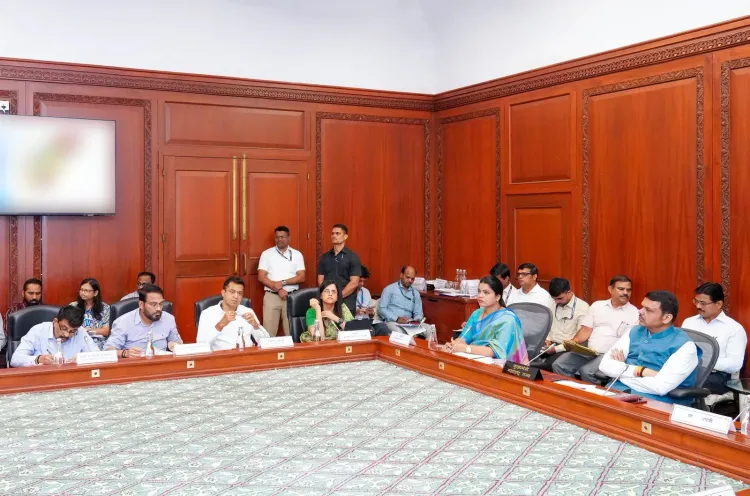
CM Devendra Fadnavis chaired a Dharavi Redevelopment Project review at Sahyadri Guest House, Mumbai on 8 June 2026 .
Redevelopment is to be modelled on Singapore and Hong Kong housing standards while preserving Dharavi's industrial and social ecosystem.
At least 10,000 homes are targeted for handover in the first phase by March 2028 ; the full project has a 10-year completion goal .
India's first multi-modal transport hub at Dharavi will integrate suburban rail, Metro, water transport, and future air-taxi (vertiport) services, with city check-in for air passengers.
A special MSME scheme will protect Dharavi's leather, textile, recycling, pottery, and food industries; a cloud kitchen concept is planned for food units.
A single-window clearance cell will be created to fast-track all project permits through process re-engineering.
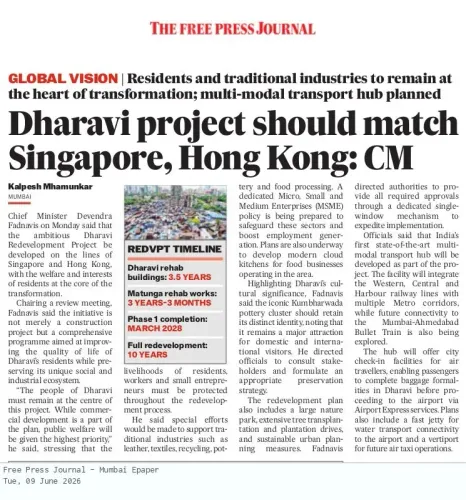
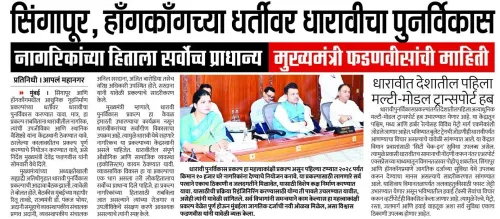
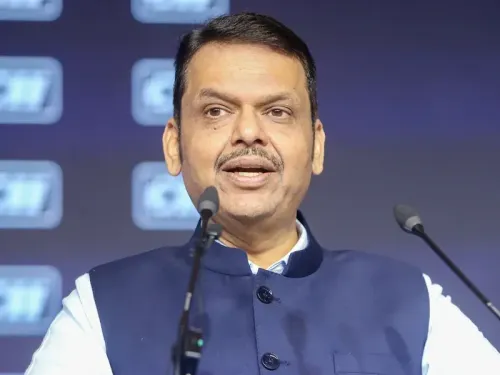
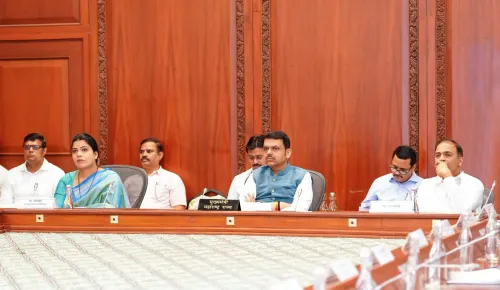
Chief Minister Devendra Fadnavis chaired a high-level review meeting on the Dharavi Redevelopment Project at Sahyadri Guest House, Mumbai, on Monday, 8 June 2026, directing that the project be modelled on modern housing schemes in Singapore and Hong Kong while keeping residents, livelihoods, and local character at its core.
Context
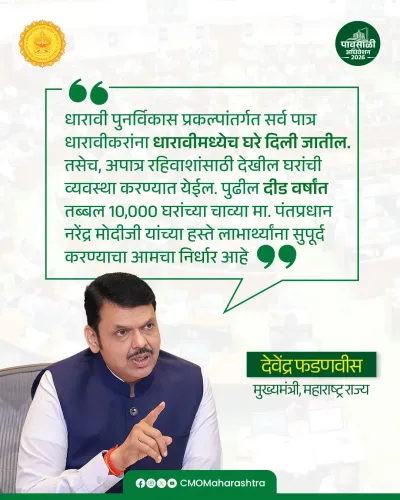
Addressing the review, CM Fadnavis stated that the Dharavi Redevelopment Project is 'केवळ इमारती उभारण्याचा कार्यक्रम नसून धारावीकरांच्या सर्वांगीण विकासाचा उपक्रम आहे' ('not merely a programme of constructing buildings, but an initiative for the all-round development of Dharavi's residents'). He directed that the entire industrial and social ecosystem of Dharavi be preserved, and that public interest must receive the highest priority even as commercial development forms part of the plan.
The Chief Minister specifically called out Kumbharwada — the traditional potters' colony — as a vital cultural and tourism asset. He directed officials to consult stakeholders and find an appropriate solution to preserve its unique character, noting that many tourists who visit Dharavi make a point of visiting Kumbharwada.
Policy Backdrop
Dharavi, widely described as Asia's largest informal settlement, has been a subject of redevelopment planning since at least 2004, when the Maharashtra government first announced a comprehensive master plan under the Slum Rehabilitation Authority framework. Successive administrations have struggled to balance commercial viability with the protection of the area's dense network of micro-industries — leather, textiles, recycling, pottery, and food processing.
The current project places particular emphasis on MSME protection: a special MSME scheme is being drawn up to safeguard Dharavi's key industries, and a modern 'cloud kitchen' concept is being developed for food-processing units. Eligible residents will receive homes with independent kitchens, bedrooms, toilets, and natural lighting; separate toilet facilities for women are a stated priority.
Stakeholders and Impact
In the first phase, at least 10,000 homes are to be handed over to residents by March 2028. Rehabilitation construction is targeted for completion in 42 months, with the Matunga area rehabilitation set at 39 months. A dedicated single-window clearance cell will be created to fast-track all project permits, with process re-engineering to speed approvals.
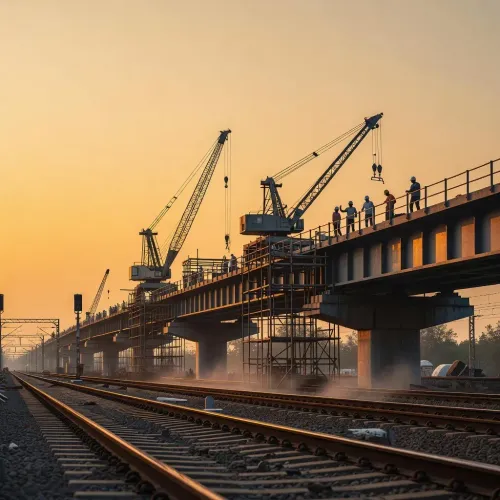
A landmark component is the country's first multi-modal transport hub at Dharavi, which will integrate Western, Central, and Harbour suburban rail lines with multiple Metro corridors. The hub will offer city check-in for air passengers — allowing baggage registration at Dharavi before travel to the airport via an Airport Express link — mirroring facilities in Singapore and Hong Kong. Plans also include a fast jetty for water transport to the airport and a vertiport for future air-taxi services.
The BKC-Dharavi corridor will be beautified with a central green belt, modern footpaths, and contemporary architecture. The existing bus depot site is earmarked for modern residential and commercial development, giving the entire zone an international character.
What's Next
CM Fadnavis said coordinated action across all departments would allow the ambitious project to be completed on schedule, giving Mumbai a new world-class identity. The full project carries a 10-year completion target. Railway land development, rehabilitation construction, and environmental clearances are already under way in a phased manner, with funding described as available and the project proceeding as planned.
The meeting was attended by State Minister Dr. Pankaj Bhoyar, Mumbai Mayor Ritu Tawde, and senior officials. The immediate milestones to watch are the operationalisation of the single-window clearance cell and the first-phase handover of 10,000 homes by March 2028 — a target that will serve as the clearest early test of whether the project's ambitious timeline can be met.
Point of View
CM Fadnavis is signalling that the Dharavi project is no longer just a slum-rehabilitation exercise but a global-city-building statement — a framing that raises both expectations and political stakes ahead of Mumbai's infrastructure cycle. The insistence on preserving livelihoods and the MSME ecosystem is a direct response to years of criticism that large-scale redevelopment displaces the very communities it claims to help. The multi-modal transport hub, if delivered, would be a structural game-changer for central Mumbai, tying Dharavi into the region's emerging rail-metro grid in a way no previous redevelopment plan attempted. The March 2028 deadline for the first 10,000 homes will be the earliest hard test of whether political ambition can survive the project's historically complex land, legal, and logistics challenges.
NationPress
23 Oct 2026
Frequently Asked Questions
What is the Dharavi Redevelopment Project?
The Dharavi Redevelopment Project is a large-scale urban renewal initiative by the Maharashtra government to replace informal settlements in Dharavi, Mumbai — widely regarded as Asia's largest such settlement — with modern housing, infrastructure, and commercial facilities while protecting residents' livelihoods and local industries.
When will Dharavi redevelopment be completed?
The full project has a 10-year completion target. The first phase, covering at least 10,000 homes, is planned for handover by March 2028, with rehabilitation construction scheduled to finish in 42 months.
What is the multi-modal transport hub planned for Dharavi?
It will be India's first such facility, integrating Western, Central, and Harbour suburban rail lines with multiple Metro corridors, a city check-in counter for air passengers, a fast jetty for water transport, and a vertiport for future air-taxi services — all at a single location in Dharavi.
Will Dharavi's industries and Kumbharwada be preserved?
Yes. CM Fadnavis specifically directed that Dharavi's industrial ecosystem — leather, textiles, recycling, pottery, and food processing — be maintained, with a dedicated MSME scheme being prepared. Kumbharwada, the traditional potters' colony, is to be preserved as a cultural and tourism landmark through stakeholder consultations.
What facilities will eligible Dharavi residents get in new homes?
Eligible residents will receive homes with independent kitchens, bedrooms, toilets, and natural lighting. Separate toilet facilities for women are a stated priority of the project.