CM Fadnavis eyes Singapore, Hong Kong model for Dharavi
Synopsis
The Chief Minister's Office of Maharashtra has invoked Singapore and Hong Kong as benchmarks for the Dharavi Redevelopment Project, with CM Devendra Fadnavis signalling fresh political will to transform Mumbai's largest informal settlement into a globally competitive urban district.
Key Takeaways
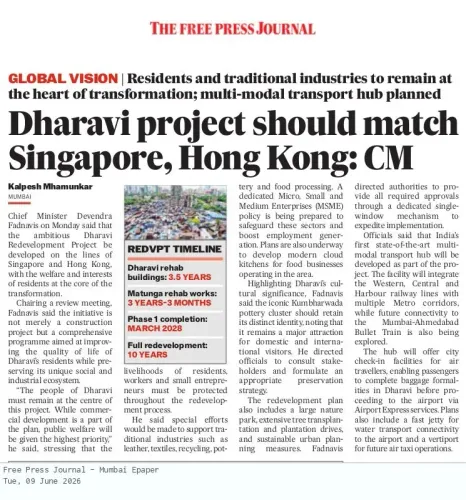
The Chief Minister's Office of Maharashtra publicly positioned the Dharavi Redevelopment Project on the lines of Singapore and Hong Kong urban renewal models on 9 June 2026 .
Dharavi spans roughly 2.1 square kilometres in central Mumbai and is home to over one million residents .
The project was first formally launched in 2004 and revived with fresh Expressions of Interest in 2019 under the Slum Rehabilitation Authority framework.
The redevelopment combines public-private partnerships with in-situ rehabilitation, aligning with national Housing for All and Smart Cities missions.
Key next steps include fresh tenders, finalisation of the master plan, and potential amendments to SRA rules .
The project's outcome will affect residents, Mumbai municipal authorities , real estate developers, and the informal economy embedded in Dharavi.
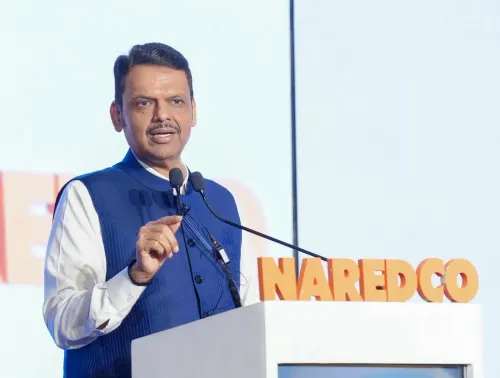
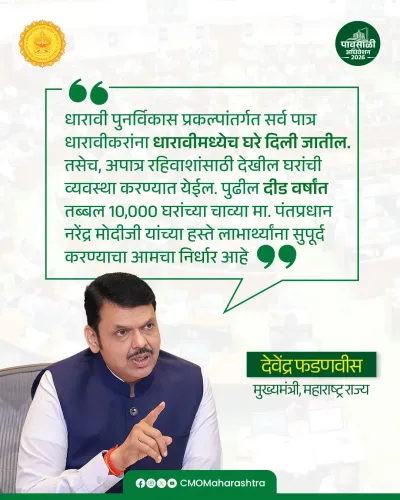
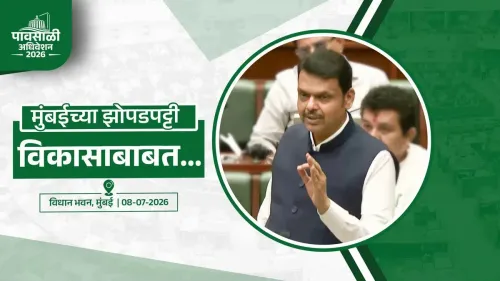
The Chief Minister's Office of Maharashtra on Tuesday, 9 June 2026 shared a vision statement from Chief Minister Devendra Fadnavis positioning the Dharavi Redevelopment Project on par with the urban renewal models of Singapore and Hong Kong, signalling fresh political momentum behind one of India's most closely watched slum rehabilitation efforts.
Context
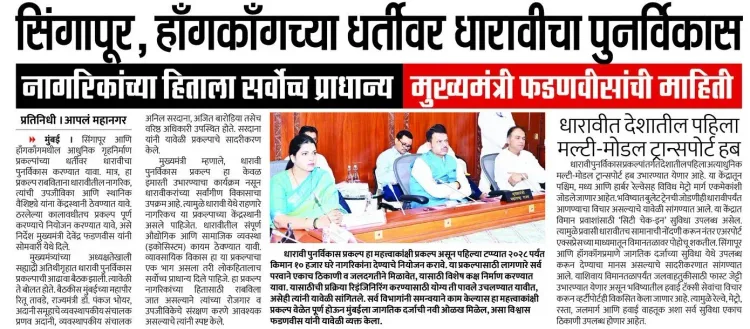
The post, shared from the official @CMOMaharashtra handle and tagging @Dev_Fadnavis, carries the Marathi phrase 'सिंगापूर, हाँगकाँगच्या धर्तीवर धारावीचा पुनर्विकास' — translated as 'Redevelopment of Dharavi on the lines of Singapore and Hong Kong.' The invocation of two East Asian city-states known for government-led, high-density public housing is deliberate: it frames the project not merely as slum clearance but as a transformation into a globally competitive urban district.
Dharavi, spread across roughly 2.1 square kilometres in the heart of Mumbai, is home to over a million residents and hosts a dense informal economy producing goods that circulate across domestic and international markets. Its redevelopment has been a recurring policy ambition for successive Maharashtra governments.
Policy Backdrop
The Dharavi Redevelopment Project was first formally launched in 2004 by the Maharashtra government, seeking to provide in-situ rehabilitation through a special purpose vehicle under the Slum Rehabilitation Authority (SRA) framework. A revival effort in 2019 brought fresh Expressions of Interest and renewed emphasis on integrating transit-oriented development with public-private partnerships.
Maharashtra governments have long benchmarked Mumbai's transformation against East Asian urban models. Singapore's Housing and Development Board estates and Hong Kong's government-led renewal estates represent the archetype of high-density, well-serviced public housing delivered at scale — a template that Indian policymakers have cited in Smart Cities and Housing for All mission documents. The CMO's framing places Dharavi squarely within that lineage.
Stakeholders and Impact
The project's primary stakeholders are the over one million Dharavi residents, many of whom have lived in the settlement for generations and have a direct interest in the quality, size, and tenure security of any replacement housing. Mumbai municipal authorities stand to gain upgraded infrastructure and expanded property-tax revenues, while real estate developers eye the prime land parcel — located minutes from the Bandra-Kurla Complex financial district.
Community groups and housing-rights advocates have historically raised concerns about eligibility cut-off dates for rehabilitation, the adequacy of transit accommodation during construction, and the risk of displacing the informal industrial ecosystem that makes Dharavi economically unique. Any master plan will need to address these fault lines to sustain political and legal momentum.
What's Next
Observers will watch for the issuance of fresh tenders, the finalisation of a master plan that specifies floor-space indices and rehabilitation unit sizes, and any legislative amendments to SRA rules needed to accelerate approvals. CM Fadnavis's public alignment with the Singapore-Hong Kong benchmark raises the bar for what the project must deliver — and sets a reference point against which outcomes will be measured by residents, investors, and the courts alike.
If the redevelopment proceeds at the scale the CMO's statement implies, Dharavi could become a test case for whether Indian cities can execute large-scale in-situ urban renewal without displacing the communities they promise to rehabilitate.
Point of View
CM Fadnavis is doing more than describing an aspiration — he is setting an internationally legible benchmark that will be used to hold his government accountable. This framing connects to a decades-long Maharashtra pattern of positioning Mumbai as a rival to East Asian financial hubs, a narrative that has driven multiple rounds of infrastructure investment but has also repeatedly run into the legal and humanitarian complexity of displacing entrenched urban communities. The political signal is clear: Fadnavis wants Dharavi to be a flagship legacy project, much as large-scale housing schemes have defined chief ministers in other states. Whether the execution matches the rhetoric will depend on how the government resolves the perennial tensions between developer interests, SRA eligibility rules, and the rights of long-standing residents.
NationPress
23 Oct 2026
Frequently Asked Questions
What is the Dharavi Redevelopment Project?
The Dharavi Redevelopment Project is a Maharashtra government initiative, first launched in 2004, to provide formal housing and upgraded infrastructure to residents of Dharavi — Mumbai's largest informal settlement — through in-situ rehabilitation under the Slum Rehabilitation Authority framework.
Why are Singapore and Hong Kong mentioned in the Dharavi redevelopment context?
CM Devendra Fadnavis's office cited Singapore and Hong Kong as models because both city-states are known for large-scale, government-led high-density public housing programmes that transformed informal or low-income urban areas into well-serviced districts — the kind of outcome Maharashtra is targeting for Dharavi.
How many people live in Dharavi?
Dharavi is estimated to house over one million residents across roughly 2.1 square kilometres in central Mumbai, making it one of the most densely populated urban settlements in Asia.
What is the Slum Rehabilitation Authority (SRA)?
The Slum Rehabilitation Authority is a Maharashtra government body that oversees the redevelopment of slum lands in the state, typically through public-private partnerships where developers provide free housing to eligible residents in exchange for the right to build commercial or market-rate units on a portion of the land.
What are the next steps for the Dharavi redevelopment?
Observers are watching for the issuance of fresh tenders, finalisation of a master plan specifying floor-space indices and unit sizes, and any legislative changes to SRA rules that could accelerate the project's approvals and construction timeline.