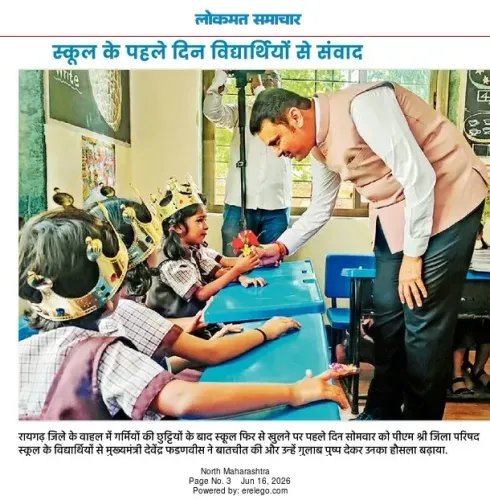
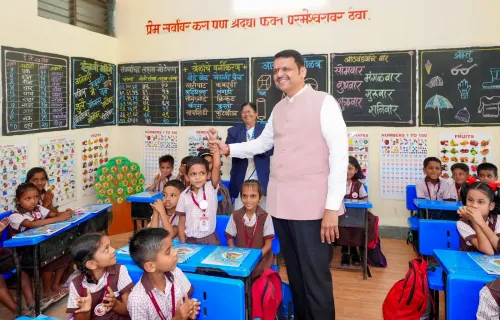
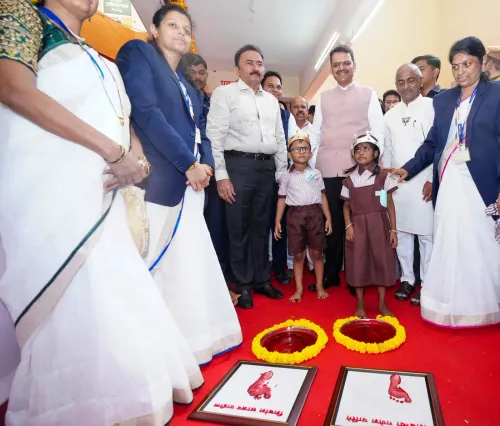
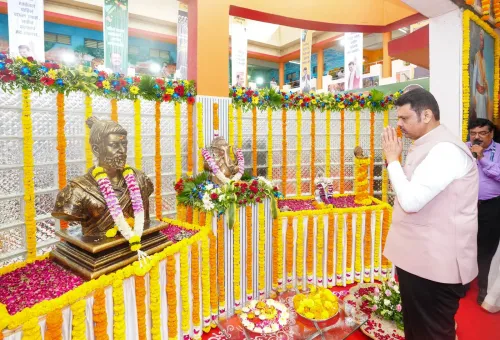
CM Fadnavis Praises Zilla Parishad Schools on First Day
Synopsis
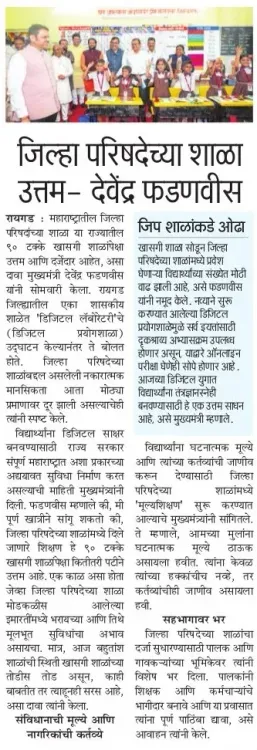
Chief Minister Devendra Fadnavis declared Zilla Parishad schools 'excellent' on the first day of Maharashtra's 2026-27 academic year, signalling continued state focus on rural government school quality and enrolment at the start of a new academic session.
Key Takeaways
Chief Minister Devendra Fadnavis publicly praised Zilla Parishad schools on 16 June 2026 , the first day of the new academic year.
The statement — 'जिल्हा परिषदेच्या शाळा उत्तम' ('Zilla Parishad schools are excellent') — was shared via the official CMO Maharashtra X account.
Zilla Parishad schools serve the majority of rural students across Maharashtra's 36 districts under the Maharashtra Zilla Parishads Act.
During his earlier 2014-2019 term, Fadnavis had launched the Shala Siddhi programme to upgrade ZP school standards.
The next ASER rural education report and monsoon session budget announcements will be key indicators of on-ground progress.
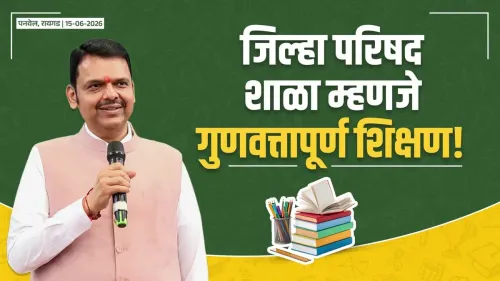
The Chief Minister's Office of Maharashtra on Tuesday, 16 June 2026 shared a statement from Chief Minister Devendra Fadnavis affirming that Zilla Parishad schools in the state are performing well, with the post coinciding with the first day of the new academic year across Maharashtra.
Context
The post, shared from the official CMO Maharashtra account, quotes Chief Minister Devendra Fadnavis in Marathi: 'जिल्हा परिषदेच्या शाळा उत्तम' — meaning 'Zilla Parishad schools are excellent.' The statement was made on the occasion of #FirstDayOfSchool, marking the start of the 2026-27 academic session in Maharashtra's government-run district council schools.
Zilla Parishad (ZP) schools are rural government primary and secondary institutions managed by district councils under the Maharashtra Zilla Parishads Act. They serve the bulk of the student population in non-urban Maharashtra, making them a critical pillar of the state's public education system.
Policy Backdrop
During his earlier tenure from 2014 to 2019, Fadnavis had championed the Shala Siddhi programme, which directed infrastructure grants and quality assessments to ZP schools under the broader Sarva Shiksha Abhiyan framework. His return to the Chief Minister's chair in late 2023 renewed administrative focus on reversing the long-running trend of enrolment decline in government schools.
Maharashtra, like several other Indian states, has invested in school infrastructure, teacher training, and midday meal improvements to slow the migration of students from government to private institutions. Public endorsements of ZP school quality at the start of the academic year are part of a broader signalling strategy to reassure parents and communities in rural districts.
Stakeholders and Impact
The primary beneficiaries of improved ZP school quality are rural students across Maharashtra's 36 districts, many of whom have no practical alternative to government schooling. Zilla Parishad teachers — a large and politically significant constituency — are also directly affected by policy attention to this segment.
A positive public statement from the Chief Minister on the first day of school carries symbolic weight for enrolment drives, as families in rural Maharashtra often make school-choice decisions at the start of the academic year. Administrative attention at this moment can influence whether children are enrolled in government or private schools.
What's Next
Observers will watch for concrete follow-through in the form of state budget allocations for ZP school grants or teacher recruitment announcements in the upcoming monsoon legislative session. The next Annual Status of Education Report (ASER) on rural learning outcomes will serve as an independent benchmark against which the Chief Minister's assessment can be measured.
Any gap between the stated optimism and ground-level data from independent assessments is likely to draw scrutiny from opposition benches and civil society groups focused on public education quality in Maharashtra.
Point of View
The gap between official assertion and measurable outcome carries significant electoral and social weight.
NationPress
15 Sept 2026
Frequently Asked Questions
What did CM Devendra Fadnavis say about Zilla Parishad schools?
Chief Minister Devendra Fadnavis declared that Zilla Parishad schools in Maharashtra are 'excellent,' making the statement on 16 June 2026, the first day of the new academic year.
What are Zilla Parishad schools in Maharashtra?
Zilla Parishad schools are rural government primary and secondary schools managed by district councils under the Maharashtra Zilla Parishads Act, serving the majority of students in non-urban areas of the state.
What is the Shala Siddhi programme?
Shala Siddhi was a school quality assessment and improvement programme launched during Fadnavis's first tenure (2014-2019) to raise standards in Zilla Parishad schools under the Sarva Shiksha Abhiyan framework.
Why do politicians praise government schools at the start of the academic year?
Public statements on school quality at the June academic-year start are intended to signal administrative attention to enrolment and learning outcomes, often aimed at encouraging rural families to choose government schools over private ones.
How will Maharashtra ZP school quality be independently assessed?
The Annual Status of Education Report (ASER) on rural learning outcomes serves as a key independent benchmark, and any state budget announcements in the monsoon legislative session will indicate the government's financial commitment to ZP schools.