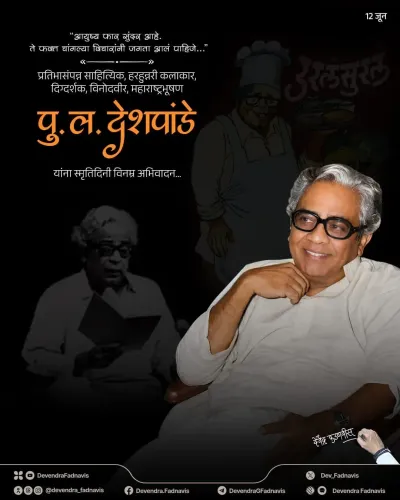
CM Fadnavis pays tribute to Dr. Vasantrao Deshpande on Smruti Din
Synopsis
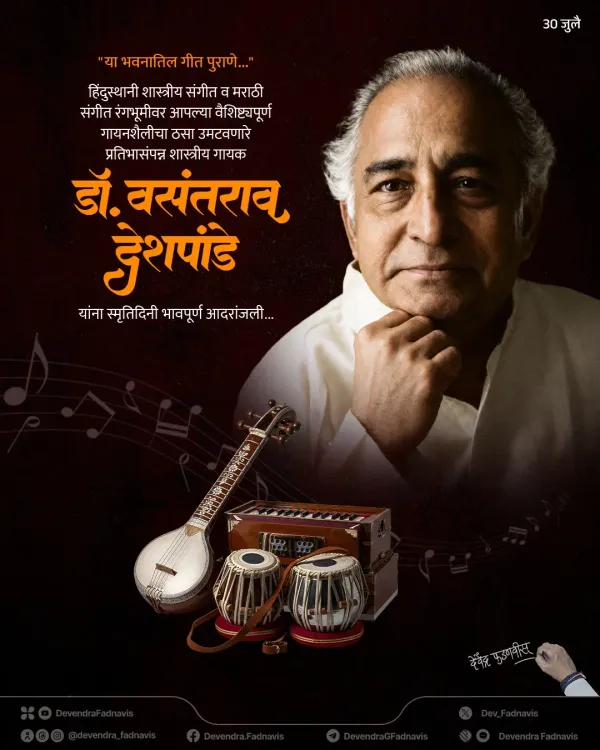
Maharashtra Chief Minister Devendra Fadnavis marked the Smruti Din of legendary Hindustani classical vocalist Dr. Vasantrao Deshpande on 30 July 2026, paying tribute to his distinctive khayal style and his immortal contributions to Marathi Sangeet Natak.
Key Takeaways
Maharashtra CM Devendra Fadnavis posted a tribute to Dr.
Vasantrao Deshpande on his Smruti Din, 30 July 2026 .
Fadnavis described Deshpande's contributions to Indian classical music and Marathi Sangeet Natak as 'unparalleled.' Dr.
Vasantrao Deshpande was a celebrated khayal vocalist associated with the Jaipur-Atrauli gharana tradition.
He was equally renowned for his roles in Marathi Sangeet Natak , the classical music-theatre form central to Maharashtra's cultural identity.
The tribute reflects Maharashtra's sustained institutional tradition of publicly commemorating its performing arts heritage.
On his Smruti Din, the voice of Dr. Vasantrao Deshpande echoes once more — across concert halls, theatre stages, and now, the timelines of those who govern the state he shaped with his art. Maharashtra Chief Minister Devendra Fadnavis paid homage to the legendary Hindustani classical vocalist on Thursday, 30 July 2026, calling his contributions to Indian classical music and Marathi Sangeet Natak 'unparalleled.'
In a bilingual post, Fadnavis wrote in Marathi: 'हिंदुस्थानी शास्त्रीय संगीतविश्वात आपल्या वैशिष्ट्यपूर्ण गायनशैलीचा ठसा उमटवणारे' — 'one who left the imprint of a distinctive singing style on the world of Hindustani classical music' — before extending what he called a heartfelt tribute, 'भावपूर्ण आदरांजली,' to the maestro's memory.
The voice that defined an era of khayal and natya sangeet
Dr. Vasantrao Deshpande was one of the most distinctive khayal singers of the twentieth century, celebrated for a voice that carried both scholarly depth and theatrical warmth. Trained in the Jaipur-Atrauli gharana tradition, he brought rigour and expressiveness to Hindustani classical music in equal measure. His renditions were marked by a rare ability to hold a raga's architecture while keeping audiences emotionally tethered.
Beyond the concert platform, Deshpande was a towering presence in Marathi Sangeet Natak — the classical music-theatre form that is Maharashtra's singular cultural inheritance. He gave immortal voice to roles in productions that remain touchstones of the genre, cementing a legacy that spans both the classical recital and the proscenium stage. Few artists have bridged those two worlds with such authority.
Maharashtra's living tradition of honouring its performing arts heritage
Public tributes to cultural figures on death anniversaries are a consistent feature of Maharashtra's political calendar, reflecting the state's deep institutional relationship with its performing arts legacy. Hindustani music and Sangeet Natak hold a documented place in state-level commemorations, and leaders across administrations have used such occasions to reaffirm that connection publicly.
Chief Minister Fadnavis's post fits that pattern — but the specificity of his tribute, naming Deshpande's 'distinctive singing style' and his 'immortal roles' on the Marathi musical stage, signals more than routine protocol. It is a reminder that the state's cultural memory is actively tended, not merely archived.
For Maharashtra's classical music community, each Smruti Din is both a moment of mourning and a quiet assertion: that the voices worth remembering are still being heard.
Point of View
Associating with icons of Marathi cultural heritage serves a consistent outreach goal toward the state's arts-conscious urban and semi-urban electorate. The specificity of Fadnavis's tribute, going beyond a generic salutation to name Deshpande's 'distinctive style' and theatrical legacy, suggests a deliberate, culturally literate posture.
NationPress
13 Sept 2026
Frequently Asked Questions
Who was Dr. Vasantrao Deshpande?
Dr. Vasantrao Deshpande was a celebrated Hindustani classical vocalist known for his distinctive khayal style and his deep association with Marathi Sangeet Natak, the classical music-theatre tradition of Maharashtra.
Why did CM Devendra Fadnavis pay tribute to Dr. Vasantrao Deshpande?
Maharashtra Chief Minister Devendra Fadnavis paid tribute on Dr. Vasantrao Deshpande's Smruti Din to honour his unparalleled legacy in Indian classical music and Marathi Sangeet Natak.
What is Marathi Sangeet Natak?
Marathi Sangeet Natak is a classical music-theatre form unique to Maharashtra, in which dramatic performances are interwoven with Hindustani classical and semi-classical compositions. Dr. Vasantrao Deshpande was one of its most iconic voices.
Which gharana did Dr. Vasantrao Deshpande belong to?
Dr. Vasantrao Deshpande was associated with the Jaipur-Atrauli gharana, one of the major traditions of Hindustani classical khayal singing.