CM Fadnavis Launches NAINA Projects, Targets 15 Lakh Jobs
Synopsis
Chief Minister Devendra Fadnavis inaugurated the ₹953-crore SBR-9/BR-4/BR-5 bridge complex and the Uran Bypass Bridge in Raigad on 25 October 2026, launching the NAINA development zone with a target of 15 lakh jobs around Navi Mumbai International Airport.
Key Takeaways
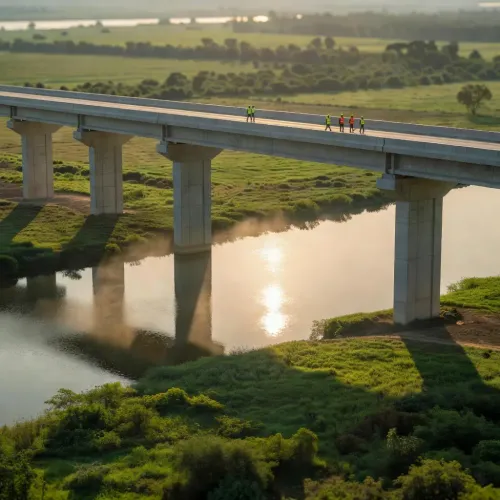
SBR-9, BR-4 and BR-5 bridges inaugurated at a cost of ₹953 crore , spanning 2,593 metres across Panvel creek for east-side airport access.
Uran Bypass Bridge (941 metres, ₹50.26 crore) inaugurated to ease traffic congestion in Dronagiri, Navi Mumbai.
NAINA zone targets 15 lakh jobs , with 5 lakh high-wage positions , prioritising local bhoomiputras.
Planned thematic clusters include EduCity, MediCity, SportsCity, Aerocity and KnowledgeCity .
Land-title documents distributed to landholders before ground-breaking, as a farmer-trust measure.
Thane, Navi Mumbai, Raigad and Palghar positioned as Maharashtra's next major economic growth corridor.
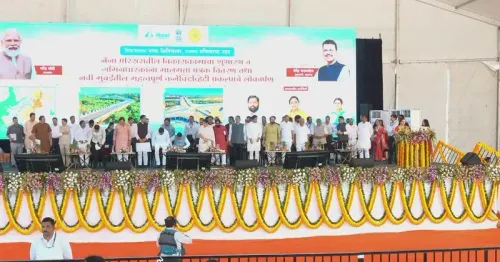
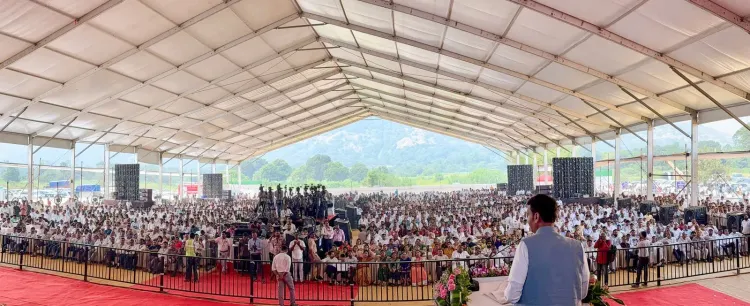
A greenfield airport is only as powerful as the city that grows around it — and on Sunday, 25 October 2026, Chief Minister Devendra Fadnavis moved to make that city real. At Panvel, Raigad, the Chief Minister's Office of Maharashtra announced the inauguration of key infrastructure works and bridge projects within the NAINA (Navi Mumbai Airport Influence Notified Area), along with the distribution of property title documents to landholders in the zone.
The event marked a pivotal moment for what CM Fadnavis is calling Maharashtra's next 'growth engine' — a planned urban cluster that he described as 'Teesri Mumbai' (the Third Mumbai), poised to reshape the economic geography of the entire Mumbai Metropolitan Region.
Three bridges, one mission: connect the airport from the east
The centrepiece of Sunday's inaugurations was the SBR-9, BR-4 and BR-5 bridge complex, built by CIDCO at a cost of ₹953 crore. Spanning the Panvel creek, the three bridges stretch a combined 2,593 metres with a total width of 60 metres, carrying four lanes in each direction on the main carriageway and two service lanes on either side. A central 100-metre-diameter traffic roundabout island anchors the interchange, while cloverleaf junctions on the airport's east and west flanks will allow signal-free, uninterrupted traffic flow.
The direct practical effect: commuters from Pune, Panvel, Thane and Kalyan will be able to reach Navi Mumbai International Airport from the east via National Highway 4B, with seamless onward access to the Ulwe Coastal Road and the Mumbai Trans Harbour Link (MTHL) — two of the region's other marquee connectivity projects.
The Uran Bypass: ending a bottleneck in Dronagiri
Also inaugurated was the Uran Bypass Bridge in the Dronagiri neighbourhood of Navi Mumbai — a 941-metre-long, 11-metre-wide structure built at a cost of ₹50.26 crore by CIDCO. The bridge runs from Hotel Anandi to Uran town and includes a 640-metre main span, a 153-metre approach road and a 148-metre link road, with 1.75-metre pedestrian footpaths on both sides and a 7.5-metre vehicular carriageway. Its purpose is straightforward: relieve chronic traffic congestion that has long bottlenecked movement through Uran.
'Third Mumbai' and the 15-lakh employment vision
CM Fadnavis used Sunday's platform to articulate a broader economic philosophy. The Navi Mumbai International Airport, he argued, is not merely transport infrastructure but an economic multiplier — and the planned NAINA zone around it will be developed through an integrated development framework with distinct thematic clusters: EduCity, MediCity, SportsCity, Aerocity and KnowledgeCity.
The stated employment target is 15 lakh jobs, of which 5 lakh are to be high-wage positions. The Chief Minister was explicit that opportunities arising from this development would prioritise bhoomiputras — the sons of the soil, meaning the original landowners and local residents of the region. He also pledged that ground-breaking ceremonies for infrastructure works would only proceed after land-related documents had been placed in the hands of landholders — an attempt to rebuild farmer trust that has historically been a fault line in large-scale land acquisition projects in the region.
Maharashtra's polycentric growth ambition
Sunday's events fit a larger pattern in Maharashtra's development strategy. The state has long sought to move beyond a single Mumbai-centric economic model, cultivating secondary nodes in Pune, Chhatrapati Sambhajinagar and Nagpur. The Thane–Navi Mumbai–Raigad–Palghar corridor is now being positioned as the next cluster in that constellation — an eastern and southern counterweight to the congested core city.
CIDCO, the City and Industrial Development Corporation, remains the nodal executing agency for the NAINA township projects. The NAINA planning zone was notified in the early 2010s to enable coordinated land-use planning around the greenfield airport, which itself received in-principle central government approval as far back as 2007 — making Sunday's ground-breakings and inaugurations a long-awaited acceleration of a nearly two-decade-old ambition.
Present at the event were Deputy Chief Minister Eknath Shinde, Deputy Chief Minister Sunetra Ajit Pawar, Minister Bharat Gogawale, MP Sunil Tatkare, MP Shrirang Appa Barne, and several other legislators and dignitaries.
Maharashtra has drawn the blueprint for its third city. The question now is whether the land-title pipeline, the employment targets, and the thematic city concepts translate from groundbreaking speeches into liveable, working urban reality — and on that score, the next few years of NAINA's phased rollout will be the only honest answer.
Point of View
Whose support is critical for the zone's expansion. Whether NAINA replicates the relative success of Navi Mumbai's first planned township phase, or stalls in the complex web of land disputes and multi-agency coordination, will test both CIDCO's execution capacity and the state's political will over the next decade.
NationPress
25 Oct 2026
Frequently Asked Questions
What is the NAINA project in Maharashtra?
NAINA stands for Navi Mumbai Airport Influence Notified Area — a planned development zone around the new Navi Mumbai International Airport, spanning Panvel and Raigad, designed to enable coordinated land-use and urban development in the airport's influence region.
What did CM Devendra Fadnavis inaugurate at Panvel on 25 October 2026?
CM Fadnavis inaugurated the ₹953-crore SBR-9, BR-4 and BR-5 bridge complex over Panvel creek, the ₹50.26-crore Uran Bypass Bridge in Dronagiri, and performed ground-breaking ceremonies for various NAINA TPS infrastructure works, alongside distributing land-title documents to area landholders.
How many jobs will the NAINA project create?
The NAINA planned development zone targets approximately 15 lakh (1.5 million) jobs in total, of which 5 lakh are to be high-wage positions, with priority given to bhoomiputras — the original local landowners and residents of the area.
What is the SBR-9 bridge project near Navi Mumbai airport?
SBR-9, along with BR-4 and BR-5, is a ₹953-crore CIDCO bridge complex spanning 2,593 metres across the Panvel creek. It provides east-side road access to Navi Mumbai International Airport from Pune, Panvel, Thane and Kalyan via NH 4B, and connects to the MTHL and Ulwe Coastal Road.
What is the Uran Bypass Bridge and why was it built?
The Uran Bypass Bridge is a 941-metre, 11-metre-wide bridge built by CIDCO at a cost of ₹50.26 crore in the Dronagiri area of Navi Mumbai, running between Hotel Anandi and Uran town, to ease chronic traffic congestion within Uran city.