DELTA Act: Maha CM Fadnavis pushes blockchain property tokenisation law

Synopsis
Maharashtra is poised to become India's first state with a dedicated blockchain property tokenisation law. CM Devendra Fadnavis has directed officials to draft the DELTA Act, linking land assets to digital tokens to unlock latent property value — a move framed as a pillar of the state's USD 1 trillion economy target by 2030.
Key Takeaways
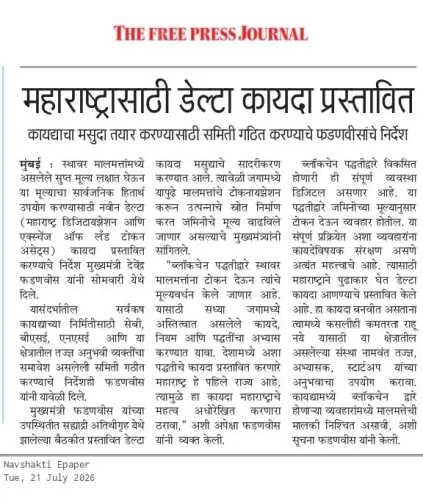
Maharashtra CM Devendra Fadnavis directed officials on 20 July to draft the DELTA (Maharashtra Digitisation and Exchange of Land Token Assets) Act .
The Act proposes tokenising immovable properties via blockchain technology to unlock latent asset value and create new revenue streams.
An expert committee with representatives from SEBI , BSE , and NSE will be constituted to draft the legislation.
Maharashtra would become the first state in India to introduce a dedicated property tokenisation law.
The initiative is tied to Maharashtra's goal of becoming a USD 1 trillion economy by 2030 .
The Urban Development and Law and Judiciary Departments have been asked to expedite the drafting process.
Maharashtra Chief Minister Devendra Fadnavis on Monday, 20 July directed state officials to draft a new DELTA (Maharashtra Digitisation and Exchange of Land Token Assets) Act, aimed at unlocking the latent economic value of immovable properties for public benefit. The proposed legislation, if enacted, would make Maharashtra the first state in India to introduce a dedicated law for blockchain-based property tokenisation.
What the DELTA Act Proposes
Under the proposed framework, immovable properties would be tokenised using blockchain technology, enabling more efficient transactions, faster property dealings, and value enhancement of land assets. Fadnavis stressed that the entire ecosystem must be fully digital, with property transactions conducted through tokens directly linked to the underlying value of land. He also directed that the legislation must clearly establish ownership rights in blockchain-enabled property transactions.
The Chief Minister noted that existing processes for property purchase, sale, and mortgage financing are often time-consuming. A tokenised digital framework, he argued, would significantly improve efficiency and allow property owners to realise the latent value of their assets, creating broader economic opportunities.
Expert Committee to Draft the Legislation
Fadnavis directed the constitution of an expert committee comprising representatives from the Securities and Exchange Board of India (SEBI), the Bombay Stock Exchange (BSE), the National Stock Exchange (NSE), and experienced professionals from relevant fields. The committee will be tasked with preparing a comprehensive and inclusive law covering all stakeholders. The Urban Development Department, along with the Law and Judiciary Department, has been asked to expedite the drafting process.
Minister of State for Urban Development Madhuri Misal was present at the review meeting, which examined the draft framework of the proposed Act.
Global Context and Maharashtra's Ambition
Fadnavis observed that several developed countries have already begun building platforms for property tokenisation, and Maharashtra should not fall behind in adopting such emerging technologies. He directed officials to study international laws, regulations, and best practices in this domain. The Chief Minister emphasised that the proposed law must be backed by a strong legal framework to ensure certainty, transparency, and legal protection.
Expertise from reputed institutions, domain experts, researchers, and start-ups is expected to be incorporated during the drafting phase. Officials have also been asked to align the proposed Act with relevant regulations of the Government of India.
Link to Maharashtra's USD 1 Trillion Economy Goal
The DELTA Act initiative is positioned as a key enabler of Maharashtra's broader economic ambition of becoming a USD 1 trillion economy by 2030. Fadnavis said the legislation should help create new revenue streams for both property owners and the state government, harnessing untapped economic potential embedded in property assets across Maharashtra.
This comes amid a global surge in interest in real-world asset tokenisation, with blockchain-based property platforms gaining traction in markets such as the UAE, Singapore, and parts of Europe. Maharashtra's move signals an intent to position itself as a regulatory pioneer in this space within India.
Point of View
But ambition and execution are different things. Property tokenisation globally has struggled with legal enforceability, liquidity depth, and retail investor protection — the same gaps that SEBI and NSE will need to address in the committee stage. Maharashtra's 'first-mover' framing is politically useful, but without a clear interoperability standard with central land registry systems, tokenised titles could create parallel ownership disputes rather than resolve them. The USD 1 trillion economy target gives this political urgency, but the harder question — whether India's property dispute backlog can coexist with a blockchain title layer — remains unanswered.
NationPress
20 Oct 2026
Frequently Asked Questions
What is the Maharashtra DELTA Act?
The DELTA Act stands for Maharashtra Digitisation and Exchange of Land Token Assets Act. It is a proposed legislation directed by Chief Minister Devendra Fadnavis on 20 July to tokenise immovable properties using blockchain technology, enabling faster transactions and unlocking the latent economic value of land assets.
Why is the DELTA Act significant for India?
If enacted, Maharashtra would become the first state in India to introduce a dedicated law for blockchain-based property tokenisation. The Act is designed to create new revenue streams for property owners and the state government, and is linked to Maharashtra's target of becoming a USD 1 trillion economy by 2030.
Who will draft the DELTA Act?
An expert committee comprising representatives from SEBI, BSE, NSE, and experienced professionals from relevant fields will be constituted to draft the legislation. The Urban Development Department and the Law and Judiciary Department have been tasked with expediting the process.
How does property tokenisation work under the proposed framework?
Under the proposed DELTA framework, immovable properties would be assigned digital tokens on a blockchain, with each token linked to the underlying value of the land. Transactions — including purchase, sale, and mortgage — would be conducted digitally through these tokens, backed by a legal framework ensuring transparency and ownership rights.
What global precedents is Maharashtra looking at?
Chief Minister Fadnavis directed officials to study international laws and best practices in property tokenisation from developed countries that have already built such platforms. Markets such as the UAE, Singapore, and parts of Europe have seen early-stage blockchain property tokenisation initiatives.