CM Fadnavis Moves to Tokenise Maharashtra Land via DELTA Act

Synopsis
Chief Minister Devendra Fadnavis chaired a meeting in Mumbai to draft the DELTA Act, which would make Maharashtra the first Indian state to legally enable blockchain-based tokenisation of immovable property, with an expert committee including SEBI, BSE, and NSE to guide the legislation.
Key Takeaways
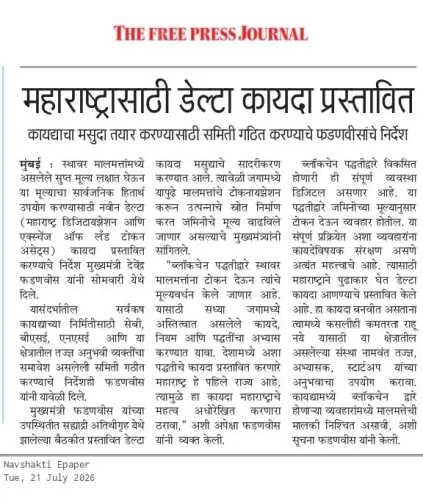
CM Devendra Fadnavis chaired a drafting meeting for the proposed Maharashtra Digitisation and Exchange of Land Token Asset Act (DELTA Act) at Sahyadri Guest House, Mumbai .
Maharashtra would become the first Indian state to enact a dedicated law for blockchain-based tokenisation of immovable property.
An expert committee comprising SEBI, BSE, NSE , and domain specialists has been directed to be constituted to guide the draft legislation.
The law aims to unlock the 'latent value' of immovable assets, speed up property transactions, and increase state government revenue.
The Urban Development and Law and Justice departments have been instructed to accelerate action on the bill.
The initiative is linked to Maharashtra's goal of becoming a 1 trillion dollar economy by 2030 .
The Chief Minister's Office of Maharashtra announced on Monday, 21 July 2026 that Chief Minister Devendra Fadnavis chaired a meeting at Sahyadri Guest House, Mumbai to begin drafting the Maharashtra Digitisation and Exchange of Land Token Asset Act (DELTA Act) — a proposed law that would make Maharashtra the first Indian state to create a dedicated legal framework for blockchain-based tokenisation of immovable property.
Context
The meeting focused on framing the draft legislation and constituting an expert committee to guide it. CM Fadnavis directed that the committee include representatives from SEBI (Securities and Exchange Board of India), the BSE (Bombay Stock Exchange), the NSE (National Stock Exchange), and domain experts and experienced practitioners from the sector. State Minister Madhuri Misal and senior officials were present at the meeting.
The Chief Minister stated that the proposed law must have the capacity to unlock the 'सुप्त मूल्य' ('latent value') embedded in immovable assets and put it to public use. He emphasised that all blockchain-based transactions under the framework must carry clear legal protection for ownership rights.
Policy Backdrop
Maharashtra's push for the DELTA Act builds on the state's participation in the national Digital India Land Records Modernization Programme, launched in 2008, which computerised land records to reduce disputes and improve transparency. The new proposal goes significantly further by linking land assets directly to capital-market mechanisms through the involvement of SEBI, BSE, and NSE.
Globally, jurisdictions are enacting frameworks for real-world asset tokenisation to unlock liquidity in real estate and infrastructure. CM Fadnavis directed that laws, rules, and practices prevalent worldwide be studied in depth, and that the state must not fall behind as such platforms are developed internationally. He also instructed the Urban Development and Law and Justice departments to accelerate action on the legislation.
The Chief Minister noted that Maharashtra has a rich tradition of giving path-breaking laws to the country, and the proposed DELTA Act should uphold and reinforce that legacy.
Stakeholders and Impact
Property owners stand to benefit most directly: the DELTA framework would allow the latent value of their assets to be recognised and monetised through tokenisation, while the current process of sale transactions and bank loan collateralisation is time-consuming. Digitising and tokenising this process, CM Fadnavis said, would bring speed and efficiency to property dealings.
Real estate investors and startups working in the blockchain and proptech space are also expected to be consulted during the drafting process. The Chief Minister directed that the experience of institutions, noted experts, researchers, and startups be utilised to ensure no gaps remain in the legislation. The state government also expects the law to increase its own revenue from property transactions.
The involvement of SEBI, BSE, and NSE signals that tokenised land assets could eventually be traded on regulated capital-market platforms, a development that would have significant implications for retail investors and institutional participants alike.
What's Next
The expert committee — comprising SEBI, BSE, NSE, and sector specialists — will now study international laws and frameworks before submitting its recommendations for the draft DELTA bill. The Urban Development and Law and Justice departments have been tasked with moving quickly on the legislative process.
The introduction of the DELTA bill in the Maharashtra legislature will be a key milestone to watch, as will any subsequent rules or notifications issued jointly by the two departments. If enacted, the law would position Maharashtra as a national model for blockchain-based land-asset regulation, with potential implications for other states and for central government policy on real-world asset tokenisation.
Point of View
BSE, and NSE at the drafting stage, Maharashtra is explicitly positioning land tokenisation as a financial-market instrument rather than merely an administrative digitisation exercise. This aligns with a global trend of real-world asset tokenisation but in the Indian context it raises novel regulatory questions about the intersection of state property law and central securities law. The move also fits a broader pattern of CM Fadnavis using Maharashtra's legislative weight to set national precedents — from cooperative sector reform to urban governance — and could pressure the central government to develop a unified national framework. The 2030 trillion-dollar economy framing gives the proposal political urgency, but the committee's success will depend on resolving jurisdictional tensions between state land laws and SEBI's oversight mandate.
NationPress
20 Oct 2026
Frequently Asked Questions
What is the Maharashtra DELTA Act?
The DELTA Act — Maharashtra Digitisation and Exchange of Land Token Asset Act — is a proposed state law that would create a legal framework for tokenising immovable properties using blockchain technology, allowing their latent value to be unlocked and traded through regulated platforms.
What is land tokenisation and how will it work in Maharashtra?
Land tokenisation involves assigning digital tokens to physical properties via blockchain, representing their monetary value. Under the proposed DELTA Act, these tokens could be used for transactions, loan collateral, or investment — replacing slow paper-based processes with a fully digital system.
Why are SEBI, BSE, and NSE involved in a state land law?
Chief Minister Fadnavis has directed that SEBI, BSE, and NSE be part of the expert drafting committee because tokenised land assets could eventually be traded on capital-market platforms, making securities regulators and exchanges essential to designing a legally sound and market-compatible framework.
Is Maharashtra the first state in India to propose such a law?
Yes. According to the Chief Minister's Office, Maharashtra would be the first Indian state to enact a dedicated law for blockchain-based tokenisation of immovable property assets.
How does the DELTA Act connect to Maharashtra's 1 trillion dollar economy goal?
CM Fadnavis has framed the DELTA Act as a tool to develop new revenue sources needed for Maharashtra to achieve its target of becoming a 1 trillion dollar economy by 2030, by unlocking capital trapped in underutilised real estate.