CM Fadnavis Calls for Probe into Ex-MHA Official's Claims
Synopsis
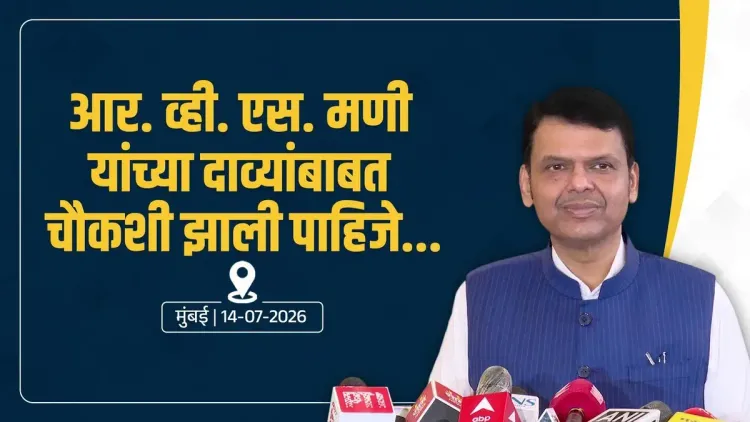
Maharashtra Chief Minister Devendra Fadnavis on July 14, 2026, publicly called for a formal inquiry into claims made by former Ministry of Home Affairs Under Secretary R.V.S. Mani, posting the demand in both Marathi and Hindi on X from Mumbai.
Key Takeaways
Devendra Fadnavis , Chief Minister of Maharashtra, on July 14, 2026 , demanded a probe into claims by former MHA Under Secretary R.V.S.
The demand was posted publicly on X in both Marathi and Hindi , signalling broad intended reach.
Mani is a retired officer who served as Under Secretary in the Ministry of Home Affairs , India's nodal internal security ministry.
The MHA has been a focus of security accountability debates since the 26/11 Mumbai attacks of 2008 .
No formal inquiry has been announced yet; the Ministry of Home Affairs in New Delhi has not publicly responded.
The matter may be raised in the next parliamentary session depending on political dynamics.
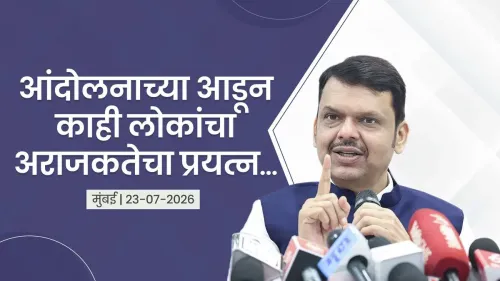
Maharashtra Chief Minister Devendra Fadnavis on Tuesday, July 14, 2026, called for a formal inquiry into claims made by R.V.S. Mani, a former Under Secretary in the Ministry of Home Affairs (MHA), posting his demand publicly on X from Mumbai.
In his post — written in Marathi and Hindi — Fadnavis stated, 'केंद्रीय गृह मंत्रालयाचे (MHA) माजी अवर सचिव आर. व्ही. एस. मणी यांनी केलेल्या दावांसंदर्भात चौकशी झाली पाहिजे' [An inquiry must be conducted into the claims made by former MHA Under Secretary R.V.S. Mani]. The demand was directed at the central government and signals Maharashtra's intent to formally pursue the matter.
Context
R.V.S. Mani is a retired Indian Administrative Service-cadre officer who served as Under Secretary in the Ministry of Home Affairs, the nodal central body overseeing internal security, intelligence coordination, and law enforcement across India. Former MHA officials occasionally make public disclosures about institutional functioning, and such statements can carry significant weight given their access to sensitive administrative processes.
Fadnavis's post does not specify the content of Mani's claims, but the Chief Minister's use of both Marathi and Hindi — and the explicit tagging of his own handle — suggests the statement is intended for a wide audience spanning Maharashtra and the national Hindi-speaking belt.
Policy Backdrop
The Ministry of Home Affairs has been at the centre of debates around intelligence coordination and internal security accountability, particularly since the 26/11 Mumbai attacks of 2008, after which multiple central and state reviews examined how information flows between the MHA and state police forces. Questions about institutional accountability within the MHA have periodically resurfaced in public discourse since then.
Indian state leaders periodically invoke their authority to demand central probes into statements by retired MHA officials — a pattern that reflects the structural tension in federal security governance, where states bear frontline responsibility but intelligence and policy authority often rests with the Centre.
Stakeholders and Impact
The primary stakeholders in this demand include investigative agencies at both the central and state level, retired and serving officials of the Ministry of Home Affairs, and Maharashtra's law enforcement apparatus. A formal inquiry, if ordered, could involve either a central agency or a Maharashtra-constituted panel, depending on the jurisdictional scope of Mani's claims.
Mumbai, as Maharashtra's capital and India's financial hub, has historically been the focal point of security accountability debates. Any inquiry touching on MHA functioning and Mumbai's security architecture would draw significant institutional and political attention.
What's Next
The immediate question is whether the Ministry of Home Affairs in New Delhi responds formally to Fadnavis's public demand, or whether Maharashtra pursues an independent inquiry mechanism. The matter could also surface during the next parliamentary session if opposition or coalition partners choose to raise it on the floor.
Fadnavis's statement sets a political marker: by making the demand publicly and bilingually, he has ensured the call for inquiry is on record and difficult to ignore at the federal level. Whether it translates into a formal institutional process will depend on the Centre's response in the days ahead.
Point of View
Public demand — rather than a quiet administrative referral — is a deliberate political signal aimed at both Maharashtra's regional audience and the national Hindi-speaking public. By naming a retired MHA official and invoking the word 'inquiry,' the Chief Minister positions Maharashtra as a proactive actor in federal security accountability, not merely a passive recipient of central directives. This fits a broader pattern in which state leaders use social media to apply pressure on central ministries without waiting for formal institutional channels. The real test will be whether the Centre treats this as a governance matter requiring response, or allows it to remain a political statement without institutional consequence.
NationPress
13 Oct 2026
Frequently Asked Questions
Who is R.V.S. Mani and why is his name in the news?
R.V.S. Mani is a former Under Secretary in India's Ministry of Home Affairs. He is in the news because Maharashtra Chief Minister Devendra Fadnavis has publicly demanded an inquiry into claims made by him.
What did CM Devendra Fadnavis say about R.V.S. Mani?
Fadnavis posted on X on July 14, 2026, stating that an inquiry must be conducted into the claims made by former MHA Under Secretary R.V.S. Mani. He made the demand in both Marathi and Hindi.
Has the Ministry of Home Affairs responded to Fadnavis's demand?
As of the time of this report, the Ministry of Home Affairs has not publicly responded to Chief Minister Fadnavis's demand for an inquiry.
Why does Maharashtra's CM have a say in MHA matters?
While the MHA is a central body, state chief ministers can publicly demand federal inquiries, especially when the matter touches on security governance that directly affects their state. Such demands reflect the federal structure of India's security architecture.
Could this issue come up in Parliament?
Yes, the matter could be raised in the next parliamentary session if opposition or coalition members choose to pursue it, particularly given that it involves a former official of a central ministry making public claims.