CM Fadnavis Marks World Blood Donor Day, Urges Donation
Synopsis
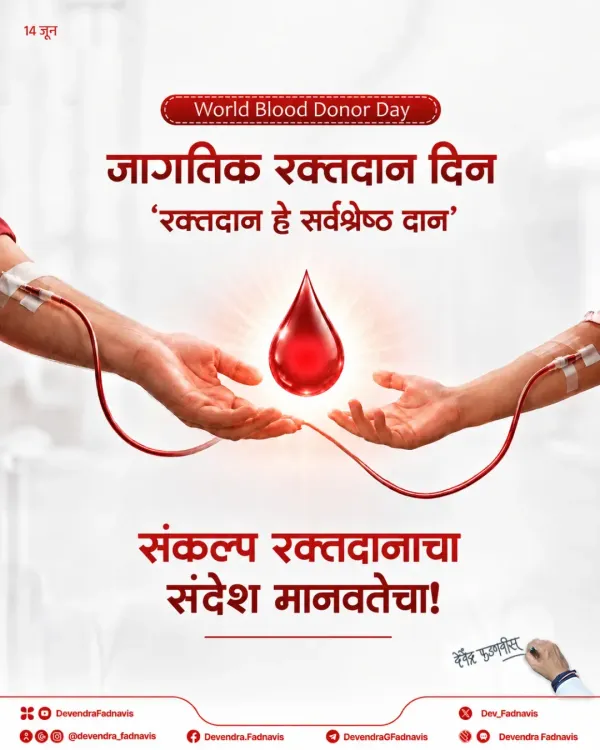
Maharashtra Chief Minister Devendra Fadnavis used World Blood Donor Day on 14 June 2026 to issue a bilingual appeal on X, urging citizens to donate blood voluntarily and calling each donation a potential lifeline — spotlighting Maharashtra's ongoing push to strengthen its voluntary blood supply.
Key Takeaways
Devendra Fadnavis , Chief Minister of Maharashtra , posted a World Blood Donor Day appeal on 14 June 2026 .
The post was bilingual — English and Marathi — and called voluntary blood donation an act of 'humanity' and a potential 'lifeline' for recipients.
World Blood Donor Day has been observed annually on 14 June since 2004 , established by the WHO .
India's National Blood Policy (2002) mandates a shift from replacement to voluntary, unpaid blood donation across all states.
Blood bank operations in Maharashtra are overseen by the Maharashtra State Blood Transfusion Council under the National AIDS Control Programme framework.
Patients with thalassaemia, sickle-cell anaemia, cancer, and surgical needs are among the primary beneficiaries of a robust voluntary donor base.
Maharashtra Chief Minister Devendra Fadnavis on Sunday, 14 June 2026, marked World Blood Donor Day with a bilingual appeal on X, calling on citizens to donate blood and describing each donation as a potential lifeline for someone in need.
Context
Posting in both English and Marathi, Fadnavis wrote: 'Every drop of blood has the power to save lives and strengthen the spirit of humanity.' In Marathi, he added — 'तुमचे रक्तदान ठरेल एखाद्यासाठी जीवनदान' ['Your blood donation will become a lifeline for someone'] — framing voluntary donation as an act of humanitarian duty rather than a medical transaction.
World Blood Donor Day is observed every year on 14 June, a date chosen to honour the birth anniversary of Karl Landsteiner, the scientist who discovered the ABO blood group system. The World Health Organization (WHO) established the annual observance in 2004 to encourage voluntary, unpaid blood donation and promote safe transfusion services globally.
Policy Backdrop
India's National Blood Policy, adopted in 2002, set the framework for transitioning the country's blood supply from replacement donations — where patient families are expected to provide donors — to a system driven entirely by voluntary, non-remunerated contributions. Two decades on, that shift remains a work in progress across many states.
In Maharashtra, blood bank operations and voluntary donation campaigns are coordinated through the Maharashtra State Blood Transfusion Council, which functions under the broader National AIDS Control Programme framework that oversees blood safety infrastructure nationwide. The council periodically sets annual collection targets and runs public awareness drives, particularly around observances such as World Blood Donor Day.
Stakeholders and Impact
The primary beneficiaries of expanded voluntary donation are patients requiring emergency transfusions, surgical procedures, cancer treatment, and management of conditions such as thalassaemia and sickle-cell anaemia — diseases with a significant burden in Maharashtra. Voluntary donors are equally central: WHO guidelines emphasise that regular, healthy donors are the safest source of blood, reducing risks associated with paid or coerced donation.
Public appeals by senior political figures carry the potential to normalise donation as a civic act, particularly in semi-urban and rural areas where awareness campaigns have historically had limited reach. CM Fadnavis used the hashtags #WorldBloodDonorDay and #Maharashtra, signalling the message was aimed at a state-wide audience.
What's Next
The Maharashtra State Blood Transfusion Council typically tracks whether high-visibility awareness moments translate into measurable upticks in donor registrations and blood units collected at state-run and private blood banks. Whether 14 June 2026 is accompanied by any state-level donation drives, camp announcements, or policy updates from the health department remains to be seen. The broader goal — achieving a fully voluntary blood supply that meets hospital demand without depending on replacement donors — continues to guide state health planning.
Point of View
Though the real test lies in whether the appeal is backed by concrete state-run donation camps or policy announcements. The bilingual framing — English and Marathi — reflects a deliberate effort to reach both urban and rural audiences across Maharashtra. Placed within India's long-running push to fulfil its 2002 National Blood Policy commitments, the post underscores that voluntary donation is still treated as a campaign goal rather than an achieved norm.
NationPress
13 Sept 2026
Frequently Asked Questions
Why is World Blood Donor Day celebrated on 14 June?
World Blood Donor Day is observed on 14 June every year to mark the birth anniversary of Karl Landsteiner , the scientist who discovered the ABO blood group system. The WHO established the observance in 2004 to promote voluntary, unpaid blood donation globally.
What did Maharashtra CM Devendra Fadnavis say on World Blood Donor Day 2026?
CM Devendra Fadnavis posted on X calling every drop of blood 'a power to save lives and strengthen the spirit of humanity.' In Marathi, he said each donation could become a lifeline — 'जीवनदान' — for someone in need.
What is the Maharashtra State Blood Transfusion Council?
The Maharashtra State Blood Transfusion Council is the nodal body that oversees blood bank regulation, voluntary donation campaigns, and annual collection targets across Maharashtra . It functions under the National AIDS Control Programme framework.
What is India's National Blood Policy?
India's National Blood Policy , adopted in 2002 , aims to replace paid and replacement blood donation with a system driven entirely by voluntary, non-remunerated donors to improve blood safety and availability across the country.
How can I donate blood in Maharashtra?
Citizens in Maharashtra can contact their nearest government hospital blood bank or a centre registered with the Maharashtra State Blood Transfusion Council . Voluntary donation camps are also organised periodically, especially around observances like World Blood Donor Day on 14 June .