Gadkari at Nagpur Airport Handover Ceremony
Synopsis
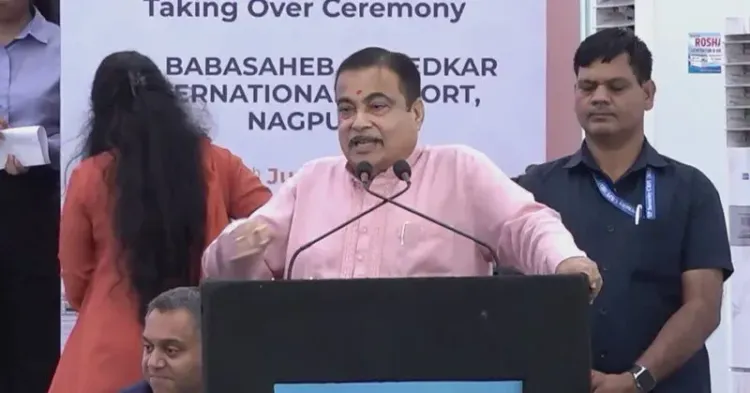
Union Minister Nitin Gadkari attended the Handing Over–Taking Over Ceremony of Dr. Babasaheb Ambedkar International Airport in Nagpur on June 25, 2026, signalling a formal management transition at one of Maharashtra's key aviation hubs amid India's broader airport privatisation push.
Key Takeaways
Union Minister Nitin Gadkari addressed the Handing Over–Taking Over Ceremony of Dr.
Babasaheb Ambedkar International Airport, Nagpur on June 25, 2026 .
The ceremony marks a formal transfer of airport management, consistent with India's policy of transitioning select airports from AAI to private operators.
The National Civil Aviation Policy 2016 underpins the public-private partnership model driving such airport transitions.
Nagpur airport is envisioned as a multimodal logistics hub linked to Vidarbha's industrial growth corridors.
Key outcomes to watch include capital expenditure rollout, route expansion, and the operational timeline under the new management.
Union Road Transport and Highways Minister Nitin Gadkari addressed the Handing Over–Taking Over Ceremony of Dr. Babasaheb Ambedkar International Airport in Nagpur on Thursday, June 25, 2026, marking a significant transition in the management of one of Maharashtra's key aviation gateways.
Context
Dr. Babasaheb Ambedkar International Airport serves Nagpur, the winter capital of Maharashtra and a strategically located city at the geographic centre of India. The airport, named after the architect of the Indian Constitution Dr. B.R. Ambedkar, operates under the Airports Authority of India (AAI) framework and handles both domestic and international traffic connecting Vidarbha to major Indian and overseas destinations.
A handover-takeover ceremony of this nature signals a formal transfer of operational or managerial authority — a process that successive central governments have employed to bring private-sector efficiency to airport infrastructure. Gadkari, as a senior BJP leader and Member of Parliament from Nagpur, carries particular political and symbolic weight at an event in his home constituency.
Policy Backdrop
The National Civil Aviation Policy 2016 laid the groundwork for expanding airport capacity through public-private partnerships, focusing on operational efficiency upgrades and growth in non-aeronautical revenue streams. In line with this policy direction, select airports across India have been progressively transitioned from AAI management to private operators as part of a broader modernisation drive.
Nagpur airport has featured prominently in successive master plans that envision it as a multimodal logistics hub integrated with industrial growth corridors in the Vidarbha region. The city's central location makes it a natural candidate for expansion into a cargo and passenger transit node connecting northern, southern, eastern, and western India.
Stakeholders and Impact
Air passengers using Dr. Babasaheb Ambedkar International Airport stand to be directly affected by any change in management, particularly with respect to terminal quality, flight connectivity, and ground services. Businesses in the Nagpur and broader Vidarbha region — including manufacturers, logistics firms, and exporters — are closely watching the transition for signals on cargo capacity and route expansion.
A successful handover can attract fresh capital investment into terminal upgrades, cargo infrastructure, and ancillary commercial development around the airport precinct. For the region's economy, improved air connectivity translates into greater access to domestic markets and international trade routes, reinforcing Nagpur's position as a logistics gateway.
What's Next
Attention will now turn to the rollout of any capital expenditure commitments, new route announcements, or land acquisition plans linked to the incoming management at Dr. Babasaheb Ambedkar International Airport. Stakeholders will look for concrete timelines on infrastructure upgrades and clarity on how the transition affects existing airline operations and passenger services.
The ceremony adds to a pattern of airport privatisation and modernisation events that have gathered pace across India, and Nagpur's handover may set a reference point for similar transitions at other Tier-2 and Tier-3 city airports in the coming months.
Point of View
Presiding over this event in his home constituency of Nagpur adds a political dimension to what is also a substantive infrastructure milestone. The transition positions Nagpur as a test case for integrating airport privatisation with multimodal logistics ambitions, particularly for the industrially significant but historically underserved Vidarbha belt. How smoothly the handover translates into tangible passenger and cargo improvements will determine whether it becomes a model cited in future airport transfer proceedings.
NationPress
25 Jun 2026
Frequently Asked Questions
What happened at Nagpur airport on June 25 2026?
Union Minister Nitin Gadkari addressed the Handing Over–Taking Over Ceremony of Dr. Babasaheb Ambedkar International Airport in Nagpur on June 25, 2026, marking a formal transition in the airport's management.
Who manages Dr. Babasaheb Ambedkar International Airport in Nagpur?
The airport has historically operated under the Airports Authority of India (AAI) framework. The June 2026 handover ceremony signals a transition in its management, though the exact identity and terms of the incoming operator have not been officially confirmed in public records.
Why is Nagpur airport being handed over to a new operator?
The move aligns with India's National Civil Aviation Policy 2016 and the broader government strategy of transferring select airports to private operators to drive modernisation, improve efficiency, and grow non-aeronautical revenue.
What is the significance of Nagpur airport for the Vidarbha region?
Dr. Babasaheb Ambedkar International Airport is a key connectivity hub for Vidarbha, featuring in master plans that envision Nagpur as a multimodal logistics centre linking manufacturers and exporters to domestic and international markets.
What should travellers and businesses expect after the Nagpur airport handover?
Stakeholders should watch for announcements on capital expenditure, terminal upgrades, new flight routes, and cargo infrastructure development under the new management in the months following the ceremony.