Gadkari: Cabinet clears ₹2,814 cr critical minerals scheme
Synopsis
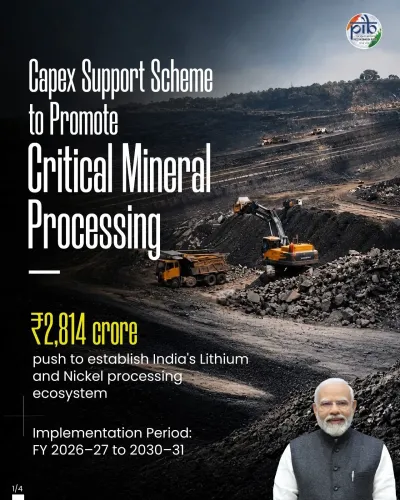
The Union Cabinet has approved the 'Capex Support Scheme to Promote Critical Mineral Processing' with a ₹2,814 crore outlay over five years, aiming to build domestic processing capacity, cut import dependence, and bolster India's strategic and economic resilience in clean energy supply chains.
Key Takeaways
The Union Cabinet, chaired by PM Narendra Modi, approved the Capex Support Scheme to Promote Critical Mineral Processing on November 4, 2026 .
The scheme carries a financial outlay of ₹2,814 crore spread across five years .
The objective is to build domestic critical mineral processing capabilities and reduce India's reliance on globally concentrated — predominantly China-based — processing hubs.
The scheme follows the Mines and Minerals Amendment Act 2023 and India's entry into the Mineral Security Partnership in June 2023, completing the upstream-to-downstream policy arc.
Key beneficiaries include India's EV manufacturers and the battery industry , which depend on processed minerals for cells and components.
The government explicitly linked domestic processing capability to India's economic sovereignty , national security , and decarbonisation goals .
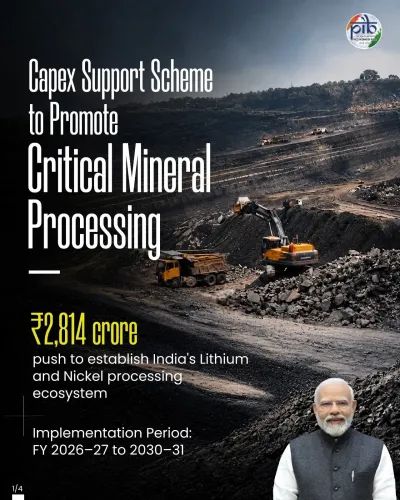
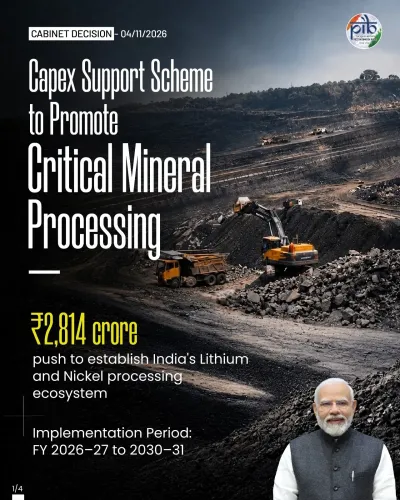
India just placed a serious bet on mineral independence. Union Road Transport and Highways Minister Nitin Gadkari announced on Wednesday, November 4, 2026 that the Union Cabinet, chaired by Prime Minister Narendra Modi, has approved the 'Capex Support Scheme to Promote Critical Mineral Processing' — a ₹2,814 crore intervention spread across five years aimed squarely at building domestic processing capacity for the minerals that power electric vehicles, clean energy infrastructure, and advanced technology.
Why India can't afford to stay dependent
The strategic logic is stark. Global processing of critical minerals — think lithium, cobalt, graphite, rare earths — is concentrated in a handful of locations, with China dominating refining capacity across multiple categories. That concentration has repeatedly exposed supply chains to geopolitical shocks, price swings, and the threat of sudden disruption. For a country accelerating its EV transition and green energy buildout, dependence on a single-point-of-failure supply chain is not a business risk — it is a national security risk.
Gadkari's post framed it in exactly those terms: the scheme targets India's 'economic sovereignty and long-term strategic resilience', and explicitly links processing capability to 'timely achievement of decarbonisation goals'. That is a rare and deliberate pairing — economic security and climate ambition in the same sentence of a Cabinet decision.
The policy runway behind this ₹2,814 crore push
This approval does not arrive in a vacuum. The Mines and Minerals (Development and Regulation) Amendment Act, 2023 had already opened critical mineral blocks for private-sector auction and exploration — the first time India systematically invited private capital into this segment. The government also identified 30 critical minerals as priority commodities and joined the Mineral Security Partnership in June 2023, a multilateral grouping designed to diversify global supply chains away from over-concentrated sources.
The Capex Support Scheme now adds the downstream piece: not just who digs the minerals, but who processes them. Mining without domestic processing still leaves India dependent on overseas refiners — often the same concentrated players the policy is trying to bypass. The five-year capital expenditure support is designed to change that equation by de-risking private investment in processing infrastructure.
Who stands to gain — and what comes next
EV manufacturers and the battery industry are the immediate industrial beneficiaries. As India scales its electric mobility ambitions, domestically processed minerals translate directly into more resilient, cost-competitive supply chains for battery cells and components. Beyond EVs, processed critical minerals feed into solar panels, wind turbines, defence electronics, and semiconductors — sectors where India has stated long-term manufacturing ambitions.
The watch-list is clear: how quickly project approvals roll out under the scheme, whether linked capacity additions materialise in refining and processing facilities, and whether further mineral block auctions and technology partnerships accelerate alongside the capital support. The framework is now set. Execution will determine whether India's critical mineral processing sector actually closes the gap with global leaders — or remains a policy on paper.
India has identified the chokepoint in its clean-energy supply chain; the ₹2,814 crore question is whether industry moves fast enough to unclog it.
Point of View
The government is attempting to replicate the kind of vertically integrated industrial policy that made China dominant in this space. The ₹2,814 crore commitment is modest relative to comparable programmes in the US and EU, but it signals state intent and can catalyse private investment multiples of that figure. The harder test will be regulatory speed and technology tie-up quality — both historically weak links in India's industrial scaling.
NationPress
4 Nov 2026
Frequently Asked Questions
What is the Capex Support Scheme for Critical Mineral Processing?
It is a Union Cabinet-approved scheme with a ₹2,814 crore outlay over five years designed to build domestic processing capacity for critical minerals in India, reducing import dependence and strengthening supply-chain resilience.
Which minerals are considered 'critical minerals' in India?
India has identified 30 critical minerals including lithium, cobalt, graphite, nickel, and rare earth elements — materials essential for EV batteries, solar panels, wind turbines, defence electronics, and semiconductors.
Why is India concerned about critical mineral processing concentration?
A handful of countries, led by China, dominate global processing of critical minerals. This concentration exposes India's clean energy and high-tech supply chains to geopolitical risk, price volatility, and potential disruption — directly threatening economic and national security.
How does this scheme connect to India's EV and clean energy goals?
EVs and renewable energy infrastructure require processed critical minerals for batteries and components. Domestic processing capability means India's EV and solar sectors are less vulnerable to overseas supply shocks and can build more cost-competitive, secure supply chains.
What earlier policy reforms led up to this Cabinet decision?
The Mines and Minerals (Development and Regulation) Amendment Act, 2023 opened critical mineral blocks for private auction, and India joined the Mineral Security Partnership in June 2023. The Capex Support Scheme adds downstream processing incentives to complete that policy framework.