Dr. Jitendra Singh: India's first manned deep-sea mission by 2028
Synopsis
Union Minister Dr. Jitendra Singh, addressing IPRD 2026 at Manekshaw Centre, announced India's target to send its first human deep-sea mission to 6,000 metres by 2028, citing NIOT's existing trial capabilities, the Ocean Mineral Explorer, and PM Modi's consecutive Independence Day references to the Deep Ocean Mission.
Key Takeaways
Jitendra Singh addressed IPRD 2026 at Manekshaw Centre , organised by the National Maritime Foundation , on 4 November 2026 .
India targets its first crewed deep-sea mission to up to 6,000 metres by 2028 under the Deep Ocean Mission , approved by the Cabinet in 2021 .
NIOT, Chennai has demonstrated capability to conduct trials at 5,000–6,000 metres in the Central Indian Ocean Basin .
The Ocean Mineral Explorer has already identified several hydrothermal sulphide deposits, which are rich in critical minerals.
PM Modi referenced the Deep Ocean Mission consecutively twice in his Independence Day addresses, signalling highest-level policy priority.
Deep-ocean resources are framed as a key pillar of Viksit Bharat 2047 , with convergence of ocean sciences, space technology, nuclear science, robotics, and geology driving the programme.
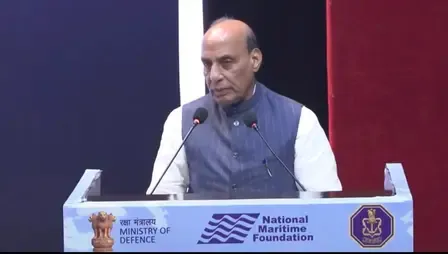
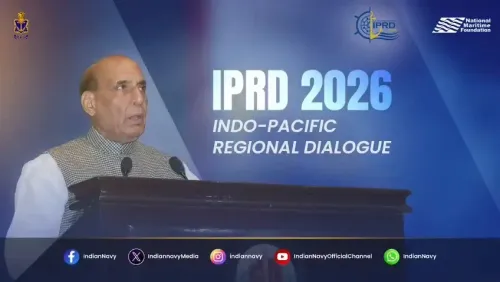
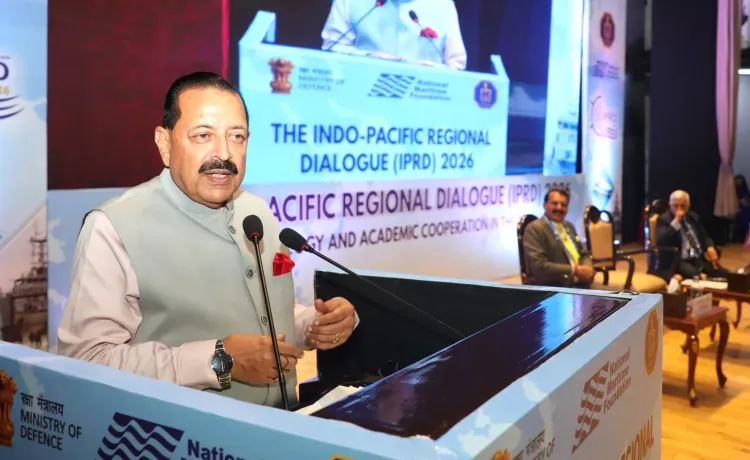
India's deep-ocean ambitions surfaced at centre stage on Wednesday, 4 November 2026, when Union Science and Technology Minister Dr. Jitendra Singh addressed the Indo-Pacific Regional Dialogue (IPRD) 2026 at Manekshaw Centre, New Delhi — laying out a detailed blueprint for how the country intends to become a serious force in the final, largely unexplored frontier: the deep sea.
Speaking at the event organised by the National Maritime Foundation, Dr. Singh outlined a vision where ocean sciences no longer sit siloed inside individual ministries but operate through a mission-mode framework stitching together departments, disciplines, and technologies. 'There is growing convergence of ocean sciences, space technology, nuclear science, geology, electronics and robotics in advancing India's maritime and deep-ocean capabilities,' he said — a statement that signals just how wide the government's aperture on this issue has become.
NIOT, Chennai and what 6,000 metres actually means
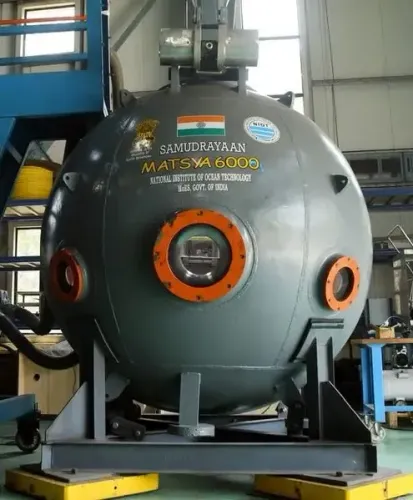
The concrete centrepiece of Dr. Singh's address was India's operational progress. The National Institute of Ocean Technology (NIOT), based in Chennai, has developed the capability to conduct trials at depths of 5,000 to 6,000 metres in the Central Indian Ocean Basin. That is not a blueprint — it is a demonstrated technical achievement in one of the planet's most hostile environments, where pressure exceeds 600 times that at the surface.
NIOT has also developed the Ocean Mineral Explorer, a system that enables high-resolution mapping of hydrothermal sulphide deposits on the seafloor. Several such deposits have already been identified — a detail that transforms the mission from aspirational science into a potential resource inventory. Hydrothermal sulphide deposits are rich in copper, zinc, gold, and silver, minerals central to the clean-energy transition.
Deep Ocean Mission and the Modi Independence Day signal
Dr. Singh drew pointed attention to Prime Minister Narendra Modi's decision to reference the Deep Ocean Mission in his Independence Day address consecutively twice — a rhetorical signal that rarely goes unnoticed in New Delhi's policy ecosystem. When a programme earns two consecutive Red Fort mentions, funding, inter-ministerial priority, and bureaucratic momentum tend to follow.
The Deep Ocean Mission, approved by the Union Cabinet in 2021, was designed precisely to build this ecosystem: indigenous deep-sea technologies, human submersibles, biological studies, and mineral extraction frameworks. Its architecture is explicitly multi-ministry and multi-institution, which explains why a Science and Technology minister is now the face of what was once primarily an Earth Sciences brief.
India's first human deep-sea mission: the 2028 target
The headline number from Dr. Singh's address is unambiguous: India is progressing towards sending its first human deep-sea mission to a depth of up to 6,000 metres by 2028. If achieved, this would place India in an extraordinarily small club — only the United States, China, Japan, France, and Russia have operated crewed submersibles at comparable depths. China's Fendouzhe reached the Mariana Trench at over 10,000 metres in 2020; India's 2028 target is a first-step milestone, not the summit, and Dr. Singh framed it as such.
The strategic calculus runs deeper than scientific prestige. Deep-ocean resources — polymetallic nodules, cobalt-rich crusts, and hydrothermal deposits — are increasingly viewed as a future-critical supply chain for critical minerals, and the country that develops the technology to extract them gains durable leverage. Dr. Singh explicitly tied the mission to Viksit Bharat 2047, the government's development vision, calling deep-ocean resources 'a major source of economic value addition.'
Atmanirbhar Bharat meets the ocean floor
The Minister's framing of 'indigenous capabilities combined with international cooperation' maps precisely onto the broader Atmanirbhar Bharat doctrine — build it at home, but do not wall off global partnerships. India holds exploration rights in designated zones of the Indian Ocean under agreements with the International Seabed Authority, giving it a legal foothold that the technology now needs to match.
The 2028 crewed mission will be the clearest test of whether that match has been made. Watch the submersible's sea-trial schedule and any new bilateral cooperation agreements on deep-ocean exploration — those two threads will tell the real story of whether India's deep-sea ambitions descend from conference rooms to the ocean floor on schedule.
Point of View
Telling the strategic community that the Deep Ocean Mission has cleared the technology-demonstration phase and is now entering its most consequential chapter. The repeated invocation of PM Modi's Independence Day references is a deliberate political move, designed to lock in bureaucratic and budgetary momentum by anchoring the programme to the highest visibility platform the Indian state commands. Framing deep-ocean resources within Viksit Bharat 2047 also quietly elevates ocean policy from a scientific brief to a development-and-security imperative, which matters for inter-ministerial resource allocation. If the 2028 crewed mission succeeds, it will mark a structural shift in India's position in the global critical-minerals race — not just a scientific milestone.
NationPress
5 Nov 2026
Frequently Asked Questions
What is India's Deep Ocean Mission?
The Deep Ocean Mission is a flagship programme approved by India's Union Cabinet in 2021 to develop indigenous technologies for deep-sea exploration, mineral extraction, and marine biology research, coordinated across multiple ministries and institutions.
When will India send its first crewed deep-sea mission?
India is targeting its first human deep-sea mission to a depth of up to 6,000 metres by 2028, as stated by Union Minister Dr. Jitendra Singh at IPRD 2026.
What is NIOT and what has it achieved in deep-ocean exploration?
The National Institute of Ocean Technology (NIOT), based in Chennai, is an autonomous institute under the Ministry of Earth Sciences. It has developed the capability to conduct trials at depths of 5,000 to 6,000 metres in the Central Indian Ocean Basin and built the Ocean Mineral Explorer for high-resolution seafloor mapping.
What are hydrothermal sulphide deposits and why does India want them?
Hydrothermal sulphide deposits are seafloor mineral formations rich in copper, zinc, gold, and silver — critical inputs for clean-energy technologies. India's Ocean Mineral Explorer has already identified several such deposits in the Indian Ocean, giving the country a potential strategic resource base.
Why did PM Modi mention the Deep Ocean Mission in his Independence Day speech twice?
PM Modi referenced the Deep Ocean Mission in consecutive Independence Day addresses to signal the programme's strategic priority at the highest level of government, which typically accelerates inter-ministerial coordination and budget allocation.