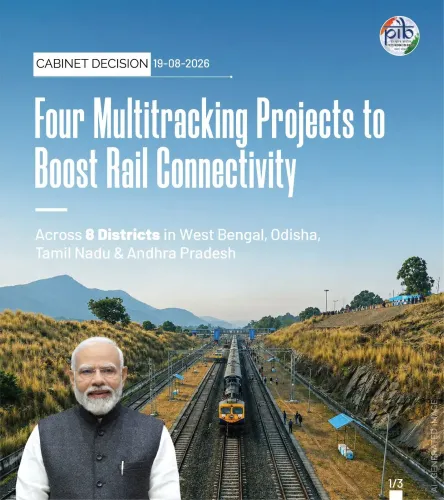
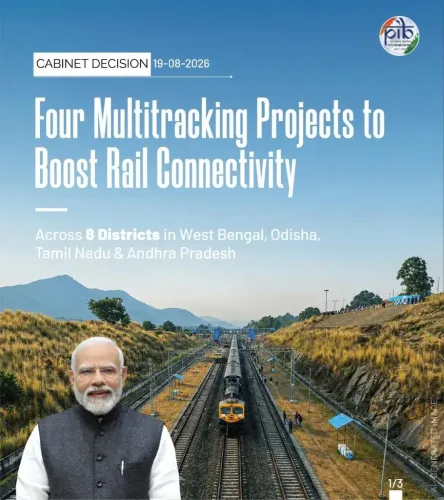
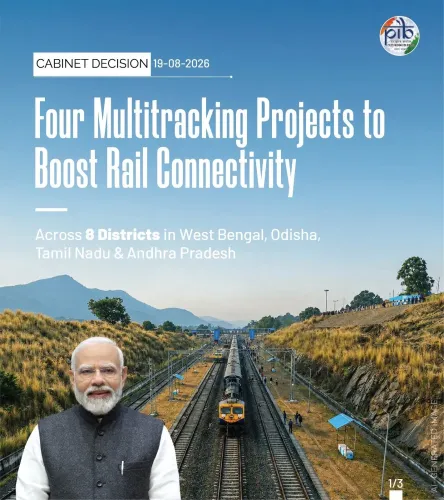
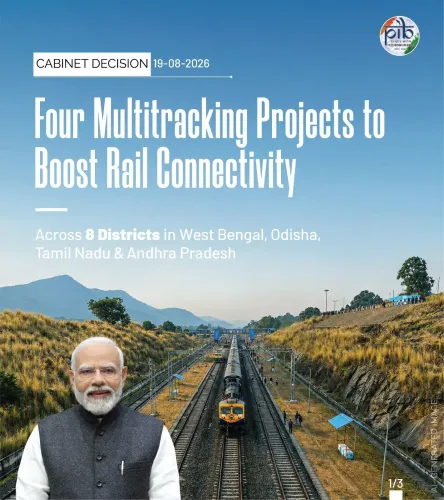
Gadkari Flags Cabinet Nod for ₹9,450 Cr Rail Multi-Tracking
Synopsis
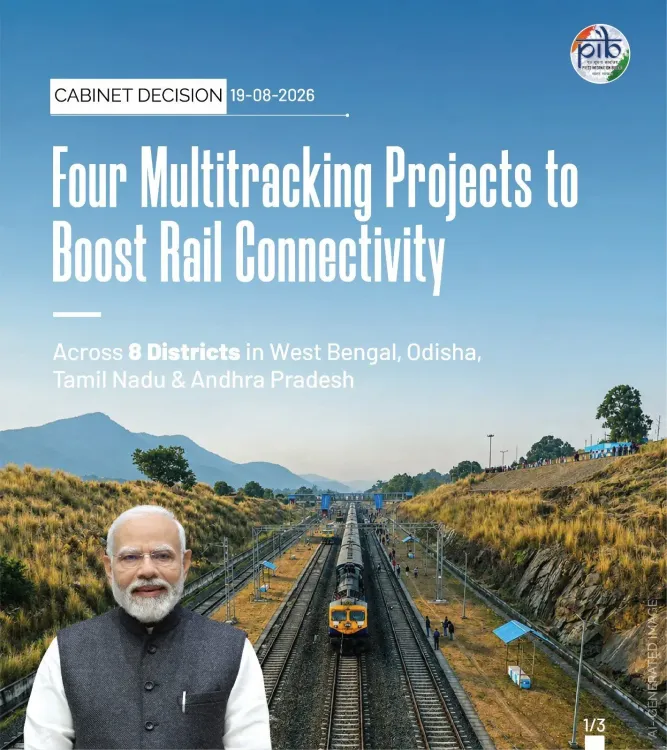
The Union Cabinet has approved four railway multi-tracking projects worth ₹9,450 crore covering 410 km across Odisha, West Bengal, Andhra Pradesh and Tamil Nadu, targeting chronic congestion on key passenger and freight corridors in eastern and southern India.
Key Takeaways
The Union Cabinet approved four railway multi-tracking projects at a total estimated cost of ₹9,450 crore .
The projects cover a combined 410 km across Odisha, West Bengal, Andhra Pradesh and Tamil Nadu .
The largest stretch is the Kharagpur–Bhadrak (Ranital) 4th Line at 173 km across West Bengal and Odisha.
The Cuttack–Paradeep 3rd and 4th Lines (72 km) directly serve Paradeep Port , a major cargo gateway.
Projects align with the National Rail Plan 2030 's strategy of multi-tracking high-density corridors.
Key next steps include land acquisition, tendering by the Ministry of Railways , and potential integration with Dedicated Freight Corridors .
Four railway corridors stretching 410 km across eastern and southern India are about to get a capacity overhaul — and the Union Cabinet, chaired by Prime Minister Narendra Modi, has just signed the cheque. Union Road Transport and Highways Minister Nitin Gadkari announced on Wednesday, August 19, 2026, that the Cabinet has approved four railway multi-tracking projects at a combined estimated cost of ₹9,450 crore, spanning Odisha, West Bengal, Andhra Pradesh and Tamil Nadu.
The four corridors: what is being built where
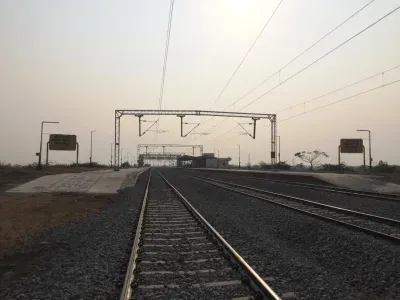
The Cabinet approval covers four distinct stretches, each targeting a chronically congested trunk route. The largest is the Kharagpur–Bhadrak (Ranital) 4th Line — a 173 km addition running across West Bengal and Odisha, one of the busiest freight arteries on the eastern network. Immediately adjacent, the Bhadrak–Haridaspur 4th Line adds 75 km entirely within Odisha, strengthening the rail spine feeding the state's industrial hinterland. In the south, the Gummidipundi–Gudur 3rd and 4th Lines will lay 90 km of new track across Andhra Pradesh and Tamil Nadu, a corridor that links Chennai's northern industrial belt to the Andhra coast. Rounding out the package, the Cuttack–Paradeep (Badabandha) 3rd and 4th Lines cover 72 km in Odisha — a route that directly serves Paradeep Port, one of India's largest cargo gateways.Why congestion on these routes has long been a bottleneck
India's high-density rail corridors — particularly those threading through eastern India's coal, steel and port economy — have for decades operated close to or beyond their designed capacity, forcing trains to queue and slowing both passenger services and freight movement. The National Rail Plan 2030, released in 2021, explicitly identified multi-tracking of such corridors as the primary lever to raise line capacity and begin separating passenger and freight flows. The four projects approved now sit squarely within that blueprint. The Odisha-heavy concentration of the package is no accident. The state's port-linked economy — centred on Paradeep and its mineral export traffic — has long demanded rail capacity that the existing double-line network struggles to provide. Adding third and fourth lines on the Cuttack–Paradeep corridor directly addresses that pinch point.Jobs, freight costs and the Atmanirbhar Bharat frame
Gadkari's announcement framed the projects explicitly within PM Modi's 'New India' and Atmanirbhar Bharat vision, citing expanded economic opportunities, stronger regional connectivity and new avenues for employment and self-employment. Multi-tracking projects of this scale typically generate significant construction-phase employment and, once commissioned, lower logistics costs for freight operators — a direct input into India's broader push to improve its competitiveness in manufacturing and exports. The next milestones to watch: land acquisition timelines, tendering by the Ministry of Railways, and any eventual integration of these corridors with the Dedicated Freight Corridor network — the piece that would unlock the full productivity gains the plan promises.Point of View
The approvals fit a pattern of using railway capacity expansion to lower logistics costs and strengthen the case for India as a manufacturing destination, directly feeding the Atmanirbhar Bharat narrative. The real test will be execution speed: land acquisition and tendering timelines on comparable projects have historically slipped, and commissioning dates will determine whether the capacity gains arrive in time to matter.
NationPress
20 Aug 2026
Frequently Asked Questions
What are the four railway multi-tracking projects approved by the Cabinet?
The Cabinet approved the Kharagpur–Bhadrak 4th Line (173 km), Bhadrak–Haridaspur 4th Line (75 km), Gummidipundi–Gudur 3rd and 4th Lines (90 km), and Cuttack–Paradeep 3rd and 4th Lines (72 km), totalling 410 km across Odisha, West Bengal, Andhra Pradesh and Tamil Nadu.
What is the total cost of the railway multi-tracking projects approved in August 2026?
The Union Cabinet approved the four projects at a combined estimated cost of approximately ₹9,450 crore.
Which states benefit from the Cabinet-approved railway multi-tracking projects?
Odisha is the biggest beneficiary with three of the four projects, while West Bengal, Andhra Pradesh and Tamil Nadu each host sections of the remaining corridors.
What is railway multi-tracking and why does it matter?
Multi-tracking means adding a third or fourth rail line alongside existing tracks on a corridor, which increases capacity, reduces congestion, and allows passenger and freight trains to run with fewer conflicts and delays.
How do these projects connect to India's National Rail Plan 2030?
The National Rail Plan 2030, released in 2021, identified multi-tracking of high-density corridors as a core strategy to raise line capacity and separate passenger and freight traffic — the four projects approved now directly implement that blueprint.