Cabinet Clears Two Rail Multitracking Projects in Odisha, Jharkhand
Synopsis
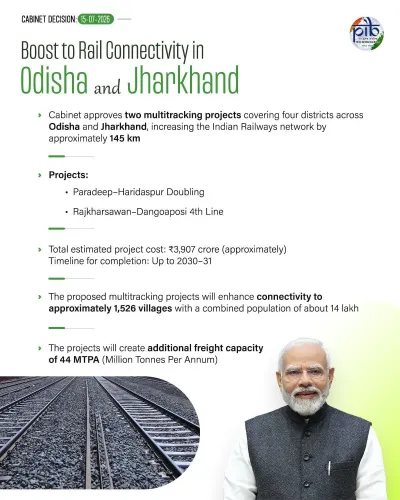
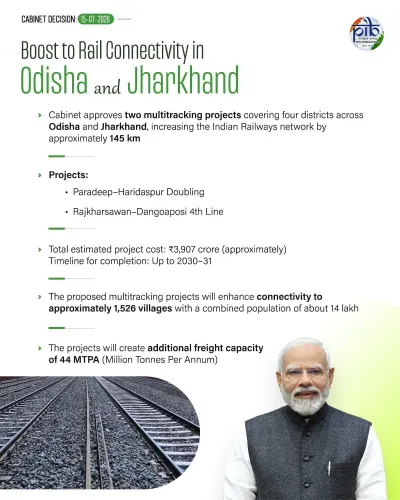
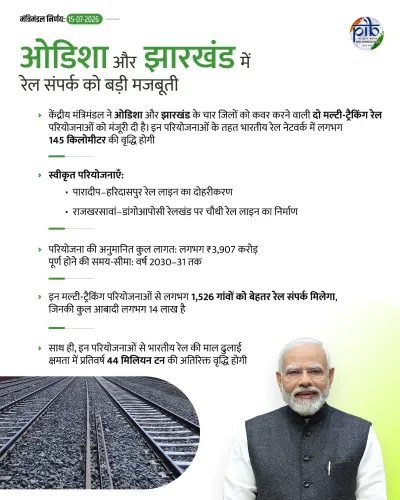
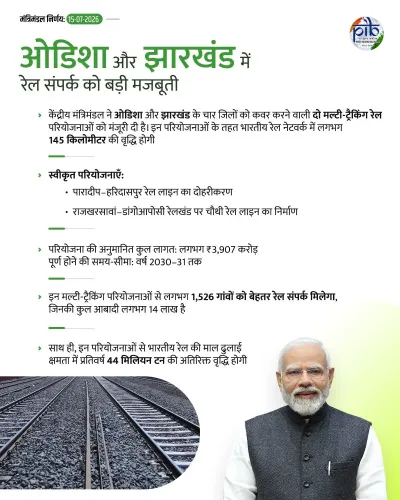
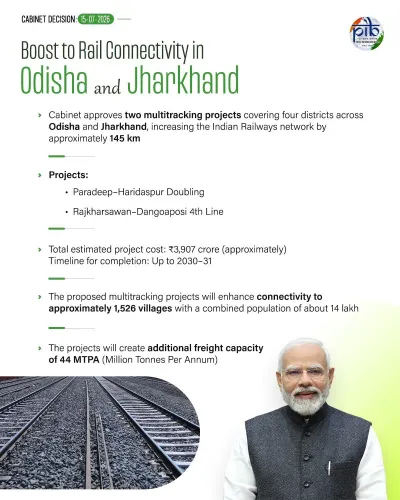
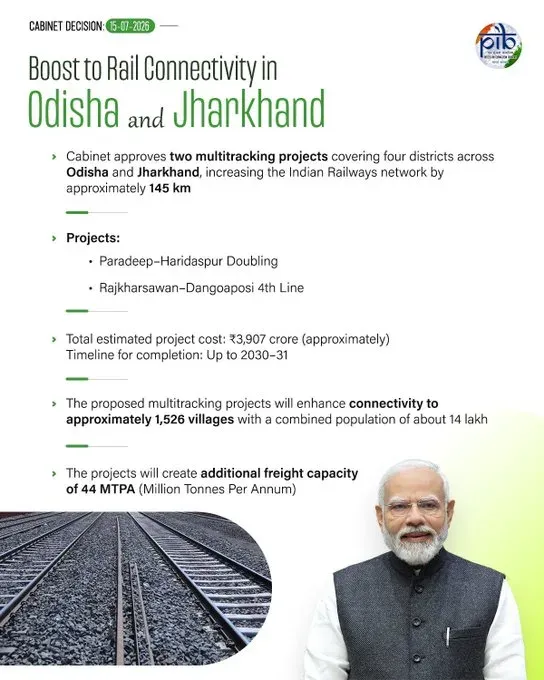
The Union Cabinet on 15 July 2026 cleared two multitracking railway projects across four districts in Odisha and Jharkhand, expanding the network by about 145 km at an estimated ₹3,907 crore, with a 2030–31 completion target.
Key Takeaways
The Union Cabinet approved two multitracking railway projects on 15 July 2026 .
The projects span four districts across Odisha and Jharkhand .
Combined network addition is approximately 145 km .
Total estimated project cost is ₹3,907 crore .
Both projects are targeted for completion by 2030–31 .
The approvals continue India's rail capacity push in the eastern mineral belt under the PM Gati Shakti framework.
The Union Cabinet, chaired by Prime Minister Narendra Modi, on Wednesday, 15 July 2026, approved two multitracking railway projects spanning four districts across Odisha and Jharkhand, adding approximately 145 km to the Indian Railways network at a combined estimated cost of ₹3,907 crore. Union Minister Dr. Jitendra Singh announced the approvals on X, flagging the projects as part of the broader Cabinet decisions of the day.
Context
The Cabinet clearance covers two separate multitracking projects that together will serve four districts — two each in Odisha and Jharkhand. Both states sit within India's mineral-rich eastern belt, where single-line or under-capacity rail sections have long been a bottleneck for freight movement. The projects are targeted for completion by 2030–31, aligning with the broader infrastructure timelines set under successive national rail plans.
Dr. Jitendra Singh, posting on X, wrote: 'Cabinet under PM Sh @NarendraModi approves two multitracking projects covering four districts across Odisha and Jharkhand, expanding the Indian Railways network by about 145 km.' He noted the total estimated outlay of approximately ₹3,907 crore.
Policy Backdrop
The approvals sit within a pattern of accelerated rail capacity augmentation that has defined infrastructure policy since 2014. The PM Gati Shakti National Master Plan, launched in 2021, created a coordinated multimodal planning framework under which railway multitracking and doubling projects in eastern India have received renewed priority.
Indian Railways has pursued track-doubling and multitracking across congested corridors — particularly those serving mineral-producing districts in Odisha and Jharkhand — to reduce logistics costs and increase line capacity for both passenger and freight traffic. The influence zone of the Eastern Dedicated Freight Corridor has further elevated the strategic importance of feeder-route upgrades in this region.
The Union Budget 2022–23 had announced a record capital outlay for Indian Railways with explicit focus on track doubling and multitracking, providing fiscal headroom for a pipeline of such projects to reach Cabinet stage in subsequent years.
Stakeholders and Impact
The immediate beneficiaries span a wide range: rail passengers in the four affected districts stand to gain from reduced congestion and potentially faster services, while freight operators — particularly those moving minerals, coal, and industrial goods from Jharkhand's mining zones and Odisha's port-linked corridors — will benefit from higher line capacity and shorter transit times.
Expanded rail infrastructure in these districts is also expected to reduce pressure on road networks, lower per-tonne logistics costs for industry, and support employment during the construction phase. State governments in both Odisha and Jharkhand have separately pursued rail connectivity improvements as a lever for industrial investment.
What's Next
With Cabinet approval secured, the next critical milestones will be tender finalisation and the launch of land-acquisition proceedings in the four districts. Progress on both fronts will be closely watched over the next two railway budget cycles, as land acquisition has historically been the primary source of delays in rail infrastructure projects across eastern India.
The 2030–31 completion target gives Indian Railways approximately five years to execute both projects. Any revision to the timeline or cost estimate will likely surface during mid-term reviews built into the project sanction framework. The approvals reinforce the government's stated intent to decongest rail arteries in the eastern mineral belt, a corridor that carries outsized strategic and economic weight for India's freight network.
Point of View
907 crore into a region that generates a disproportionate share of the country's mineral freight, the government is making a calculated bet that logistics-cost reduction will compound industrial competitiveness in both states. The 2030–31 timeline is ambitious but consistent with the project pipeline that the PM Gati Shakti framework was designed to accelerate. The real test — as with virtually every eastern rail project before it — will be how swiftly land acquisition proceeds in the four districts.
NationPress
14 Oct 2026
Frequently Asked Questions
Which states are covered by the Cabinet-approved railway multitracking projects in July 2026?
The two multitracking projects approved by the Union Cabinet on 15 July 2026 cover four districts across Odisha and Jharkhand .
What is the total cost of the Odisha and Jharkhand railway multitracking projects?
The total estimated cost of the two projects is approximately ₹3,907 crore , as announced following the Cabinet decision.
By when will the new railway multitracking projects in Odisha and Jharkhand be completed?
Both projects are expected to be completed by 2030–31 , according to the Cabinet approval.
How much new rail track will be added under these Cabinet-approved projects?
The two projects will expand the Indian Railways network by approximately 145 km across the four districts in Odisha and Jharkhand.
What is PM Gati Shakti and how does it relate to these railway projects?
PM Gati Shakti is the National Master Plan launched in 2021 to coordinate multimodal infrastructure planning; rail multitracking projects in eastern India's mineral belt, such as these approvals, fall within its broader framework for logistics-cost reduction and capacity augmentation.