CCEA clears 2 railway projects worth ₹3,907 crore for Odisha and Jharkhand
Synopsis
The CCEA has cleared two railway multi-tracking projects worth ₹3,907 crore for Odisha and Jharkhand — adding 145 km of line, unlocking 44 MTPA of extra freight capacity, and connecting 1,526 villages. For a mineral-heavy corridor dependent on coal and iron ore movement, this is a logistics upgrade with direct industrial consequences.
Key Takeaways
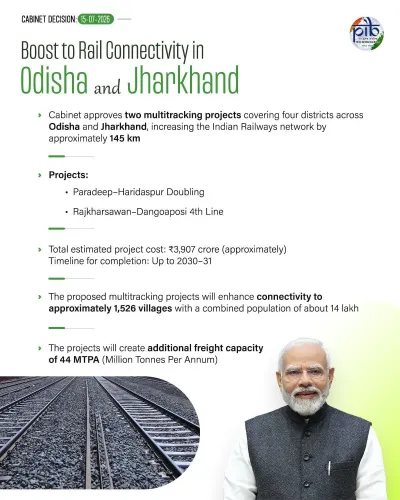
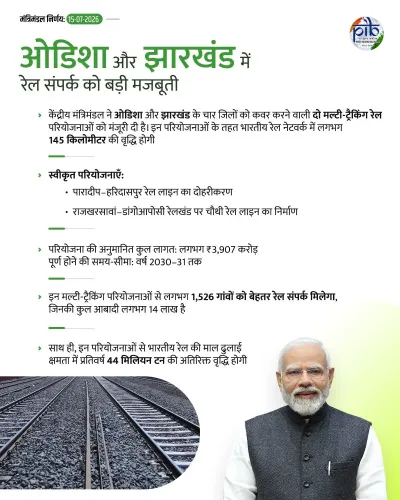
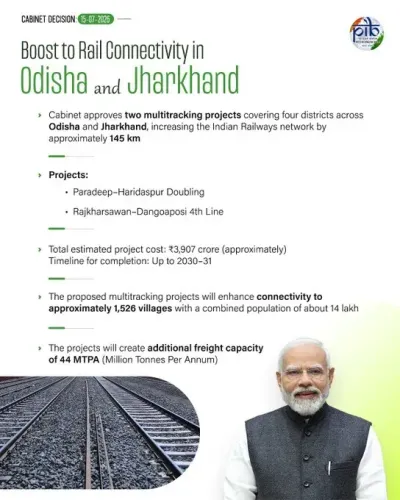
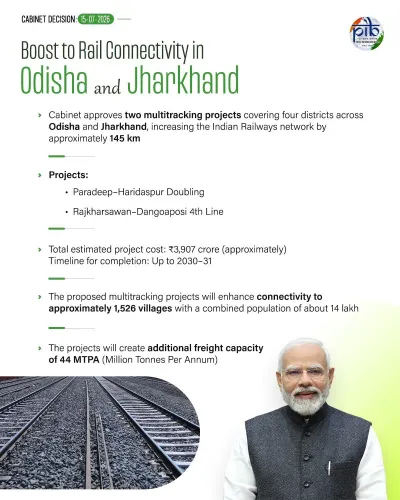
The CCEA approved two multi-tracking railway projects worth ₹3,907 crore on 15 July .
Projects span four districts across Odisha and Jharkhand , adding about 145 km to the Indian Railways network.
Rail connectivity will be extended to nearly 1,526 villages with a population of around 14 lakh .
Additional freight capacity of 44 MTPA expected; key commodities include coal, iron ore, and limestone.
Environmental benefits cited: reduction of 6 crore litres of oil imports and 29 crore kg of CO2 emissions.
Projects are planned under the PM-Gati Shakti National Master Plan .
The Cabinet Committee on Economic Affairs (CCEA), chaired by Prime Minister Narendra Modi, on Wednesday, 15 July approved two multi-tracking railway projects worth ₹3,907 crore spanning four districts across Odisha and Jharkhand. The projects will add approximately 145 km to the existing Indian Railways network, boosting both freight capacity and passenger connectivity in a mineral-rich corridor.
Key Developments
According to the Cabinet communiqué, the multi-tracking works will enhance rail connectivity to nearly 1,526 villages with a combined population of around 14 lakh. The expanded network will also improve access to notable tourist and religious destinations, including the Lalitgiri Buddhist Complex, Shree Baladevjew Temple, and Meghahatuburu Hills.
The two projects are planned under the PM-Gati Shakti National Master Plan, which focuses on integrated multi-modal connectivity and logistics efficiency through coordinated planning and stakeholder consultations.
Freight and Commodity Impact
The CCEA described both corridors as essential freight arteries for commodities including coal, iron ore, dolomite, limestone, and gypsum. The capacity augmentation is projected to generate additional freight traffic of 44 million tonnes per annum (MTPA) — a significant uplift for eastern India's industrial supply chains.
This comes amid sustained government emphasis on shifting bulk cargo from road to rail, a strategy aimed at reducing logistics costs and easing highway congestion in the region.
Environmental and Energy Benefits
The Cabinet communiqué highlighted that rail's inherent energy efficiency would help India meet its climate commitments. Specifically, the projects are expected to reduce oil imports by 6 crore litres and cut CO2 emissions by 29 crore kg — an environmental offset described as equivalent to planting 1 crore trees.
What the Government Said
The official communiqué stated that the projects align with the government's vision of comprehensive regional development, aimed at making communities in the area self-reliant — or 'Atmanirbhar' — by expanding employment and self-employment opportunities. The CCEA noted that increased line capacity would 'significantly enhance mobility, resulting in improved operational efficiency and service reliability for Indian Railways.'
What Comes Next
With Cabinet clearance secured, the projects move to detailed execution planning. Once operational, the upgraded corridors are expected to provide seamless connectivity for the movement of people, goods, and services across the two states. Industry observers will watch whether disbursements and construction timelines hold, given the historically uneven pace of railway infrastructure delivery in eastern India.
Point of View
907 crore sanction is strategically sound on paper — eastern India's mineral corridors are chronically under-railed relative to freight demand. But the real question is execution velocity. Indian Railways has a well-documented gap between Cabinet approvals and ground-level completion, particularly in forested, tribal-belt terrain where land acquisition and environmental clearances routinely stall timelines. The 44 MTPA freight projection is credible only if the multi-tracking is delivered on schedule — something that past corridor upgrades in Odisha and Jharkhand have struggled to guarantee. The PM-Gati Shakti framing adds coordination architecture, but it does not by itself resolve the on-ground bottlenecks that have historically plagued eastern railway expansion.
NationPress
14 Oct 2026
Frequently Asked Questions
What are the two railway projects approved by the CCEA for Odisha and Jharkhand?
The CCEA approved two multi-tracking railway projects worth ₹3,907 crore on 15 July, covering four districts across Odisha and Jharkhand. The projects will add approximately 145 km to the Indian Railways network and are planned under the PM-Gati Shakti National Master Plan.
How many villages will benefit from these railway projects?
The multi-tracking projects will enhance rail connectivity to nearly 1,526 villages with a combined population of around 14 lakh across the two states.
What is the freight capacity impact of these projects?
The capacity augmentation is projected to generate additional freight traffic of 44 million tonnes per annum (MTPA). Key commodities transported through these corridors include coal, iron ore, dolomite, limestone, and gypsum.
What are the environmental benefits cited by the government?
According to the Cabinet communiqué, the projects will reduce oil imports by 6 crore litres and cut CO2 emissions by 29 crore kg — an offset described as equivalent to planting 1 crore trees — by shifting freight from road to the more energy-efficient rail mode.
Which tourist and religious sites will gain improved connectivity?
The expanded rail network will improve access to the Lalitgiri Buddhist Complex, Shree Baladevjew Temple, and Meghahatuburu Hills, among other destinations across the region.