Jal Shakti Minister Paatil flags Navsari water drive
Synopsis
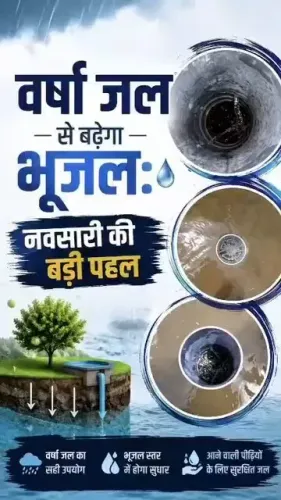
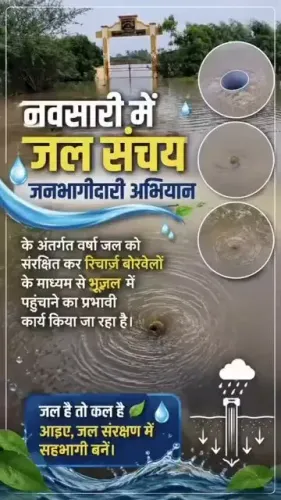
Union Jal Shakti Minister C. R. Paatil on 15 July 2026 highlighted the 'Jal Sanchay Jan Bhagidari' community water conservation campaign in Navsari district, Gujarat, framing village-level rainwater harvesting as a step toward a water self-reliant India under PM Modi's guidance.
Key Takeaways
Union Jal Shakti Minister C.
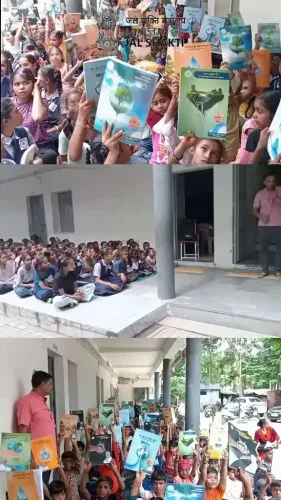
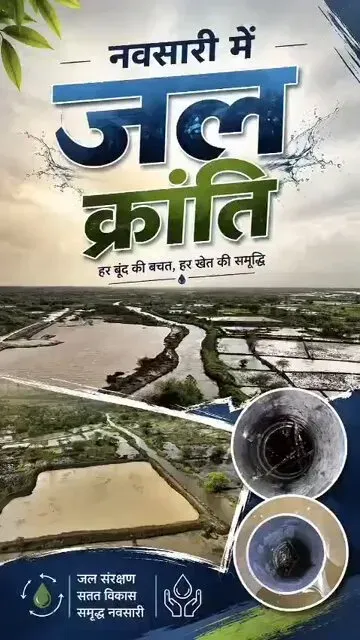
Paatil posted on 15 July 2026 about the Jal Sanchay Jan Bhagidari campaign active in villages of Gandevi taluka, Navsari district, Gujarat .
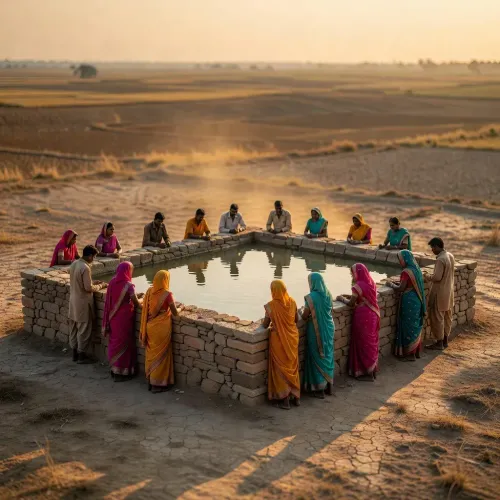
The campaign aims to harvest every drop of rainwater through community participation, framed as a jan andolan (people's movement).
The initiative is backed by a broader policy stack including the Jal Shakti Abhiyan (2019), Jal Jeevan Mission (2019), and Atal Bhujal Yojana (2018–19).
Paatil linked local village-level action to the national Viksit Bharat goal of water self-reliance.
The minister attributed the drive's direction to Prime Minister Narendra Modi and closed with the slogan Jal hai toh kal hai — 'If there is water, there is tomorrow.'
Union Jal Shakti Minister C. R. Paatil on Wednesday, 15 July 2026 highlighted the ongoing 'Jal Sanchay Jan Bhagidari' campaign running across villages in Gandevi taluka, Navsari district, Gujarat, calling it a foundational step toward a water self-reliant India under the guidance of Prime Minister Narendra Modi.
Context
Posting in Hindi, Paatil wrote that the resolve to turn water conservation into a jan andolan (people's movement) is now visibly taking shape village by village across Gujarat. He described the campaign as 'not merely a water conservation effort, but a strong foundation for the secure future of coming generations.' The minister closed with the widely used conservation slogan: Jal hai toh kal hai — 'If there is water, there is tomorrow.'
The Jal Sanchay Jan Bhagidari initiative is a community-participation drive promoted by the Jal Shakti Ministry to harvest rainwater and recharge aquifers. Its core premise is that durable water security requires active ownership by local communities, not just government infrastructure alone.
Policy Backdrop
The campaign sits within a layered policy architecture built since 2018–19. The Atal Bhujal Yojana, rolled out in water-stressed states including Gujarat, focuses on improving groundwater management through community-level participation. The Jal Shakti Abhiyan, launched in 2019, extended rainwater harvesting and groundwater recharge efforts to over 1,000 blocks nationwide, with Gujarat among the priority states.
The Jal Jeevan Mission, also announced in 2019, complements these efforts by emphasising source sustainability alongside the delivery of functional household tap connections to rural homes. Together, these schemes form the central government's integrated response to India's long-term groundwater stress.
Stakeholders and Impact
The most direct beneficiaries are rural households in Navsari district's Gandevi taluka, a region in southern Gujarat. Community-led harvesting structures — check-dams, farm ponds, and recharge wells — built under such campaigns reduce dependence on erratic monsoon cycles and deepen local resilience against drought years.
Gujarat has historically been a testing ground for decentralised water harvesting, with check-dam networks developed over decades serving as a model cited in national policy discussions. Paatil, as a former BJP Gujarat state president, brings direct administrative familiarity with the state's water landscape to his role as the Union minister overseeing these programmes.
What's Next
The monsoon season is the critical window for rainwater harvesting campaigns, making mid-July a strategically significant moment for such public mobilisation. Policymakers and district administrations in Navsari are expected to track groundwater recharge levels in participating villages as the season progresses. The Jal Shakti Ministry may use district-level outcomes from campaigns like this to inform replication decisions in other states during upcoming review cycles. The broader Viksit Bharat framework, referenced in the minister's post, positions water self-reliance as a prerequisite for India's long-term development ambitions.
Point of View
When water conservation messaging carries the most public resonance. By anchoring a local taluka-level campaign to PM Modi's national vision and the Viksit Bharat framework, the ministry reinforces a pattern of connecting grassroots implementation to top-down political credit. Gujarat's established check-dam culture gives the campaign credibility, but the absence of verifiable outcome data means the post functions more as a mobilisation signal than a progress report. The broader arc points toward the Jal Shakti Ministry using monsoon-season visibility events to build the case for scaling community-participation models to other water-stressed states.
NationPress
14 Oct 2026
Frequently Asked Questions
What is the Jal Sanchay Jan Bhagidari campaign?
The Jal Sanchay Jan Bhagidari campaign is a community-participation initiative promoted by the Union Jal Shakti Ministry to harvest rainwater and recharge groundwater aquifers, with citizens and local bodies actively involved in building and maintaining water conservation structures.
Where is the Jal Sanchay Jan Bhagidari campaign being carried out in Gujarat?
As of July 2026, the campaign is active across multiple villages in Gandevi taluka of Navsari district in southern Gujarat, as highlighted by Union Jal Shakti Minister C. R. Paatil.
What is Jal Shakti Abhiyan and how is it related?
Jal Shakti Abhiyan is a nationwide water conservation campaign launched in 2019 covering over 1,000 blocks across India, including in Gujarat. It forms part of the policy foundation on which community drives like Jal Sanchay Jan Bhagidari are built.
Who is C. R. Paatil and what is his role in water policy?
C. R. Paatil is the Union Minister of Jal Shakti and a senior BJP leader who previously served as BJP Gujarat state president. He oversees the implementation of national water schemes including the Jal Jeevan Mission, Jal Shakti Abhiyan, and Atal Bhujal Yojana.
What does 'Jal hai toh kal hai' mean?
'Jal hai toh kal hai' is a Hindi conservation slogan that translates to 'If there is water, there is tomorrow,' widely used in Indian government water awareness campaigns to underscore the link between water security and the future.