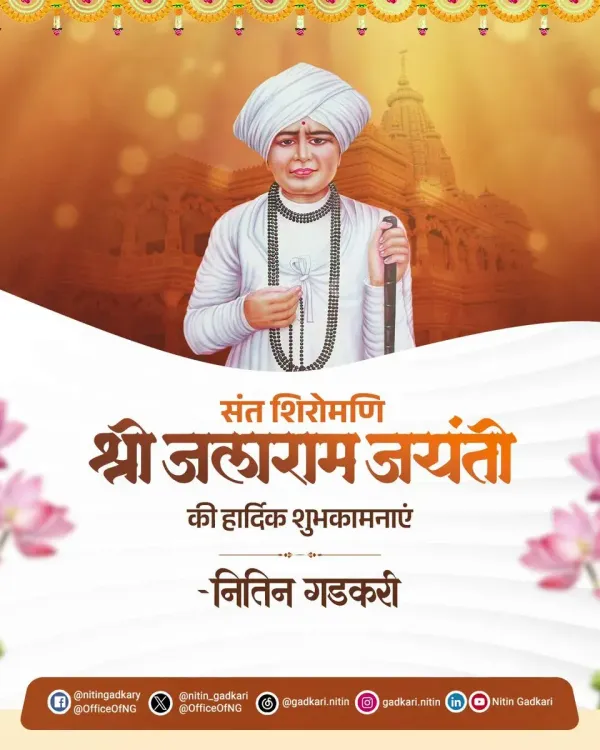
Gadkari Greets Nation on Jalaram Jayanti
Synopsis
Union Minister Nitin Gadkari extended heartfelt greetings on Jalaram Jayanti on 16 November 2026, honouring Gujarat saint Jalaram Bapa — born 1799 in Virpur — whose life of perpetual charity and service to the hungry continues to inspire millions across India.
Key Takeaways
Union Minister Nitin Gadkari posted Jalaram Jayanti greetings on 16 November 2026 .
Shri Jalaram Bapa was born in 1799 in Virpur, Gujarat and is revered as Sant Shiromani — the supreme saint.
Jalaram Bapa is celebrated for his lifelong practice of sadavrat — free, perpetual community feeding.
His shrine at Virpur attracts millions of devotees and operates a round-the-clock community kitchen.
Senior BJP leaders routinely mark major saint jayantis on social media as part of cultural outreach.
On the auspicious occasion of Jalaram Jayanti, Union Road Transport and Highways Minister Nitin Gadkari extended warm greetings to devotees across the country, honouring the legacy of the beloved Gujarati saint known as Sant Shiromani — the crown jewel of saints.
Gadkari's message, posted on Monday, 16 November 2026, saluted Shri Jalaram Bapa with the phrase 'Sant Shiromani Shri Jalaram Jayanti ki hardik shubhkamnayein' — 'heartfelt greetings on the Jayanti of the supreme saint Shri Jalaram.' The post accompanied a video marking the occasion.
Who was Jalaram Bapa?
Shri Jalaram Bapa, born in 1799 in Virpur, Gujarat, devoted his life to feeding the hungry and serving travellers — a practice he called sadavrat, or perpetual charity. His shrine at Virpur draws millions of devotees every year, and his memory is kept alive through community kitchens that serve free meals around the clock, a living embodiment of the compassion he preached.
Revered across Gujarat and among Gujarati communities worldwide, Jalaram Bapa occupies a special place in the devotional landscape of western India. His jayanti is observed with prayers, processions, and mass community feeding programmes.
BJP leaders and the culture of saint-jayanti outreach
Gadkari's greeting follows a well-established pattern among senior BJP leaders and Union ministers, who routinely acknowledge major saint jayantis and festivals on social media as part of broad cultural and community outreach. For a party with deep roots in Gujarat — the birthplace of both Jalaram Bapa and several of India's most prominent national leaders — paying tribute to the saint carries particular resonance.
No policy announcements or follow-up events were indicated alongside the greeting. The post stands as a moment of public reverence for one of Hinduism's most beloved figures of charitable service.
In a country where a saint's centuries-old vow to feed every stranger still inspires millions of community meals daily, remembering Jalaram Bapa is not merely ceremonial — it is a reminder of what endures.
Point of View
As both the birthplace of Jalaram Bapa and the home state of the party's dominant leadership, makes this tribute particularly resonant. Such messaging costs nothing politically and builds considerable goodwill among Gujarati and broader Hindu devotee communities. No policy dimension attaches to this post, but it reflects a wider pattern of using digital platforms to maintain cultural presence between elections.
NationPress
16 Nov 2026
Frequently Asked Questions
Who is Jalaram Bapa?
Jalaram Bapa was a Hindu saint born in 1799 in Virpur, Gujarat , celebrated for his selfless charity and practice of feeding every hungry person who came to his door. He is widely revered as Sant Shiromani — the crown jewel of saints — especially among Gujarati devotees.
What is Jalaram Jayanti?
Jalaram Jayanti is the birth anniversary of Saint Jalaram Bapa. It is observed with prayers, community processions, and large-scale free-meal programmes inspired by his lifelong commitment to feeding the hungry.
Why did Nitin Gadkari post Jalaram Jayanti wishes?
As a senior BJP leader and Union Minister, Gadkari extended greetings as part of the standard cultural outreach that Indian ministers and BJP leaders routinely undertake on major saint jayantis and Hindu festivals.
Where is the main shrine of Jalaram Bapa?
The principal shrine of Jalaram Bapa is located in Virpur , in Gujarat , India. It draws millions of pilgrims annually and runs a free community kitchen around the clock in keeping with the saint's legacy.