Gadkari Hails India's Youth as Nation-Builders on IYD

Synopsis
On International Youth Day, Union Minister Nitin Gadkari reframed India's youth as 'nation-builders of today', urging ambition matched by responsibility and dreams matched by action — a pointed upgrade from the standard 'leaders of tomorrow' political formula.
Key Takeaways
International Youth Day is observed globally on 12 August each year under a United Nations designation.
Union Minister Nitin Gadkari called India's youth 'nation-builders of today', explicitly rejecting the 'leaders of tomorrow' framing.
His message called for ambition paired with responsibility, dreams with action, and courage with conviction.
India's National Youth Policy (revised 2014) similarly repositioned youth as active agents in national development.
India holds one of the world's largest youth populations, a demographic frequently described in policy circles as a 'demographic dividend'.
India's vast young population — one of the largest on earth — received a pointed reminder on International Youth Day that the future is already here. Union Road Transport and Highways Minister Nitin Gadkari marked the 12 August observance with a message that reframed the familiar 'leaders of tomorrow' trope into something more urgent: a call to act today.
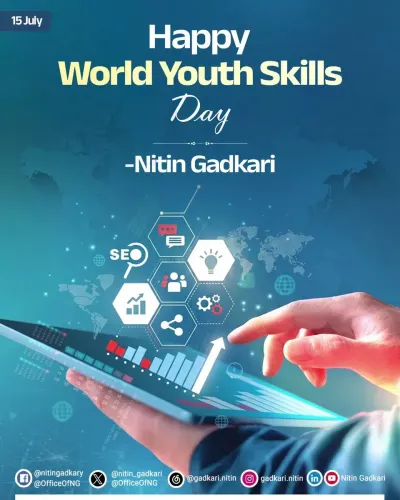
Posting on International Youth Day 2026, Gadkari wrote: 'India's youth are not merely the leaders of tomorrow; they are the nation-builders of today. May their ambition be matched by responsibility, their dreams by action, and their courage by conviction.'
Why 'Nation-Builders of Today' Lands Differently
The phrase is a deliberate pivot. For decades, political messaging has parked India's youth in the future tense — patient, waiting, promising. Gadkari's framing collapses that distance. In a country where a significant share of the population falls under the age of 35, the distinction between 'future leader' and 'present builder' is not rhetorical — it carries real policy weight around employment, skilling, and civic participation. The sentiment echoes the thrust of India's National Youth Policy (revised 2014), which repositioned young Indians as active agents in national development rather than passive beneficiaries of government schemes. The triad Gadkari invokes — ambition paired with responsibility, dreams with action, courage with conviction — maps neatly onto that policy architecture of empowerment through accountability.The Demographic Dividend That Demands Delivery
India's youth demographic is routinely cited in policy circles as a structural advantage — a 'demographic dividend' that could power economic growth for decades if channelled into productive employment and education. The pressure, however, runs both ways: the dividend only pays out if skilling and job-creation keep pace with the sheer scale of young people entering the workforce each year. International Youth Day, designated by the United Nations and observed every 12 August, serves as an annual checkpoint for governments worldwide to signal commitment to youth issues. In India, it has increasingly become a platform for ministers across portfolios to anchor messaging around skill development, entrepreneurship, and civic responsibility. Gadkari's post, brief as it is, lands squarely in that tradition — but the energy in his closing line gives it a forward edge. Ambition without responsibility stalls. Dreams without action fade. Courage without conviction collapses. The implicit ask is clear: step up now, not later.Point of View
But the rhetorical shift from 'tomorrow's leaders' to 'today's nation-builders' is worth noting — it aligns with the BJP-led government's consistent effort to tie youth identity to active economic participation rather than deferred promise. The framing reinforces the policy logic behind skilling and employment initiatives without naming any specific scheme, keeping the message broad enough for maximum reach. It also reflects a wider pattern among senior ministers of using global observance days to reinforce domestic policy narratives. Whether the messaging translates into fresh programme announcements around youth employment will be the real measure of its intent.
NationPress
12 Aug 2026
Frequently Asked Questions
When is International Youth Day celebrated?
International Youth Day is observed every year on 12 August , as designated by the United Nations to highlight youth issues and contributions worldwide.
What did Nitin Gadkari say on International Youth Day 2026?
Nitin Gadkari said India's youth are 'not merely the leaders of tomorrow' but 'the nation-builders of today', calling for their ambition to be matched by responsibility and their dreams by action.
What is India's National Youth Policy?
India's National Youth Policy , revised in 2014 , focuses on youth empowerment through education, skill development, and employment, framing young Indians as active participants in national development.
Why is India's youth population significant?
India has one of the largest youth populations in the world, which policy experts describe as a 'demographic dividend' — a potential engine for economic growth if supported by adequate skilling and job creation.
What is Nitin Gadkari's current role?
Nitin Gadkari serves as Union Minister of Road Transport and Highways and is a senior BJP leader who previously served as the party's national president.