Gadkari Hails Modi Govt's 12-Year Youth Empowerment Record
Synopsis
Union Minister Nitin Gadkari marked 12 years of the Modi government's youth policy on 13 June 2026, citing Skill India, PMKVY, Startup India, MY Bharat, Rozgar Melas, and Khelo India as the pillars transforming Amrit Peedhi from learners to leaders toward Viksit Bharat 2047.
Key Takeaways
Union Minister Nitin Gadkari posted on 13 June 2026 under #12YearsOfYuvaShakti , marking 12 years of the Modi government's youth agenda.
Skill India and PMKVY , launched in July 2015 , form the flagship skilling and certification backbone of the government's employability push.
Startup India , announced in January 2016 , provides tax benefits and compliance relief to encourage young entrepreneurs and job creators.
Khelo India , relaunched in 2017 , targets grassroots sports development and talent identification at the school and community level.
The MY Bharat portal, introduced in 2023 , serves as a unified digital platform for youth civic engagement and volunteering.
All initiatives are positioned under the Viksit Bharat vision of transforming India into a developed economy by 2047 .
Union Road Transport and Highways Minister Nitin Gadkari on Saturday, 13 June 2026 credited the Narendra Modi government's 12 years in office with fundamentally reshaping India's youth economy, highlighting flagship schemes spanning skill development, entrepreneurship, sports, and civic engagement as pillars of a confident new generation.
Context
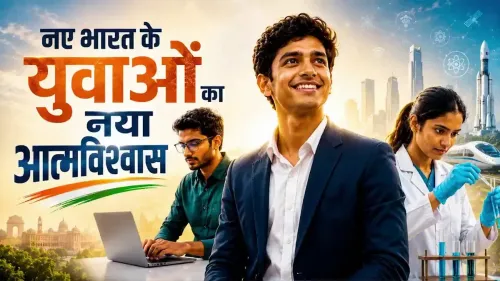
Posting under the hashtag #12YearsOfYuvaShakti, Gadkari described India's youth — referred to as Amrit Peedhi, or the 'nectar generation' — as having moved 'from learning to leading' over the past decade-plus. The post arrives as the BJP marks 12 years of continuous governance at the Centre, with youth policy forming a central plank of the party's outreach messaging.
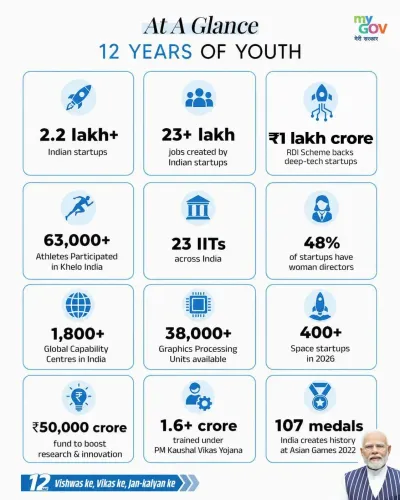
Gadkari specifically named Skill India, PMKVY, Startup India, MY Bharat, Rozgar Melas, and Khelo India as instruments through which the government has channelled the aspirations of young Indians into measurable economic and social outcomes.
Policy Backdrop
The programmes Gadkari cited span more than a decade of youth-focused policymaking. Skill India was launched in July 2015 as an umbrella mission to train millions of Indians in market-relevant skills; its flagship certification arm, Pradhan Mantri Kaushal Vikas Yojana (PMKVY), has been the primary vehicle for short-term, industry-aligned skilling across sectors.
Startup India, announced in January 2016, created a framework of tax incentives, simplified compliance, and funding access intended to convert young Indians from job-seekers into job creators. Khelo India, relaunched in 2017, extended the government's youth agenda into grassroots sports infrastructure, aiming to identify and nurture athletic talent at the school and community level.
The MY Bharat portal, introduced in 2023, added a digital layer to youth engagement by providing a unified platform for volunteering and civic participation. Rozgar Melas — government-organised job fairs — have been used to facilitate direct entry into formal employment, particularly in public-sector roles.
Stakeholders and Impact
The overarching frame for all these initiatives is Viksit Bharat — the government's stated ambition to transform India into a fully developed economy by 2047, the centenary of independence. Gadkari's post explicitly links individual youth ambition to this national development milestone, a rhetorical pattern consistent with BJP's broader messaging on the demographic dividend.
India's youth population — among the largest in the world — represents both the primary beneficiary and the central political audience for these schemes. Job seekers, aspiring entrepreneurs, student athletes, and first-time formal-economy entrants are the constituencies these programmes are designed to reach.
What's Next
Attention will now turn to the next Union Budget's allocations for Skill India and Khelo India, and whether fresh targets for Rozgar Melas in 2026-27 are announced. The 12-year milestone messaging is likely to intensify as the BJP frames its governance record ahead of upcoming electoral cycles, with youth empowerment and formal employment remaining key battlegrounds of political credibility.
Point of View
With youth policy chosen as a high-visibility, cross-demographic frame. By bundling skilling, entrepreneurship, sports, and digital civic engagement under a single 'Amrit Peedhi' narrative, the party is attempting to make the demographic dividend a BJP brand asset ahead of future electoral cycles. The explicit linkage to Viksit Bharat 2047 extends the political promise well beyond any single term, tying the party's credibility to a generational outcome. For the opposition, the challenge will be to contest outcomes — enrolment quality, placement rates, startup survival — rather than the programmes themselves, which have broad public recognition.
NationPress
22 Sept 2026
Frequently Asked Questions
What is Skill India and how does it help youth?
Skill India is a national mission launched in July 2015 to train millions of Indians in industry-relevant skills. Its flagship arm, PMKVY (Pradhan Mantri Kaushal Vikas Yojana) , provides short-term skill certification to improve the employability of young job seekers across sectors.
What is Startup India and who benefits from it?
Startup India is a government initiative announced in January 2016 that offers tax incentives, simplified regulatory compliance, and funding access to new businesses. It is designed to encourage young Indians to become entrepreneurs and job creators rather than solely job seekers.
What is Khelo India and what is its purpose?
Khelo India is a central government scheme relaunched in 2017 to develop grassroots sports infrastructure and identify athletic talent at the school and community level across India.
What is the MY Bharat portal?
MY Bharat is a unified digital platform introduced in 2023 to facilitate youth engagement, volunteering, and civic participation, giving young Indians a structured entry point into public life and government programmes.
What is Viksit Bharat and why is it mentioned alongside youth schemes?
Viksit Bharat is the Modi government's vision to transform India into a fully developed economy by 2047 , the centenary of independence. Youth skilling, entrepreneurship, and sports programmes are consistently framed as the human capital foundation required to achieve this long-term national development goal.