Gadkari Signs Bihar MoU: River Silt to Build Highways
Synopsis
India's road ministry and Bihar government signed an MoU on 3 November 2026 to desilit major rivers including the Ganga and Kosi, deploying 243 lakh cubic metres of extracted silt free-of-cost into 16 ongoing NHAI highway projects — turning a flood liability into highway fill.
Key Takeaways
MoU signed on 3 November 2026 between the Ministry of Road Transport and Highways and the Bihar government in New Delhi.
243 lakh cubic metres of free river silt to be used in 16 under-construction NHAI projects ; 835 lakh cubic metres proposed for 27 future projects .
Bihar currently has 39 NHAI projects (≈ 1,561 km , ₹58,340 crore ) under construction and 11 proposed projects (≈ 1,982 km , ₹1,85,200 crore ).
NHAI will lead desilting of rivers including the Ganga, Kosi, Gandak, Falgu and Bagmati using scientific methods.
The initiative aims to reduce highway construction costs, lower flood risk, revive river ecosystems, and limit extraction of natural topsoil.
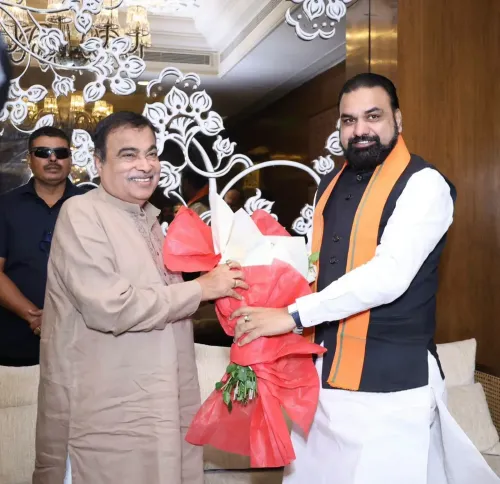
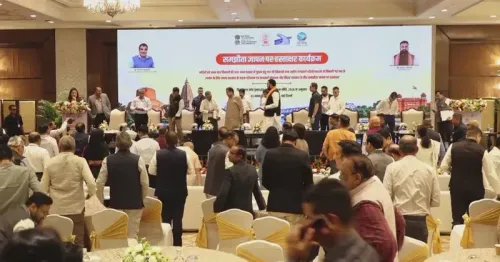
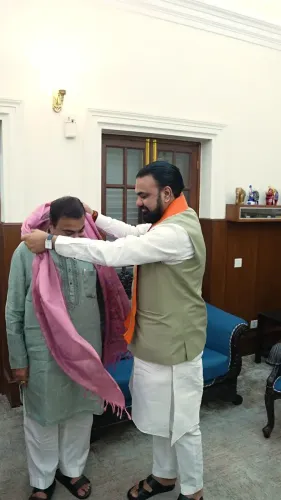
Bihar Chief Minister Samrat Choudhary and senior NHAI officials attended the signing ceremony alongside Gadkari.
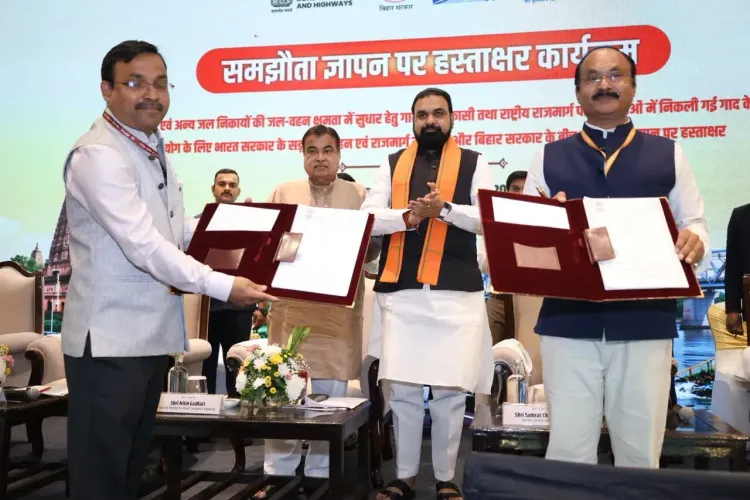
The silt choking Bihar's rivers — the same silt that swells the Ganga and the Kosi into seasonal monsters — is about to become the foundation of its highways. Union Road Transport and Highways Minister Nitin Gadkari on Tuesday, 3 November 2026 signed a landmark MoU between the Ministry of Road Transport and Highways and the Bihar government in New Delhi, setting up a first-of-its-kind framework to dredge Bihar's rivers and deploy that silt directly into national highway construction.
What the deal actually does — and why it matters for Bihar's floods
Bihar is, at its core, a river state. The Ganga, Kosi, Gandak, Falgu and Bagmati course through its plains, feeding its agriculture and culture for millennia. But unrelenting silt accumulation has steadily choked these channels — reducing their water-carrying capacity, worsening drainage, and amplifying the annual flood risk that devastates millions of families. The MoU directly targets that accumulation. NHAI will lead the desilting process using modern scientific methods, and the extracted material — instead of being dumped — will be channelled as free construction fill into highway projects across the state.
Gadkari framed the initiative in his post with a pointed line: 'जहां कल तक गाद बाढ़ की वजह थी, अब वही गाद बिहार के राजमार्गों की नींव बनेगी' ('Where silt was yesterday the cause of floods, that same silt will now become the foundation of Bihar's highways'). That pivot — from liability to asset — is the conceptual engine of the entire agreement.
The numbers: 243 lakh cubic metres now, 835 lakh cubic metres ahead
The scale is substantial. Under the MoU, 243 lakh cubic metres of free silt from rivers will be deployed across 16 currently under-construction NHAI projects in Bihar. Looking further ahead, an estimated 835 lakh cubic metres of silt is proposed for use in 27 future projects. That is not a rounding error — it is a structural shift in how Bihar's highway programme sources raw material.
The backdrop makes those numbers even more meaningful. Bihar currently has 39 NHAI projects under construction spanning approximately 1,561 km at a cost of ₹58,340 crore. A further 11 new projects covering roughly 1,982 km worth ₹1,85,200 crore are proposed. Highways of that ambition require enormous quantities of fill material — material that is now, at least partially, coming directly out of the state's riverbeds at no purchase cost.
Who was in the room — and what it signals politically
The signing ceremony brought together Bihar Chief Minister Samrat Choudhary (@samrat4bjp), NHAI Chairman Santosh Kumar Yadav, Director General Sudeep Chaudhary, NHIDCL MD Krishna Kumar, and Bihar government secretaries Pankaj Pal and Atul Kumar. Gadkari credited the initiative to the guidance of Prime Minister Narendra Modi.
The political geometry here is deliberate. Bihar is a perpetually pivotal state in national electoral arithmetic, and the Centre's infrastructure push there since 2014 — which includes approximately 29 new bridges being built across its major rivers — has been a consistent plank of the BJP-led alliance's outreach. An agreement that simultaneously promises flood relief and faster highways hits two of Bihar's most persistent voter concerns in one move.
The circular economy logic — and the environmental claim
Gadkari's ministry has pitched the MoU as an example of sustainable resource use: river ecosystems revived, highway construction costs reduced, extraction of natural topsoil curbed, and infrastructure timelines accelerated — all at once. The hashtags accompanying the post — #NadiSanjivani and #ScientificDesilting — signal that the government intends to brand this as a replicable model, potentially for other flood-prone river states.
The real test will be execution: whether NHAI's scientific desilting methods translate into measurable improvements in river flow, and whether the silt volumes actually reach project sites on schedule. Forty-three projects — current and proposed — are now watching the same riverbed.
Point of View
It extends his signature infrastructure-as-economic-engine narrative into ecological territory, framing desilting not as an environmental obligation but as a construction supply chain solution. Politically, the optics in Bihar — a state that has swung federal outcomes — are carefully calibrated: flood relief and highway connectivity are the two most tangible governance metrics for Bihar's electorate. The genuine test, however, lies in whether NHAI's scientific desilting translates into verifiable river-flow improvements and whether silt logistics match project timelines across all 43 current and proposed schemes.
NationPress
3 Nov 2026
Frequently Asked Questions
What is the Bihar river desilting MoU signed by Nitin Gadkari?
It is an agreement between the Union Ministry of Road Transport and Highways and the Bihar government to dredge silt from Bihar's major rivers and use that silt as free construction material in NHAI national highway projects across the state.
How much silt will be used in Bihar highway projects under this MoU?
243 lakh cubic metres of silt will be used across 16 currently under-construction NHAI projects, and an estimated 835 lakh cubic metres is proposed for 27 future projects.
Which rivers in Bihar will be desilted under this agreement?
The Ganga, Kosi, Gandak, Falgu and Bagmati are among the rivers cited for desilting under the MoU.
How many NHAI projects are currently under construction in Bihar?
39 NHAI projects spanning approximately 1,561 km at a total cost of ₹58,340 crore are currently under construction in Bihar, with 11 more projects covering 1,982 km worth ₹1,85,200 crore proposed.
How does desilting rivers help reduce Bihar's floods?
Removing accumulated silt increases a river's water-carrying capacity, improves drainage, and lowers the risk of seasonal flooding by allowing channels to hold and move greater volumes of water.