Gadkari pays tribute to freedom fighter Nana Patil on birth anniversary
Synopsis
Union Minister Nitin Gadkari saluted Maharashtrian freedom fighter Krantisinh Nana Patil on his birth anniversary, honouring the leader who ran a Parallel Government in Satara during the 1942 Quit India Movement.
Key Takeaways
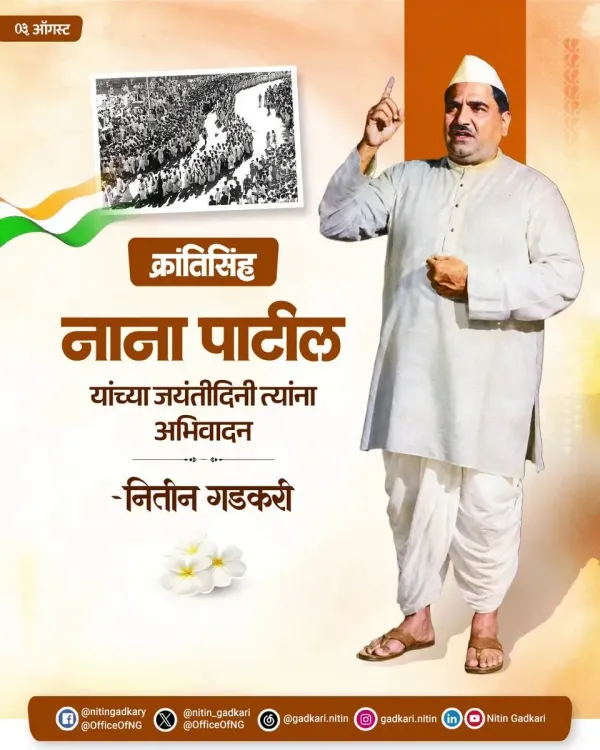
Union Minister Nitin Gadkari posted a birth-anniversary tribute to freedom fighter Krantisinh Nana Patil on 3 August 2026 .
Nana Patil (1900–1976) was a Maharashtrian independence leader known for establishing a Parallel Government in Satara during the 1942 Quit India Movement .
His title 'Krantisinh' translates to 'Lion of the Revolution,' reflecting his standing among Maharashtra's most celebrated freedom fighters.
The Satara Parallel Government administered justice, revenue, and education outside British control — a rare feat of organised grassroots resistance.
Commemorating regional independence icons is a well-established practice among Indian political leaders, particularly on birth and death anniversaries.
On the birth anniversary of Krantisinh Nana Patil, Union Road Transport and Highways Minister Nitin Gadkari paid his respects to the legendary Maharashtrian freedom fighter, honouring a man who once ran a government within a government to defy British rule.
Posting on Monday, 3 August 2026, Gadkari wrote in Marathi: 'स्वातंत्र्यसैनिक 'क्रांतिसिंह' नाना पाटील यांच्या जयंतीदिनी त्यांना अभिवादन' — 'Salutations to freedom fighter 'Krantisinh' Nana Patil on his birth anniversary.'
The man who built a parallel republic in Satara
Nana Patil (1900–1976), known by the title 'Krantisinh' — meaning 'Lion of the Revolution' — was one of the most audacious figures of the 1942 Quit India Movement. While most resistance was crushed swiftly by colonial authorities, Patil did something almost without precedent: he established a functioning Parallel Government in the Satara district of present-day Maharashtra, administering justice, collecting revenue, and running schools entirely outside British jurisdiction.
That shadow administration held for years, a living proof that Indian self-rule was not merely an aspiration but a practical reality — even under occupation. Patil's legacy endures as a symbol of grassroots defiance, rooted not in elite nationalism but in rural Maharashtra's will to govern itself.
Why Maharashtra's freedom icons draw national attention
For senior BJP leaders like Gadkari — himself a product of Maharashtra's political culture — commemorating figures such as Nana Patil is both an act of genuine regional pride and a reminder of the state's outsized contribution to India's independence struggle. Such tributes are a consistent feature of Indian political life, with leaders across the spectrum marking the anniversaries of regional icons who might otherwise be overshadowed in a national narrative dominated by a handful of names.
Patil's story, in particular, carries a democratic charge: a farmer-leader who proved that ordinary people could build institutions, not just fight battles. That legacy does not fade with a calendar date.
Point of View
Maharashtra's large and politically significant rural base. For the BJP, associating with figures like Nana Patil, who represent grassroots anti-colonial resistance rather than elite nationalism, broadens the party's historical legitimacy beyond its usual ideological anchors. The Parallel Government legacy also carries a subtle democratic resonance: it frames self-governance as a lived tradition, not just a constitutional gift. Such commemorations rarely carry immediate policy weight, but they are never entirely without political texture.
NationPress
3 Aug 2026
Frequently Asked Questions
Who was Nana Patil, the freedom fighter?
Nana Patil (1900–1976), also known as Krantisinh , was a Maharashtrian independence leader famous for establishing a Parallel Government in Satara during the 1942 Quit India Movement , administering justice and civic functions entirely outside British control.
What was the Satara Parallel Government?
The Satara Parallel Government was an alternative administration set up by Nana Patil in Satara district , Maharashtra, during the 1942 Quit India Movement . It ran courts, schools, and revenue collection in defiance of British colonial authority.
Why did Nitin Gadkari pay tribute to Nana Patil?
Nitin Gadkari posted the tribute on Nana Patil's birth anniversary on 3 August 2026 , in keeping with the common Indian political practice of honouring regional freedom fighters on their commemorative dates.
What does 'Krantisinh' mean?
'Krantisinh' is a Marathi honorific meaning 'Lion of the Revolution.' It was given to Nana Patil in recognition of his fierce and organised resistance against British rule in Maharashtra.
What is Nitin Gadkari's political background?
Nitin Gadkari is a senior BJP leader, former BJP national president, and currently serves as Union Minister of Road Transport and Highways . He is one of Maharashtra's most prominent national-level politicians.