Gadkari pays tribute to ISRO legend Prof. Satish Dhawan on birth anniversary
Synopsis
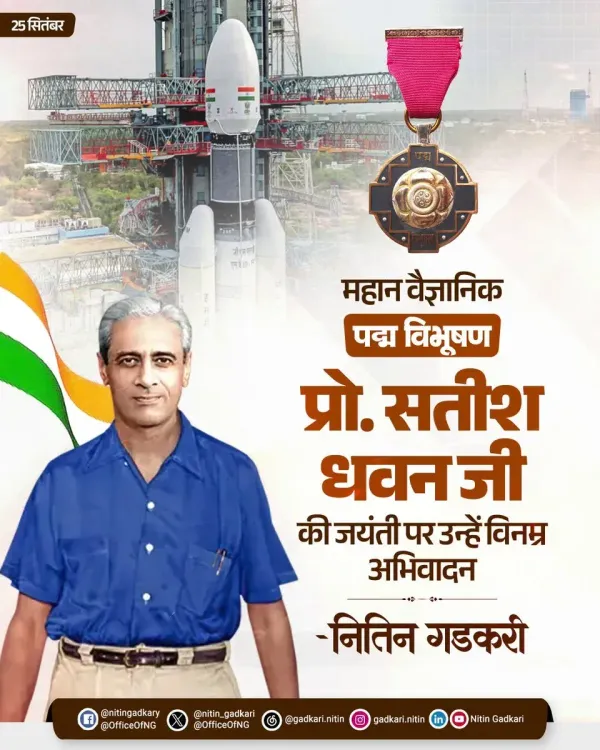
Union Minister Nitin Gadkari paid tribute to Prof. Satish Dhawan, former ISRO chairman and aerospace pioneer, on his birth anniversary on 25 September, calling his contributions to science invaluable for India.
Key Takeaways
Nitin Gadkari posted a tribute to Prof.
Satish Dhawan on his birth anniversary, 25 September 2026 .
Satish Dhawan served as ISRO chairman from 1972 to 1984 , shaping India's early space programme.
Dhawan was a pioneering aerospace engineer with expertise in rocket propulsion and fluid dynamics .
ISRO was established in 1969 under the Department of Space, following the Indian National Committee for Space Research founded in 1962 .
Gadkari called Dhawan's contribution to science for the nation 'priceless' ( amulya ).
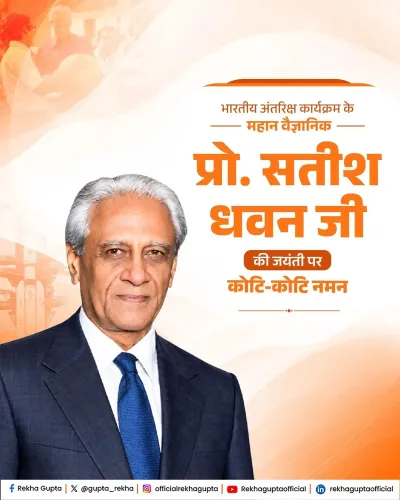
On the birth anniversary of one of India's greatest aerospace pioneers, Union Road Transport and Highways Minister Nitin Gadkari on Friday, 25 September 2026 paid tribute to Prof. Satish Dhawan, former chairman of ISRO, calling his contribution to science invaluable and irreplaceable.
Posting on X in Hindi, Gadkari wrote: 'महान भारतीय रॉकेट वैज्ञानिक, इसरो के भूतपूर्व अध्यक्ष प्रो. सतीश धवन जी की जयंती पर उन्हें विनम्र अभिवादन' — 'Humble greetings to the great Indian rocket scientist and former ISRO chairman Prof. Satish Dhawan on his birth anniversary. His contribution to science for the nation is priceless.'
The architect of India's launch vehicle programme
Prof. Satish Dhawan served as chairman of the Indian Space Research Organisation (ISRO) from 1972 to 1984 — a tenure that proved transformative for India's space ambitions. A distinguished aerospace engineer specialising in rocket propulsion and fluid dynamics, Dhawan steered ISRO through its most formative years, laying the institutional and technical foundations that would eventually power satellites, planetary probes, and the world-recognised launch vehicles India operates today.
Under his leadership, ISRO evolved from a fledgling scientific committee into a credible national space agency. ISRO itself had been formally established in 1969 under the Department of Space, building on the Indian National Committee for Space Research that began operating in 1962. Dhawan's steady hand shaped that evolution into something durable.
A pattern of honouring India's scientific heritage
Gadkari's tribute is part of a wider, consistent practice among Indian ministers and political leaders of marking the birth anniversaries of scientists and national figures on social media — a public acknowledgement that connects modern governance with the intellectual legacy that built independent India's institutions. For a nation whose space programme now draws global attention, pausing to name its pioneers carries genuine resonance.
Dhawan's legacy endures not merely in textbooks but in the design philosophy and organisational culture of ISRO — an institution that today competes with the world's best. Every rocket that clears the launchpad at Sriharikota carries, in some measure, the imprint of his work.
Point of View
Invoking Dhawan connects the party's 'Viksit Bharat' narrative to a lineage of institutional excellence that predates it. Such posts also keep public attention on the Department of Space ahead of any upcoming mission milestones or policy announcements. The consistency of this pattern across the political class reflects a broader consensus that scientific legacy is potent symbolic capital in contemporary Indian politics.
NationPress
25 Sept 2026
Frequently Asked Questions
Who was Prof. Satish Dhawan?
Prof. Satish Dhawan was a pioneering Indian aerospace engineer who served as chairman of ISRO from 1972 to 1984. He made foundational contributions to rocket propulsion and fluid dynamics and is widely regarded as a key architect of India's space programme.
When is Satish Dhawan's birth anniversary?
Satish Dhawan's birth anniversary falls on 25 September , which is when Nitin Gadkari and other leaders typically pay public tributes to him each year.
Why did Nitin Gadkari post about Satish Dhawan?
Union Minister Nitin Gadkari posted a tribute on X to mark the birth anniversary of Prof. Satish Dhawan, calling his contribution to science for India invaluable. Indian ministers regularly mark such anniversaries on social media.
What is ISRO and when was it established?
ISRO, the Indian Space Research Organisation, is India's national space agency. It was formally established in 1969 under the Department of Space, building on scientific committee work that began in 1962 .
What did Satish Dhawan contribute to India's space programme?
During his tenure as ISRO chairman from 1972 to 1984, Satish Dhawan transformed ISRO into a credible national space agency, laying the technical and institutional foundations for India's satellite and launch vehicle programmes.