Gadkari pays tribute to Kanhoji Angre on death anniversary
Synopsis
Union Minister Nitin Gadkari paid homage to Sarkhel Kanhoji Angre on his death anniversary, honouring the 17th-18th century Maratha naval commander's legacy of resistance against European colonial forces along the Konkan coast. Gadkari called his tale of bravery immortal and his name etched forever in history.
Key Takeaways
Nitin Gadkari , Union Road Transport and Highways Minister, paid tribute to Kanhoji Angre on his death anniversary on 4 July 2026 .
Kanhoji Angre (circa 1669–1729 ) was the Sarkhel (supreme commander) of the Maratha Empire's navy .
Angre is celebrated for successfully resisting the naval forces of the Portuguese , British East India Company , and Dutch along the Konkan coast .
Gadkari described his tale of bravery as 'immortal' and said his name is 'etched forever in history.' The tribute aligns with a broader BJP pattern of honouring Maratha-era historical figures to reinforce cultural outreach in Maharashtra .
Heritage sites associated with Kanhoji Angre, including forts along the Konkan coast , continue to attract calls for greater conservation investment.
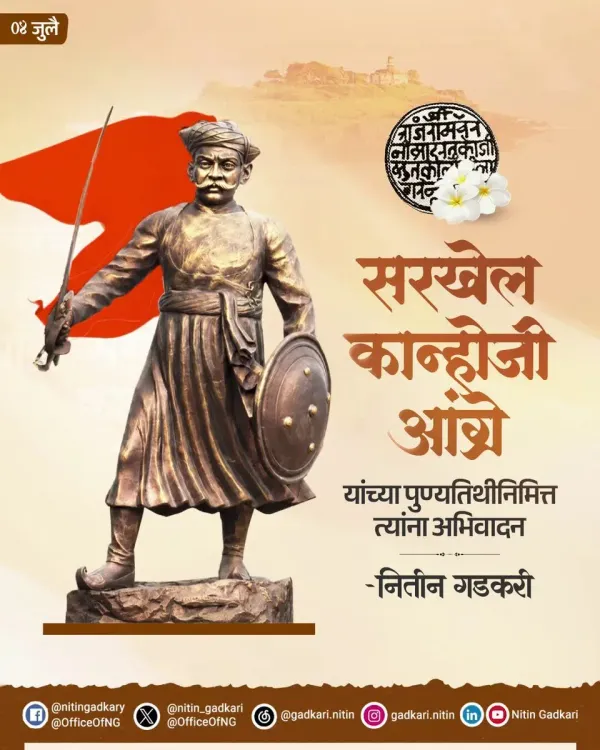
Union Road Transport and Highways Minister Nitin Gadkari on Saturday, 4 July 2026, paid homage to Sarkhel Kanhoji Angre, the legendary Maratha naval commander, on the occasion of his death anniversary. Gadkari, a senior BJP leader from Maharashtra, took to X to honour the admiral's legacy of maritime resistance and valour.
In his post, Gadkari wrote in Marathi: 'सरखेल कान्होजी आंग्रे यांच्या पुण्यतिथीनिमित्त त्यांना विनम्र अभिवादन' — 'Humble salutations to Sarkhel Kanhoji Angre on his death anniversary.' He added that Kanhoji's tale of bravery, as the chief of the Maratha Empire's navy, is immortal and his name is etched forever in history.
Context
Kanhoji Angre (circa 1669–1729) served as the Sarkhel — the supreme commander — of the Maratha navy under the Maratha Empire. Operating primarily along the Konkan coast, he is celebrated for mounting sustained and largely successful resistance against the naval forces of European colonial powers, including the Portuguese, the British East India Company, and the Dutch. His headquarters at Vijaydurg and Colaba (present-day Alibag) became symbols of indigenous maritime power.
His death anniversary is observed annually as a moment of reflection on India's pre-colonial naval heritage, particularly in coastal Maharashtra. Kanhoji Angre is regarded as the father of the Indian Navy by many historians, and his legacy has been periodically invoked in debates around maritime heritage and coastal defence.
Policy Backdrop
Indian political leaders — especially those from Maharashtra — routinely mark the death anniversaries of Maratha-era figures on social media, situating such tributes within a broader cultural and political assertion of Maratha pride and regional identity. For BJP leaders in particular, honouring figures like Kanhoji Angre reinforces the party's outreach to Maharashtrian communities and its alignment with the legacy of Chhatrapati Shivaji Maharaj's empire-building vision, of which a powerful navy was a cornerstone.
The Indian Navy itself has long acknowledged Kanhoji Angre's contributions, and heritage conservation efforts around Maratha-era coastal forts — several of which are UNESCO-listed — continue to attract policy attention at both the state and central levels.
Stakeholders and Impact
The tribute resonates most directly with the Maharashtrian community, particularly those with roots in the Konkan region and those who identify with Maratha martial history. Gadkari's post, carrying the hashtags #कान्होजी_आंग्रे and #KanhojiAngre, is likely to circulate widely among cultural and historical interest groups on social media.
For the BJP in Maharashtra, such commemorations serve a dual purpose: honouring a genuine historical figure while also signalling cultural sensitivity ahead of any electoral or political engagement with the state's dominant communities. Historians and heritage advocates who campaign for greater recognition of India's maritime history also find common cause in such public acknowledgements by senior ministers.
What's Next
State-level commemorative events, cultural programmes, and heritage walks at Maratha coastal forts may accompany the death anniversary in Maharashtra. Advocacy groups focused on Maratha naval history and coastal heritage conservation are likely to use the occasion to renew calls for greater investment in the preservation of sites associated with Kanhoji Angre's legacy, including forts along the Konkan coast. The broader momentum around celebrating India's pre-colonial maritime identity is expected to continue influencing both cultural policy and political messaging from New Delhi.
Point of View
Weaving regional cultural pride into national political messaging. By invoking the Maratha navy's resistance against European colonial powers, such posts tap into a potent narrative of indigenous strength and sovereignty that resonates deeply in coastal Maharashtra. The tribute also implicitly supports ongoing advocacy for recognising India's pre-colonial maritime heritage, a cause that intersects with both cultural policy and the Indian Navy's own institutional identity. In a state where Maratha identity remains electorally significant, these commemorations function simultaneously as historical acknowledgement and political signalling.
NationPress
4 Jul 2026
Frequently Asked Questions
Who was Kanhoji Angre?
Kanhoji Angre (circa 1669–1729) was the Sarkhel, or supreme commander, of the Maratha Empire's navy. He is celebrated for resisting the naval forces of the Portuguese, British East India Company, and Dutch along the Konkan coast of India, and is widely regarded as a foundational figure in Indian maritime history.
Why did Nitin Gadkari pay tribute to Kanhoji Angre?
Nitin Gadkari paid tribute on the occasion of Kanhoji Angre's death anniversary, honouring him as an immortal figure of Maratha naval history whose bravery is etched forever in history.
What does 'Sarkhel' mean?
'Sarkhel' is a Marathi title meaning the supreme commander or admiral of a naval force. Kanhoji Angre held this rank under the Maratha Empire.
Where was Kanhoji Angre based?
Kanhoji Angre operated primarily along the Konkan coast, with key strongholds at Vijaydurg and Colaba, present-day Alibag in Maharashtra.
Why do BJP leaders frequently honour Maratha historical figures?
BJP leaders from Maharashtra regularly commemorate Maratha-era figures to reinforce cultural ties with the Maharashtrian community, assert regional pride, and align with the legacy of Chhatrapati Shivaji Maharaj's empire, of which a powerful navy was a central element.