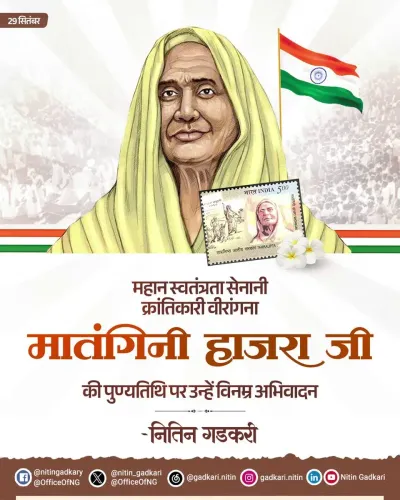
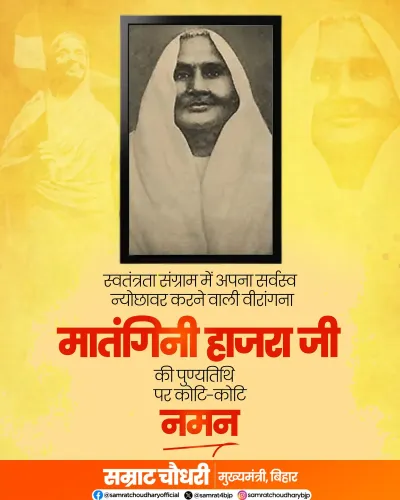
Gadkari pays tribute to revolutionary Matangini Hazra on her birth anniversary
Synopsis
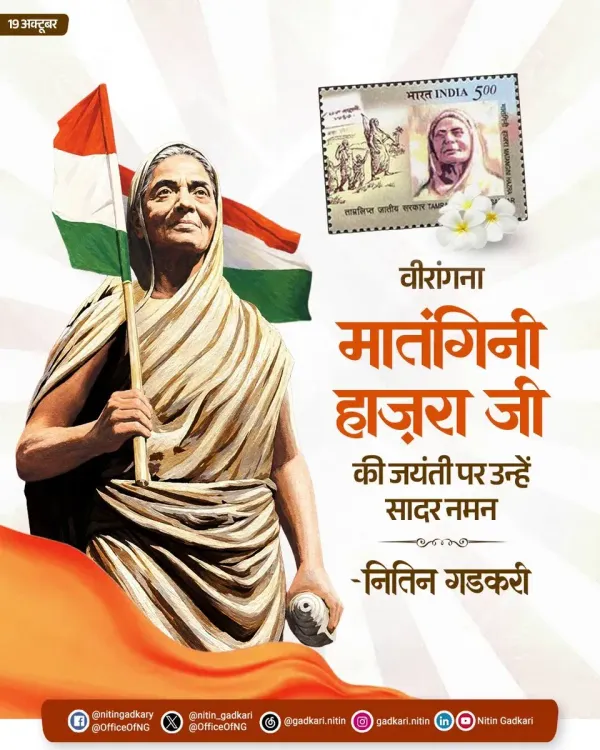
Union Minister Nitin Gadkari honoured freedom fighter Matangini Hazra on her birth anniversary, 19 October 2026, saluting the Bengali revolutionary who was shot dead by British police in 1942 while leading a Quit India Movement procession, the tricolour still in her hands.
Key Takeaways
Nitin Gadkari posted a tribute to Matangini Hazra on her birth anniversary, 19 October 2026 .
Matangini Hazra was born on 19 October 1870 in Hogla village, Tamluk, Midnapore, West Bengal .
She was known as Gandhi Buri for her role in the Civil Disobedience and Salt Satyagraha movements.
She was shot by British police on 29 September 1942 during the Quit India Movement while leading a procession in Tamluk — she was 72 years old .
She reportedly kept the national flag raised and cried Vande Mataram even after being hit by bullets.
A prominent statue of her stands in Kolkata , and she is commemorated as a symbol of grassroots courage in West Bengal.
On the birth anniversary of one of India's most fearless freedom fighters, Union Road Transport and Highways Minister Nitin Gadkari offered his respectful homage to Matangini Hazra — the Bengali revolutionary who gave her life so that India could breathe free.
Posting on Monday, 19 October 2026, Gadkari wrote: 'देश की स्वतंत्रता के लिए अपने प्राणों की आहुति देने वाली महान क्रांतिकारी वीरांगना मातंगिनी हाज़रा जी की जयंती पर उन्हें सादर नमन' — 'Respectful salutations to the great revolutionary heroine Matangini Hazra, who sacrificed her life for the independence of the country, on her birth anniversary.'
Who was Matangini Hazra — and why her story endures
Matangini Hazra, born on 19 October 1870 in Hogla village, Tamluk, Midnapore district of present-day West Bengal, earned the title Gandhi Buri — 'Old Gandhi' — from the people of her district for her unshakeable adherence to Gandhian non-violent resistance. Widowed young and childless, she channelled every ounce of her life into the nationalist movement, participating in the Civil Disobedience Movement and the Salt Satyagraha.
Her finest — and final — hour came on 29 September 1942, during the Quit India Movement. Leading a procession of several thousand volunteers in Tamluk, she was shot by British police. Even as bullets struck her, she reportedly kept the Indian National Congress flag raised and cried 'Vande Mataram' until she fell. She was 72 years old. The colonial administration's guns could silence her voice, but not her legend.
A tribute from a senior voice in Indian public life
Gadkari's tribute is part of a broader national tradition of remembering freedom fighters whose contributions often remained in the shadow of more celebrated names. Matangini Hazra's statue stands prominently in Kolkata, and she is commemorated in Tamluk — the town she made historic — as a symbol of grassroots courage and ordinary citizens who chose sacrifice over survival.
Her story is a reminder that India's independence was not won in legislatures alone — it was won in village lanes, by ordinary women who picked up flags instead of fleeing.
Point of View
Honouring revolutionary figures from Bengal also carries electoral and cultural resonance in a state where the party has aggressively sought to expand its footprint. Gadkari's tribute, while ceremonial, fits into a wider pattern of reclaiming grassroots, regional heroes as part of a shared national inheritance. The fact that Hazra's story — an elderly widow who defied empire until a bullet stopped her — resonates across partisan lines makes such remembrances among the least contentious and most enduring forms of political communication.
NationPress
19 Oct 2026
Frequently Asked Questions
Who was Matangini Hazra?
Matangini Hazra was a Bengali revolutionary and freedom fighter born on 19 October 1870 in Tamluk, Midnapore, West Bengal. Known as Gandhi Buri , she was shot dead by British police on 29 September 1942 during the Quit India Movement while leading a procession, reportedly holding the national flag aloft until she fell.
Why is Matangini Hazra called Gandhi Buri?
Gandhi Buri means 'Old Gandhi' in Bengali. The people of Midnapore gave her this title because of her devoted, lifelong adherence to Mahatma Gandhi's principles of non-violent resistance and her active participation in movements like the Salt Satyagraha and Civil Disobedience Movement.
What did Nitin Gadkari say about Matangini Hazra?
On her birth anniversary, 19 October 2026 , Gadkari posted a tribute in Hindi offering 'respectful salutations to the great revolutionary heroine Matangini Hazra, who sacrificed her life for the independence of the country.'
When and where was Matangini Hazra martyred?
Matangini Hazra was martyred on 29 September 1942 in Tamluk, Midnapore, West Bengal , when British police opened fire on a Quit India Movement procession she was leading. She was 72 years old at the time.
Where is Matangini Hazra's statue located?
A prominent statue of Matangini Hazra stands in Kolkata, West Bengal . She is also specially commemorated in Tamluk , the town where she was martyred during the 1942 Quit India Movement.