Gadkari Remembers Bharat Ratna Aruna Asaf Ali on Birth Anniversary
Synopsis
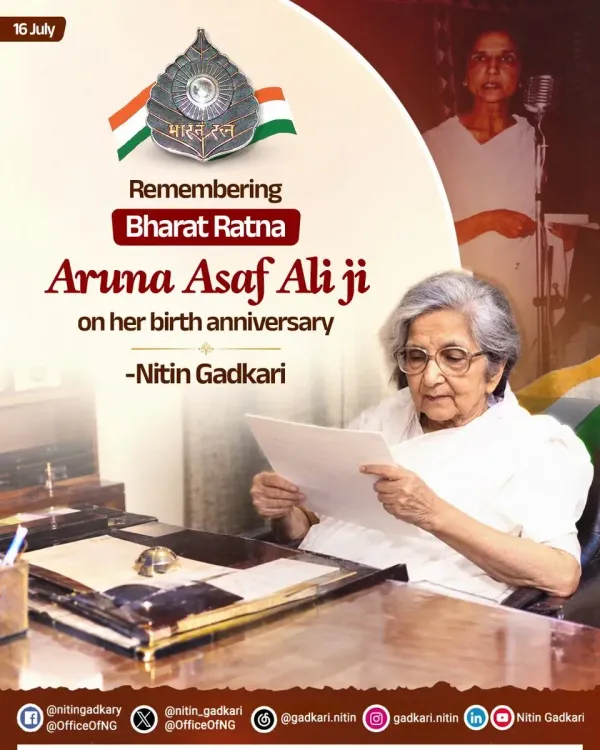
Union Minister Nitin Gadkari on 16 July 2026 remembered Bharat Ratna Aruna Asaf Ali on her birth anniversary, honouring the freedom fighter famed for hoisting the Indian flag at Gowalia Tank during the 1942 Quit India Movement.
Key Takeaways
Nitin Gadkari , Union Road Transport and Highways Minister, paid tribute to Aruna Asaf Ali on her birth anniversary on 16 July 2026 .
Aruna Asaf Ali is celebrated for hoisting the Indian national flag at Gowalia Tank, Bombay during the Quit India Movement of August 1942 .
She was posthumously awarded the Bharat Ratna — India's highest civilian honour — in 1997 .
Gadkari's tribute reflects the cross-party tradition of commemorating independence-era figures across India's political spectrum.
Aruna Asaf Ali also served as Delhi's first Mayor and was active in journalism and left-wing politics after independence.
Union Road Transport and Highways Minister Nitin Gadkari on Thursday, 16 July 2026, paid tribute to freedom fighter and Bharat Ratna awardee Aruna Asaf Ali on her birth anniversary, honouring her enduring legacy in India's independence movement.
Context
Aruna Asaf Ali is remembered as one of the most courageous figures of the freedom struggle. She is best known for hoisting the Indian national flag at Gowalia Tank, Bombay, during the Quit India Movement of August 1942 — a defiant act that made her an icon of civil resistance against British rule.
Her contribution transcended party lines: she was associated with the Indian National Congress during the independence era and later aligned with left-wing politics, yet commands reverence across India's political spectrum. The Government of India posthumously conferred on her the Bharat Ratna — the country's highest civilian honour — in 1997.
Policy Backdrop
The practice of senior Union ministers issuing public tributes to independence-era figures on birth and death anniversaries is a long-standing feature of Indian political culture. Such commemorations serve to affirm continuity with the national movement and are observed across party affiliations.
Gadkari, a senior BJP leader and former national president of the party, regularly uses his social media presence to mark such occasions alongside his infrastructure-focused announcements. The tribute to Aruna Asaf Ali — a figure historically associated with Congress socialism and the left — reflects the cross-party nature of India's independence commemoration tradition.
Stakeholders and Impact
Commemorations of Aruna Asaf Ali resonate with a wide audience: historians, educators, civil society groups, and citizens who study the independence movement. Her story is part of school curricula across India, making her birth anniversary a moment of national reflection.
The tribute also signals the political significance of invoking freedom fighters whose legacies are not exclusively claimed by any single party, reinforcing a shared national heritage. Aruna Asaf Ali's life — spanning underground activism, municipal governance as Delhi's first Mayor, and journalism — offers multiple points of identification for different segments of Indian society.
What's Next
On 16 July, tributes from other Union ministers, state governments, and political parties are expected across social media platforms, alongside possible wreath-laying ceremonies at memorials dedicated to freedom fighters. Institutions and schools named after Aruna Asaf Ali across the country typically mark the occasion with commemorative events.
As India approaches the anniversaries of the Quit India Movement in August, public attention to the figures of that era — including Aruna Asaf Ali — is likely to intensify, with her flag-hoisting at Gowalia Tank remaining a defining symbol of popular resistance.
Point of View
Not merely those from the party's own ideological lineage. Aruna Asaf Ali's association with Congress socialism and later the left makes her commemoration by a senior BJP minister particularly notable as a gesture of inclusive nationalism. This practice serves a dual purpose: it reinforces the government's claim to the broader national heritage while keeping the memory of the freedom struggle alive in public discourse. As the anniversary of the Quit India Movement approaches in August, such tributes are likely to multiply, shaping a competitive commemorative landscape among political parties.
NationPress
16 Jul 2026
Frequently Asked Questions
Who was Aruna Asaf Ali?
Aruna Asaf Ali was a prominent Indian freedom fighter best known for hoisting the Indian national flag at Gowalia Tank in Bombay during the Quit India Movement of August 1942. She was posthumously awarded the Bharat Ratna in 1997.
When is Aruna Asaf Ali's birth anniversary?
Aruna Asaf Ali's birth anniversary falls on 16 July. In 2026, Union Minister Nitin Gadkari was among the leaders who publicly paid tribute on this date.
What is Aruna Asaf Ali's connection to the Quit India Movement?
Aruna Asaf Ali played a defining role in the Quit India Movement of August 1942 by hoisting the Indian national flag at Gowalia Tank in Bombay, defying British authorities at great personal risk.
Why did Aruna Asaf Ali receive the Bharat Ratna?
The Government of India posthumously conferred the Bharat Ratna — India's highest civilian honour — on Aruna Asaf Ali in 1997 in recognition of her outstanding contributions to the independence struggle.
What did Nitin Gadkari say about Aruna Asaf Ali?
On 16 July 2026, Nitin Gadkari posted a tribute on X remembering Aruna Asaf Ali as a 'great freedom fighter' and Bharat Ratna awardee on her birth anniversary.