Amit Shah at Gujarat Vidyapith: Gandhi's ideas will stay relevant for 100 more years
Synopsis
At Gujarat Vidyapith's 72nd convocation, Amit Shah made a pointed case for Gandhian permanence — citing khadi's turnover jump from ₹31,000 crore to ₹1.87 lakh crore as proof that Gandhi's economics works, while urging graduates to guard against the seven social sins. The speech was as much a political framing exercise as a convocation address.
Key Takeaways
Amit Shah addressed the 72nd convocation of Gujarat Vidyapith in Ahmedabad on 27 August .
Shah declared Gandhi's message will remain relevant for at least another 100 years , rooted in India's own cultural traditions.
Gujarat Vidyapith was founded by Gandhi on 18 October 1920 as a model for post-independence Indian education.
Khadi and village industries turnover grew from ₹31,000 crore in 2013-14 to ₹1.87 lakh crore in 2025-26 , according to Shah.
Shah urged graduates to internalise Gandhi's seven social sins and 11 vows as lifelong guides.
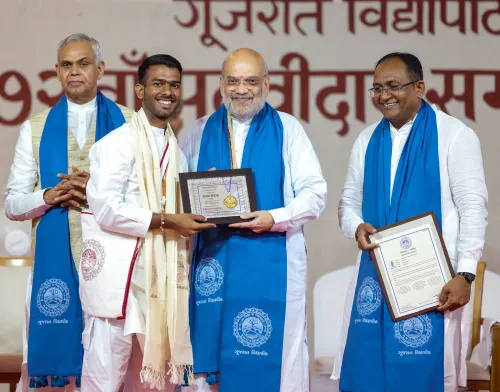
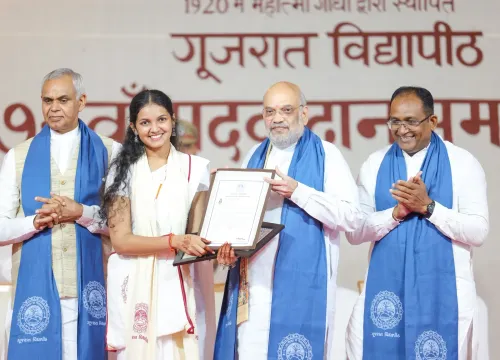
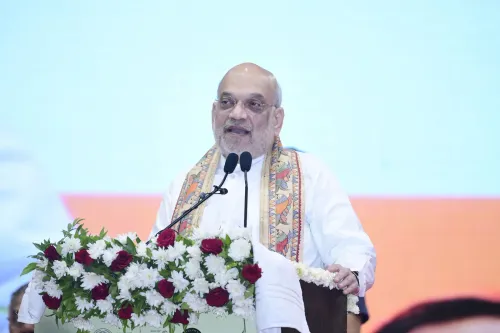
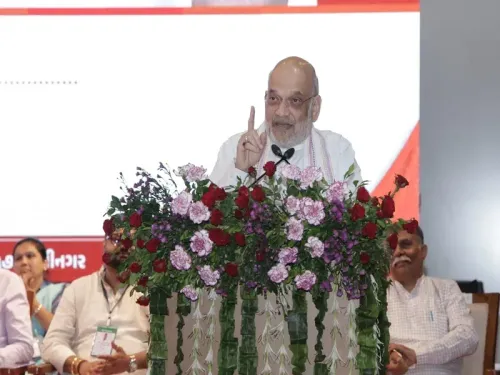
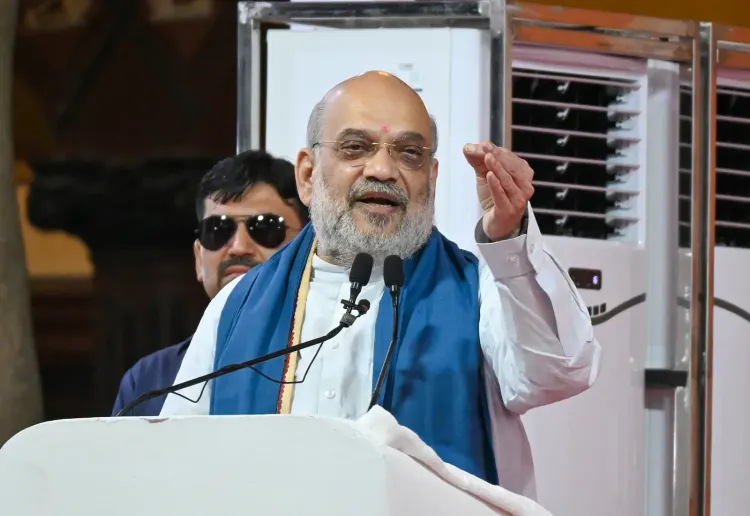
Union Home and Cooperation Minister Amit Shah on Thursday, 27 August declared that Mahatma Gandhi's message is as pertinent to modern society as it was during his lifetime — and will remain so for at least another century. Addressing the 72nd convocation of Gujarat Vidyapith in Ahmedabad, Shah urged graduating students to carry Gandhi's principles as a lifelong compass.
Gandhi's Ideas Rooted in Indian Tradition
Shah argued that the enduring power of Gandhi's philosophy lies in its origins. 'Gandhi ji's message was as relevant then as it is today, and it will remain equally relevant even after 100 years. It will never become irrelevant,' he said. He pointed to a statement displayed within the Vidyapith premises in which Gandhi himself acknowledged that he had conveyed not new ideas but wisdom heard across centuries of Indian life.
According to Shah, Gandhi's thought was not imported or derived from foreign intellectual traditions — it grew from India's own cultural and knowledge heritage, which is precisely why it has proved durable.
Gujarat Vidyapith: Gandhi's Educational Laboratory
Shah recalled the founding of Gujarat Vidyapith by Gandhi on 18 October 1920, describing it as a deliberate experiment in reimagining Indian education after independence. The institution, he said, treated the field, the handicraft workshop, the village assembly, and society itself as classrooms — a radical departure from colonial models.
'Gandhi believed freedom would remain incomplete unless India's language, culture, labour and purpose were rooted in the nation,' Shah said. He noted that Gandhi, after returning from abroad, had travelled extensively across India and observed both its extraordinary diversity — in languages, dialects, dress, food, and faiths — and the deeper unity that ran beneath it.
Shah described education as a coordination of 'hand, heart and mind': skills for the hands, sensitivity for the heart, and knowledge tempered by wisdom for the mind. 'A mind filled only with knowledge creates arrogance. A mind that possesses both knowledge and wisdom produces both humility and scholarship,' he observed.
Seven Social Sins and Eleven Vows
Shah urged the graduating class to internalise Gandhi's seven social sins: politics without principles, business without morality, wealth without labour, knowledge without wisdom, indulgence without restraint, knowledge without character, and science without humanity. He added worship without sacrifice as an eighth failing worth guarding against.
'If we remain conscious of them, we will certainly hesitate and stop ourselves before committing them,' he said, acknowledging that no individual could claim perfect adherence. He added that where circumstances pushed a person toward wrongdoing, repentance should follow.
He also recalled Gandhi's 11 vows — truth, non-violence, non-stealing, celibacy, non-possession, physical labour, control of the palate, fearlessness, equal respect for all religions, Swadeshi, and removal of untouchability — calling them equally relevant today.
Khadi Economy and Gram Swaraj
On Gandhi's emphasis on khadi, Shah described it not merely as an economic activity but as an act of solidarity with fellow citizens. He cited figures showing that khadi and village industries turnover had risen from ₹31,000 crore in 2013-14 to ₹1.87 lakh crore in 2025-26, framing the growth as a validation of Gandhian economics.
Shah also stressed Gandhi's vision of Gram Swaraj — village self-governance and prosperity through cooperation — as principles the new graduates must carry into public and social life. On language, he said learning other tongues was welcome, but people should never feel inferior for speaking their mother tongue, since language connects individuals to their culture, history, and roots.
Point of View
And a convocation address is a low-friction venue to do so. The khadi turnover figure, however, is a substantive data point that deserves scrutiny: growth in headline turnover does not automatically translate into weaver incomes or rural employment quality. The seven social sins framing is also worth noting — 'politics without principles' from a serving Home Minister carries an irony that the audience was left to resolve for themselves.
NationPress
27 Aug 2026
Frequently Asked Questions
What did Amit Shah say about Mahatma Gandhi at Gujarat Vidyapith?
Amit Shah said Gandhi's message was as relevant today as during his lifetime and would remain so for at least 100 more years. He argued that Gandhi's ideas were rooted in India's own cultural and knowledge traditions, making them inherently enduring.
What is Gujarat Vidyapith and who founded it?
Gujarat Vidyapith is a university in Ahmedabad founded by Mahatma Gandhi on 18 October 1920. It was envisioned as a model for Indian education after independence, treating fields, workshops, and village assemblies as classrooms alongside formal instruction.
What are Gandhi's seven social sins that Amit Shah referenced?
The seven social sins are: politics without principles, business without morality, wealth without labour, knowledge without wisdom, indulgence without restraint, knowledge without character, and science without humanity. Shah also cited worship without sacrifice as an additional failing to guard against.
How much has khadi and village industries turnover grown, according to Amit Shah?
Shah said khadi and village industries turnover rose from ₹31,000 crore in 2013-14 to ₹1.87 lakh crore in 2025-26, presenting the growth as evidence of the continued economic relevance of Gandhian principles.
What is Gram Swaraj and why did Shah mention it at the convocation?
Gram Swaraj refers to Gandhi's vision of village self-governance and prosperity through cooperation. Shah urged the graduating students to carry this principle into their public and social lives as they left the institution.