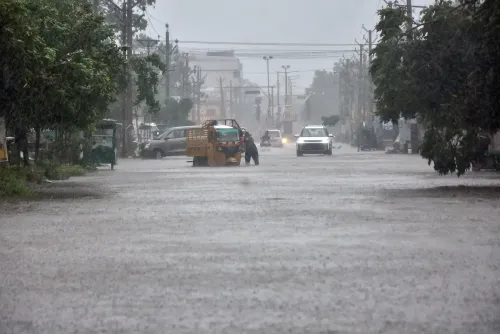
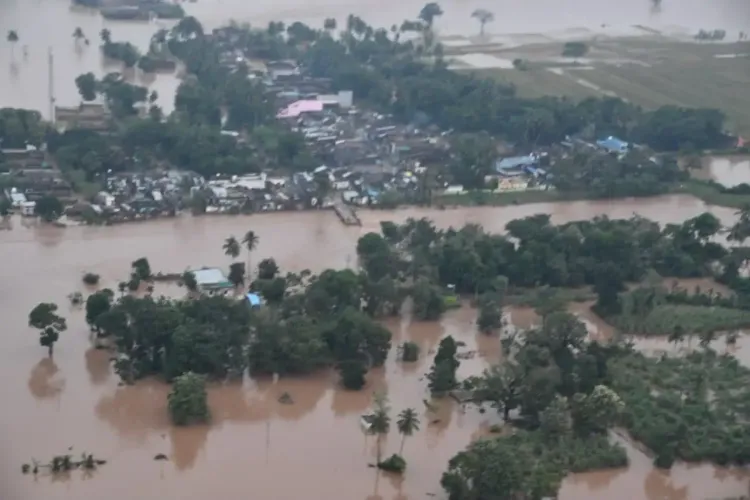
Ganjam floods caused by unprecedented rainfall, not mismanagement: Odisha
Synopsis
Odisha's top bureaucrat has put hard numbers to the Ganjam flood crisis — rainfall 65% above Cyclone Phailin levels, 808 mm over three days in Patrapur, and river discharge at double carrying capacity. The Central government's own assessment team backed the state's position, undercutting opposition claims of a man-made disaster. No casualties were reported despite the scale of the event.
Key Takeaways
Odisha Chief Secretary Anu Garg said Ganjam floods were caused by rainfall 65% higher than during 2013 Cyclone Phailin .
Patrapur recorded a three-day total of 808 mm , including 546 mm in a single day.
Only 10% of the Rushikulya-Bahuda catchment area drains into dams; the remaining 90% flows directly into rivers.
River discharge at Purushottampur hit 6,907 cumecs — double the river's carrying capacity — while dam release was just 746 cumecs .
A Central team from the Ministry of Jal Shakti confirmed the floods were caused by unprecedented rainfall.
No casualties were reported; power restoration is targeted within 3 days and water supply within 2 days .
Odisha Chief Secretary Anu Garg on 11 November 2026 defended the state government's handling of the devastating Ganjam floods, attributing the disaster to unprecedented rainfall that was 65 per cent higher than what was recorded during the 2013 Cyclone Phailin — pushing back firmly against opposition allegations of a man-made crisis.
What the rainfall data shows
Patrapur recorded 546 mm of rainfall in a single day, preceded by 89 mm on the first day and followed by 173 mm on the third, bringing the three-day cumulative total to 808 mm. Several other rainfall monitoring stations in the region also breached their previous records, logging more than 300 mm each. Garg noted a critical distinction from Phailin: while that cyclone delivered heavy rainfall within a single day, the recent event involved three consecutive days of intense precipitation — a compounding factor that overwhelmed drainage systems across the district.
Role of reservoir operations
Addressing questions over dam management — a central point of opposition criticism — the Chief Secretary explained that the combined catchment area of the Rushikulya and Bahuda rivers spans approximately 9,800 sq km. Of this, only around 880 sq km, or roughly 10 per cent, drains into reservoirs. The remaining 90 per cent flows directly into the rivers and lies beyond any dam-based control. Engineers, she said, followed established protocols, conducting continuous assessments before releasing water. Reservoir releases during the event were described as being at 60 to 65 per cent of capacity, with additional water diverted through irrigation canals — the same approach adopted during Cyclone Phailin.
River discharge versus dam discharge
At Purushottampur, river discharge peaked at 6,907 cumecs, which Garg described as double the river's carrying capacity. By contrast, dam-related discharge stood at just 746 cumecs — a figure the Chief Secretary cited to counter claims that reservoir releases were the primary driver of flooding. 'We have to understand that there was unprecedented rainfall. Even so, the required amount of water was released from the dams, and everything that needed to be done was done. Despite these measures, the crisis happened,' Garg stated.
Central team assessment and relief timeline
A Central team led by a Joint Secretary, with members drawn from the Ministry of Jal Shakti, visited the flood-affected areas shortly after the disaster. Following its on-ground assessment, the team conveyed to state officials that the situation was caused by unprecedented rainfall — lending institutional backing to the state's position. On relief, Garg said the administration's primary objective had been to prevent loss of life, and that no casualties had occurred. Power restoration is targeted within three days and water supply within two days, with relief operations for affected residents being expedited.
Opposition criticism and what comes next
The opposition had characterised the Ganjam floods as a man-made disaster, implying mismanagement of dams and reservoirs. The state government's detailed technical briefing appears aimed at shifting the narrative toward the scale of the natural event itself. This comes amid a broader pattern across India where flood-season dam operations have repeatedly drawn political fire — highlighting the need for clearer, real-time public communication protocols during such events. With essential services restoration underway and a Central team assessment already on record, attention is likely to shift toward long-term flood mitigation planning for the Rushikulya-Bahuda basin.
Point of View
Cumec figures, day-wise rainfall data — is as much a political defence as a hydrological explanation, and that duality matters. The opposition's 'man-made crisis' framing has traction precisely because dam-release communication in India is chronically opaque, rarely reaching affected communities before floodwaters do. Garg's numbers are credible, but credibility established after the fact does little for flood-plain residents who had no warning. The more important question is not whether the dams were mismanaged this time, but whether the Rushikulya-Bahuda basin has an early-warning and evacuation protocol calibrated for three-day rainfall events — which climate data suggests will only become more frequent.
NationPress
11 Nov 2026
Frequently Asked Questions
What caused the Ganjam floods in Odisha?
The Ganjam floods were caused by unprecedented three-day rainfall, according to Odisha Chief Secretary Anu Garg. Patrapur alone recorded 808 mm over three days, with rainfall 65% higher than during the 2013 Cyclone Phailin — a scale that overwhelmed natural drainage capacity.
Were the Ganjam floods man-made, as the opposition claims?
The Odisha government rejects the characterisation. A Central team from the Ministry of Jal Shakti, which visited the affected areas, concluded the crisis was caused by unprecedented rainfall. Dam-related discharge was 746 cumecs, while overall river discharge at Purushottampur reached 6,907 cumecs — double carrying capacity.
How did the 2026 Ganjam rainfall compare to Cyclone Phailin in 2013?
The 2026 rainfall was 65% higher than what was recorded during Cyclone Phailin. Crucially, while Phailin delivered heavy rainfall in a single day, the recent event involved three consecutive days of intense precipitation, making the cumulative impact significantly more severe.
Were there any casualties in the Ganjam floods?
Chief Secretary Anu Garg confirmed that no casualties occurred despite the severity of the floods. The administration said its primary objective had been to prevent loss of life.
When will essential services be restored in flood-hit Ganjam?
Power restoration is targeted within three days and water supply within two days of the Chief Secretary's statement on 11 November 2026. Relief operations for affected residents are also being expedited, according to the state government.