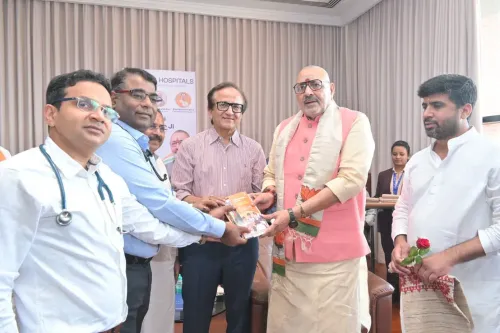
Giriraj Singh: India's public health funding tripled since 2013-14
Synopsis
Union Textiles Minister Giriraj Singh on 28 May 2026 shared government data claiming India's public health funding has tripled since 2013-14 to ₹3.85 lakh crore, highlighting a decade of increased investment spanning Ayushman Bharat, the National Health Mission, and post-pandemic health infrastructure outlays.
Key Takeaways
Union Textiles Minister Giriraj Singh posted on 28 May 2026 that India's public health funding has reached ₹3.85 lakh crore , three times the 2013-14 level.
The claim benchmarks current outlays against the pre- 2014 baseline, a standard framing used by BJP leaders to illustrate governance gains under PM Modi .
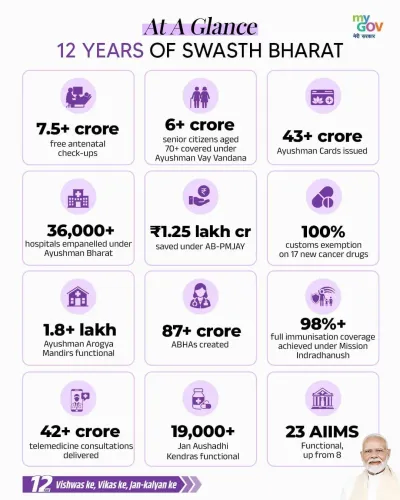
Ayushman Bharat-PMJAY , launched in September 2018 , and the National Health Mission are among the major programmes driving higher central health allocations.
The National Health Policy 2017 set a target of raising government health expenditure to 2.5 per cent of GDP by 2025 .
Outcome metrics — including state-level utilisation of central grants and insurance claim data — remain key indicators to watch in forthcoming Economic Survey and budget documents.
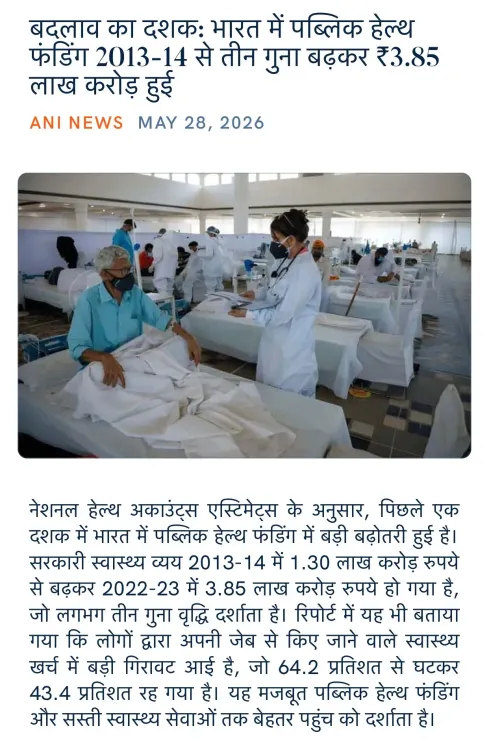
Union Textiles Minister Giriraj Singh on Thursday, 28 May 2026 shared data claiming that India's public health funding has tripled since 2013-14, reaching ₹3.85 lakh crore, describing the period as a 'decade of transformation' under the Modi government.
Context
Singh shared the figure via the NaMo App, posting in Hindi: 'बदलाव का दशक: भारत में पब्लिक हेल्थ फंडिंग 2013-14 से तीन गुना बढ़कर ₹3.85 लाख करोड़ हुई' ('Decade of transformation: India's public health funding has tripled from 2013-14 levels to ₹3.85 lakh crore'). The post is part of a pattern of senior BJP leaders benchmarking current welfare outlays against the pre-2014 baseline to illustrate governance gains under Prime Minister Narendra Modi.
While Singh serves as Union Minister of Textiles and is a Lok Sabha MP from Begusarai, Bihar, he regularly amplifies central government achievements across policy domains on social media. The health-funding claim reflects official government communication rather than a textiles-ministry announcement.
Policy Backdrop
Public health financing has been a stated priority of successive Union Budgets since 2014-15, with allocations to the Ministry of Health and Family Welfare rising in nominal terms each year. The National Health Policy 2017 set a target of raising government health expenditure to 2.5 per cent of GDP by 2025, a benchmark that has driven annual budget negotiations between the health ministry and the finance ministry.
Key programmes driving the expanded outlay include the National Health Mission, which channels central funds to state health systems, and Ayushman Bharat, launched in September 2018, which combines the Pradhan Mantri Jan Arogya Yojana (PMJAY) insurance cover for low-income families with a network of Health and Wellness Centres for primary care. The PM Atmanirbhar Swasth Bharat Yojana, announced in 2020 in the wake of the COVID-19 pandemic, added further outlays for health infrastructure and disease surveillance.
Stakeholders and Impact
The primary beneficiaries of expanded public health funding are the roughly 50 crore low-income Indians covered under Ayushman Bharat-PMJAY and the broader population served through National Health Mission-supported state facilities. State health departments are the key implementation partners, receiving a significant share of central grants for hospital upgrades, maternal and child health programmes, and disease control.
Analysts and health economists have noted that while nominal allocations have risen sharply, real per-capita spending and actual utilisation rates — tracked through state absorption of central grants — remain important metrics for assessing outcomes. Outcome data including hospitalisation rates, insurance claim settlements, and primary care utilisation are expected to feature in forthcoming Economic Survey documents.
What's Next
The government's stated fiscal trajectory points toward continued expansion of the Ayushman Bharat ecosystem, with discussions around extending coverage and integrating digital health records under the Ayushman Bharat Digital Mission. The next Union Budget and Economic Survey will be closely watched for utilisation data that contextualises the headline allocation figures cited by the minister. State-level absorption rates and health-outcome indicators will determine whether the tripling in nominal funding translates into measurable improvements in public health delivery on the ground.
Point of View
If accurate, would represent a significant nominal expansion, but the more consequential debate — whether per-capita real spending and health outcomes have kept pace — is precisely what such posts leave unaddressed. Investors in public health policy will watch the next Economic Survey to see whether utilisation data validates the headline allocation story.
NationPress
20 Sept 2026
Frequently Asked Questions
Has India's public health funding really tripled since 2013-14?
Union Textiles Minister Giriraj Singh has cited government data claiming India's public health funding has tripled from 2013-14 levels to ₹3.85 lakh crore. This reflects nominal budget allocations; independent verification of the precise figure and real-terms growth requires cross-referencing official Union Budget documents and Economic Survey data.
What is Ayushman Bharat and how does it relate to health funding?
Ayushman Bharat, launched in September 2018, is the flagship central health scheme combining PMJAY — which provides insurance cover to low-income families for secondary and tertiary care — with a network of Health and Wellness Centres for primary care. It is one of the largest drivers of increased central public health allocations since 2018.
What is the National Health Policy 2017 target for health spending?
The National Health Policy 2017 set a goal of raising government health expenditure to 2.5 per cent of GDP by 2025. Annual Union Budgets since then have recorded successive nominal increases in the health ministry's allocation as part of efforts to move toward this target.
Why is a Textiles Minister posting about health funding?
Giriraj Singh, while serving as Union Minister of Textiles, is a senior BJP leader who regularly uses social media to amplify central government achievements across policy domains. Senior party leaders routinely share welfare and development statistics as part of coordinated government communications.
What health schemes have driven India's increased public health spending since 2014?
Key programmes include the National Health Mission, Ayushman Bharat-PMJAY launched in 2018, and the PM Atmanirbhar Swasth Bharat Yojana announced in 2020 for post-pandemic health infrastructure. Together these have significantly raised central government commitments to health financing.