Giriraj Singh: Opposition using foreign toolkits to spread unrest
Synopsis
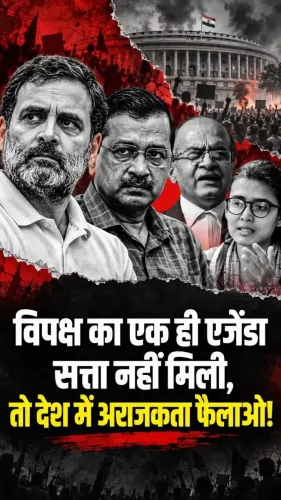
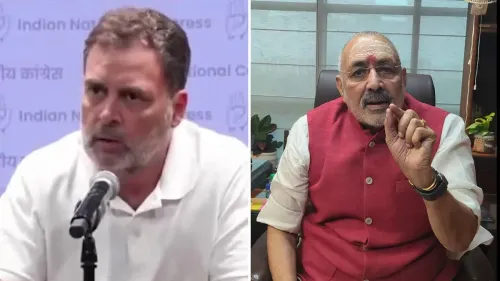
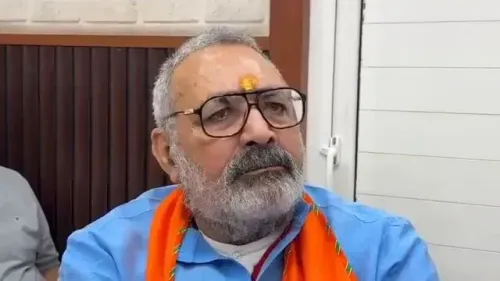
Union Textiles Minister Giriraj Singh accused opposition parties of using foreign toolkits to foment unrest and block development, alleging students were used as pawns before targeting national security. He declared that only the electorate's vote — not street protests — will determine the political outcome.
Key Takeaways
Giriraj Singh alleged that opposition parties rely on a foreign toolkit to spread unrest and stall development in India.
He claimed students were first deployed as political pawns; the target has now shifted to national security and peace .
Singh declared the contest will be resolved through electoral votes , not street protests — a direct delegitimisation of demonstration politics.
The 'foreign toolkit' framing echoes BJP rhetoric used consistently since 2014 , including during the 2020–21 farmer protests and the CAA-NRC agitations .
The statement is seen as pre-positioning for upcoming state assembly elections beyond October 2026.
Street protests, he says, are not the arena — the ballot box is. Union Textiles Minister Giriraj Singh fired a sharp political salvo on Sunday, 25 October 2026, accusing opposition parties of leaning on foreign-linked toolkits to engineer domestic unrest and block India's development, and warning that the people's vote — not demonstrations — will settle the contest.
Posting in Hindi on X, the senior BJP leader and Lok Sabha MP from Begusarai, Bihar wrote: 'Virodhi dalon ka ekamatra agenda videshi toolkit ke sahare desh mein ashanti phailana aur vikas ko rokna hai.' ('The sole agenda of opposition parties is to spread unrest in the country with the support of a foreign toolkit and to obstruct development.') He went further, alleging that students were first used as pawns and that the target has now shifted to the country's security and peace.
The 'toolkit' charge — a well-worn BJP playbook
The accusation is not new. The BJP has deployed the 'foreign toolkit' frame repeatedly since 2014 — most prominently during the 2020–21 farmer protests, when party leaders pointed to a circulated coordination document they alleged had foreign origins. The same rhetorical architecture reappeared through the CAA-NRC agitations and subsequent street-level mobilisations, consistently framing opposition-aligned protests as externally orchestrated rather than organically domestic.
Singh's post lands within that established pattern. By invoking 'security and peace' as the latest target, he escalates the charge from mere inconvenience to something approaching a national-security framing — positioning the current opposition activity as qualitatively more dangerous than earlier episodes.
Votes over streets — the democratic-legitimacy argument
The closing line of Singh's post carries its own political logic. 'The outcome of this entire game,' he wrote, 'will be decided not on the streets but by the power of each and every vote of the people.' It is a dual move: it delegitimises protest as a form of political expression while simultaneously projecting confidence in the BJP's electoral standing. The framing is a direct call to the party's base to channel energy into voter turnout rather than counter-demonstrations.
With state assembly elections on the horizon beyond October 2026, the rhetoric signals that the BJP intends to make opposition 'toolkit' links a campaign-trail centrepiece — testing whether the charge still resonates with voters the way it did in earlier cycles.
Point of View
He stacks two charged narratives to amplify the sense of organised subversion. The pivot to 'votes, not streets' is strategically significant: it pre-empts any large-scale protest momentum by casting it as illegitimate before it fully forms, while energising the party's turnout machine. How opposition parties respond — whether they contest the framing or pivot to governance issues — will shape the pre-election narrative battle.
NationPress
25 Oct 2026
Frequently Asked Questions
What did Giriraj Singh say about the opposition and foreign toolkits?
Singh alleged that opposition parties' sole agenda is to spread unrest using foreign toolkits and block development, accusing them of first using students as pawns and now targeting India's security and peace.
What is the 'foreign toolkit' controversy in Indian politics?
The 'foreign toolkit' charge refers to BJP allegations — prominent since the 2020–21 farmer protests — that opposition-aligned agitations are coordinated using documents or support of foreign origin, framing protests as externally engineered rather than organic.
Why does Giriraj Singh say the fight will be decided by votes, not streets?
Singh's framing delegitimises protest as a political tool while positioning the ballot box as the only valid arena, a tactic aimed at channelling public energy into electoral participation and away from street-level opposition mobilisation.
Who is Giriraj Singh?
Giriraj Singh is a senior BJP leader, Union Minister of Textiles, and Lok Sabha MP from Begusarai, Bihar, known for outspoken political positions on issues of nationalism and development.
How does this statement connect to upcoming elections in India?
Analysts see it as early campaign positioning ahead of state assembly elections after October 2026, with the BJP signalling it will make alleged foreign interference in domestic protests a key electoral talking point.