Giriraj Singh hails IndiaAI-backed Avataar's video AI launch
Synopsis
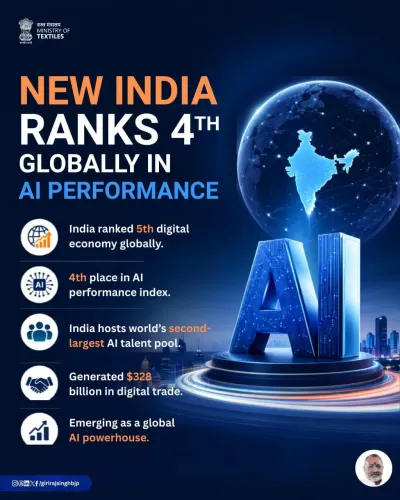
Union Textiles Minister Giriraj Singh on 14 June 2026 amplified the launch of Avataar's indigenously built distilled video AI model, backed by the government's Rs 10,371.92 crore IndiaAI Mission — a signal that the programme is delivering tangible startup outputs in frontier AI.
Key Takeaways
Union Textiles Minister Giriraj Singh shared news of the Avataar video AI model launch on 14 June 2026 via the NaMo App.
Avataar is an IndiaAI Mission-supported Indian startup; its new model is described as India's first indigenously distilled video AI model.
The IndiaAI Mission was approved by the Union Cabinet in March 2024 with an outlay of Rs 10,371.92 crore .
The mission is overseen by MeitY and aims to build domestic AI infrastructure, datasets, and a pipeline of Indian AI startups.
The launch reflects India's Atmanirbhar Bharat push to reduce dependence on foreign AI platforms in frontier technology sectors.
Progress on other IndiaAI Mission-funded projects and forthcoming MeitY AI guidelines are the key developments to watch next.
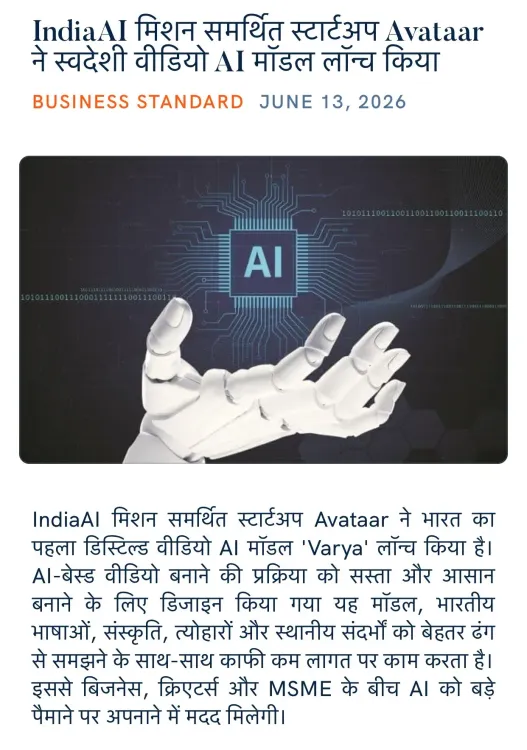
Union Textiles Minister Giriraj Singh on Sunday, 14 June 2026 shared news of Avataar, an IndiaAI Mission-supported startup, launching what is being described as India's first indigenously developed distilled video AI model — marking a milestone in the country's push for self-reliant artificial intelligence capability.
Context
Singh shared the development via the NaMo App, flagging the launch with the Hindi phrase 'स्वदेशी वीडियो AI मॉडल' (indigenous video AI model). His post highlighted the role of the IndiaAI Mission in supporting Avataar's breakthrough, signalling cross-ministerial enthusiasm for the programme beyond its nodal ministry.
Avataar is an Indian AI startup focused on video generation and avatar technologies. The company's latest model is positioned as a domestically built alternative to foreign video AI platforms, aligning with the government's broader Atmanirbhar Bharat drive in frontier technology sectors.
Policy Backdrop
The IndiaAI Mission was approved by the Union Cabinet in March 2024 with a total outlay of Rs 10,371.92 crore. The programme is overseen by the Ministry of Electronics and Information Technology (MeitY) and aims to build domestic AI infrastructure, large-scale datasets, and a pipeline of Indian AI startups capable of competing globally.
India's structured approach to AI dates to 2018, when NITI Aayog released the National Strategy for AI under the banner '#AIForAll'. The IndiaAI Mission represents the operational, funded evolution of that early strategic vision — moving from policy documents to mission-mode public investment.
The emphasis on 'distilled' models — smaller, efficient derivatives of larger AI systems — reflects a global trend toward accessible, deployable AI. For India, developing such models domestically reduces dependence on foreign AI infrastructure and keeps sensitive data processing within national boundaries.
Stakeholders and Impact
The primary beneficiaries of the IndiaAI Mission's startup support track are Indian AI companies seeking public backing to develop and scale foundation models. A successful video AI model from an Indian startup could open commercial opportunities in sectors such as media, entertainment, e-commerce, and digital education — all of which have large and growing markets in India.
For the broader Indian tech sector, the launch signals that the IndiaAI Mission is beginning to yield tangible outputs, not just infrastructure commitments. Startups in adjacent spaces — speech AI, image generation, and multimodal models — are likely watching Avataar's trajectory closely as a benchmark for what mission support can enable.
Singh's amplification of the news, despite Textiles being his primary portfolio, underscores how senior BJP leaders have made technology nationalism a shared political messaging priority across ministries.
What's Next
Attention will now turn to MeitY's progress reports on other IndiaAI Mission-funded projects, and to any new AI governance guidelines the ministry may issue. If Avataar's model demonstrates commercial viability, it could serve as a template for how mission-funded startups move from development to deployment at scale.
India's ability to produce competitive indigenous AI models will be a key test of whether the Rs 10,371.92 crore IndiaAI Mission investment translates into durable, globally relevant technological capability — or remains confined to domestic demonstration projects.
Point of View
Not merely a sectoral portfolio. The IndiaAI Mission's Rs 10,371.92 crore outlay was always as much a political statement about Atmanirbhar Bharat as a policy instrument, and startup launches like Avataar's provide the government with concrete, shareable proof points. The focus on 'distilled' models is strategically smart: they are cheaper to run, easier to deploy at Indian scale, and harder for critics to dismiss as mere cloud dependency on foreign hyperscalers. Whether the model's commercial traction matches its political symbolism will determine how durable this narrative becomes in the run-up to future electoral cycles.
NationPress
13 Sept 2026
Frequently Asked Questions
What is the IndiaAI Mission and how much funding does it have?
The IndiaAI Mission is a government programme approved by the Union Cabinet in March 2024 with an outlay of Rs 10,371.92 crore. It is overseen by MeitY and aims to build domestic AI infrastructure, datasets, and support Indian AI startups in developing foundation models.
What did Avataar launch under the IndiaAI Mission?
Avataar, an Indian AI startup supported by the IndiaAI Mission, launched what is described as India's first indigenously developed distilled video AI model — a compact, efficient AI system for video generation built domestically.
Why did Giriraj Singh share news about an AI startup if he is the Textiles Minister?
Senior BJP leaders, including those with non-technology portfolios, have made technology nationalism a shared political messaging priority. Singh's post reflects the broader Atmanirbhar Bharat narrative that cuts across ministry boundaries.
What is a distilled AI model?
A distilled AI model is a smaller, more efficient version derived from a larger AI system. It retains much of the capability of the original but requires less computing power, making it easier and cheaper to deploy at scale — a key advantage for Indian market conditions.
What should we watch next on India's AI policy?
Key things to watch include MeitY's progress reports on other IndiaAI Mission-funded projects and any new AI governance guidelines the ministry is expected to release, which could shape how Indian AI startups develop and deploy models going forward.