Giriraj Singh Hails Women's Rise in Digital Finance
Synopsis
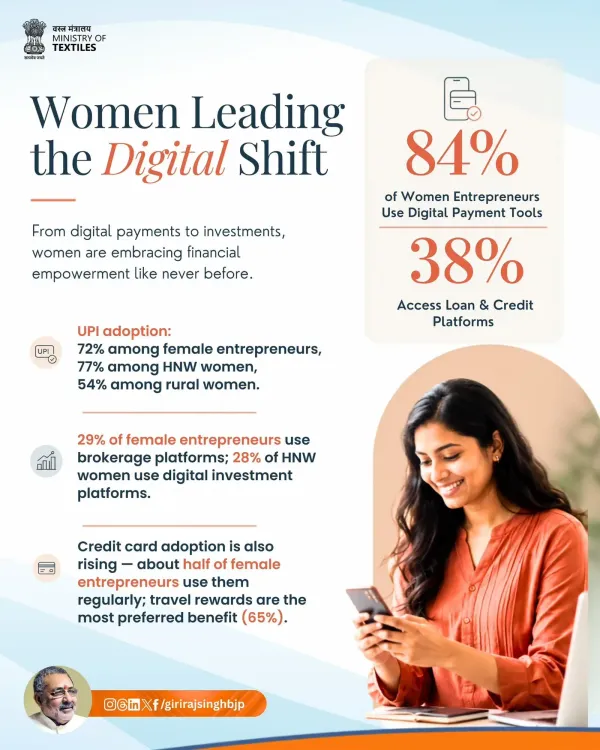
Union Textiles Minister Giriraj Singh on 3 July 2026 praised the rapid adoption of digital financial services by Indian women, linking the trend to PM Modi's Digital India and financial inclusion drive and the Viksit Bharat 2047 vision.
Key Takeaways
Union Textiles Minister Giriraj Singh posted on 3 July 2026 highlighting women's growing adoption of digital financial services in India.
He credited PM Narendra Modi's leadership for driving digital empowerment and financial inclusion for women.
The post links rising access to digital payments, investment, and credit to the Viksit Bharat 2047 vision of a developed India.
The government's Jan Dhan–Aadhaar–UPI ('JAM Trinity') framework, built since 2014 , underpins the financial inclusion architecture for women.
Singh's cross-portfolio amplification reflects a coordinated government communication push around women's economic empowerment.
Future Union Budget outlays and RBI gender-disaggregated payment data will indicate the depth of actual uptake.
Union Textiles Minister Giriraj Singh on Friday, 3 July 2026, highlighted the rapid adoption of digital financial services by women in India, crediting the leadership of Prime Minister Narendra Modi for opening new economic opportunities through digital empowerment and financial inclusion.
Context
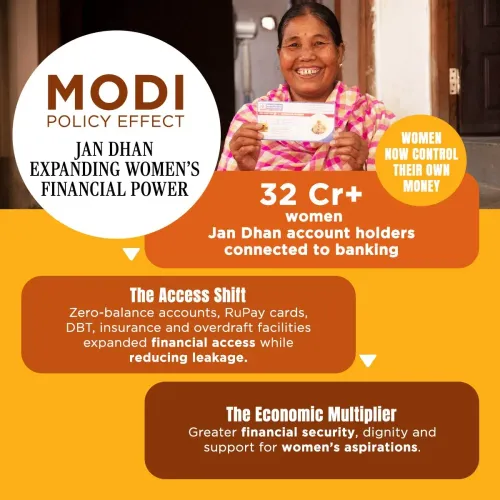
In his post, Minister Singh observed that women across India are increasingly embracing digital financial services. Translated from Hindi, he wrote: 'Bharat mein mahilaen digital vittiya sevaon ko teji se apna rahi hain' — 'Women in India are rapidly adopting digital financial services.' He noted that growing access to digital payments, investment platforms, and credit is making women more economically empowered.
Singh attributed this shift to the continuous efforts under PM Modi's leadership toward digital empowerment and financial inclusion, stating that these efforts are 'opening doors to new opportunities for women.' He linked the transformation to the Viksit Bharat 2047 vision, calling it a source of 'new strength' for the goal of a developed India.
Policy Backdrop
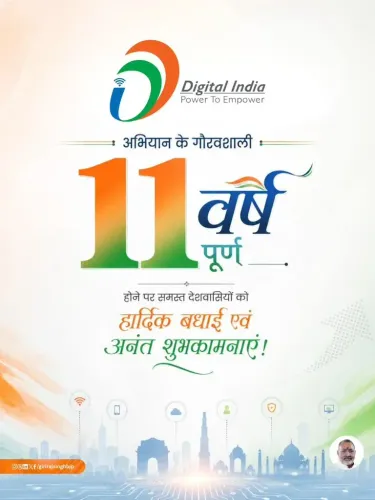
The post reflects a broader policy architecture built over the past decade. The Pradhan Mantri Jan Dhan Yojana, launched in 2014, aimed to bring unbanked adults — particularly women — into the formal financial system by opening zero-balance bank accounts. This was followed by the formal inauguration of the Digital India programme in July 2015, which sought to expand digital infrastructure, literacy, and e-services nationwide.
The rollout of the Unified Payments Interface (UPI) in 2016 further accelerated digital transaction growth across demographics, including rural and semi-urban women. Together, Aadhaar, Jan Dhan, and UPI — often referred to as the 'JAM Trinity' — have formed the backbone of the government's financial inclusion strategy, with gender equity as a stated objective.
Stakeholders and Impact
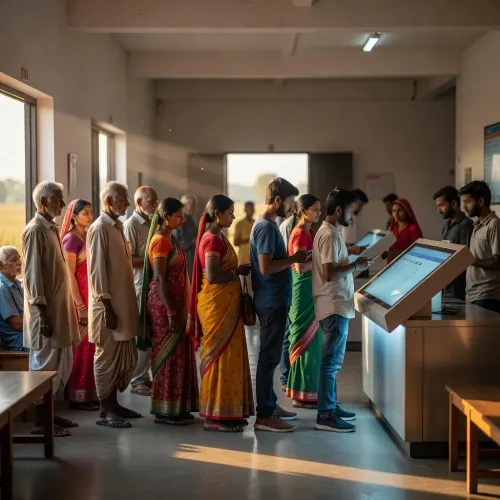
The primary beneficiaries of these converging programmes are Indian women, particularly those in rural households who have historically faced barriers to formal banking, credit, and investment. Expanding digital payment access reduces dependence on cash intermediaries and gives women greater control over household finances.
Minister Singh's amplification of this theme from the Textiles Ministry — beyond his own portfolio — reflects a cross-ministry effort to align government communication with the Viksit Bharat 2047 roadmap. The textiles sector itself employs a large proportion of women workers, giving Singh a direct stake in female economic empowerment narratives.
What's Next
Upcoming parliamentary sessions and the next Union Budget are expected to shed light on fresh outlays targeting women-focused digital literacy and credit schemes. Gender-disaggregated data on digital payment trends from the Reserve Bank of India and the Ministry of Electronics and Information Technology will be closely watched as indicators of actual on-ground uptake.
As India pushes toward its 2047 development milestone, the intersection of women's financial inclusion and digital infrastructure is likely to remain a central pillar of both policy design and political messaging across party and ministry lines.
Point of View
Not a single-scheme win. The cross-ministry nature of the post — a Textiles Minister speaking to digital finance — reflects the BJP's disciplined whole-of-government communication strategy. Whether the rhetoric translates into measurable gender-disaggregated outcomes will depend on data that independent regulators like the RBI are best placed to verify.
NationPress
2 Oct 2026
Frequently Asked Questions
What did Giriraj Singh say about women and digital finance?
On 3 July 2026, Union Textiles Minister Giriraj Singh posted on X stating that women in India are rapidly adopting digital financial services, and that growing access to digital payments, investment, and credit is making them more economically empowered, crediting PM Modi's leadership for this shift.
What is Viksit Bharat 2047?
Viksit Bharat 2047 is the Indian government's official vision and campaign for India to achieve developed-nation status by the centenary of its independence in 2047, encompassing goals across infrastructure, economy, and social inclusion.
How has the government promoted women's financial inclusion in India?
The government has used the 'JAM Trinity' — Jan Dhan bank accounts (launched 2014), Aadhaar biometric identity, and UPI digital payments (launched 2016) — to bring women, especially in rural areas, into the formal financial system.
What is the Digital India programme?
Digital India is a flagship government programme formally launched in July 2015 to expand digital infrastructure, promote digital literacy, and make government services accessible electronically to all citizens.
Why is a Textiles Minister commenting on digital financial inclusion?
While digital finance falls outside the Textiles Ministry's direct mandate, senior ministers across portfolios routinely amplify the government's flagship scheme narratives; Singh's interest also reflects the fact that the textiles sector employs a large number of women workers.