Giriraj Singh: Bharat Tex 2026 signals India's textile rise
Synopsis
Union Textiles Minister Giriraj Singh on 18 July 2026 cited Bharat Tex 2026 as proof that India's textile sector is advancing with new momentum, blending traditional craft with modern technology under the Viksit Bharat 2047 vision.
Key Takeaways
Union Textiles Minister Giriraj Singh posted on 18 July 2026 lauding Bharat Tex 2026 as a symbol of India's textile resurgence.
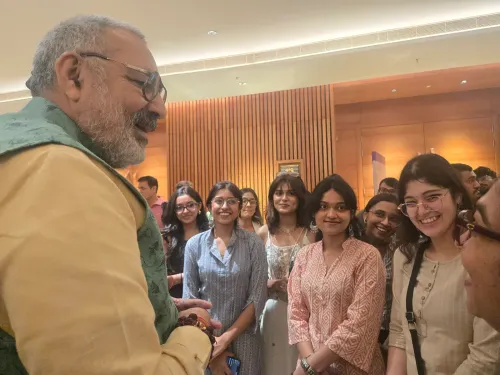
The minister said every conversation, exhibition and innovation at the event carried a single message: the sector is moving forward with renewed momentum.
He framed India's textile growth as a fusion of traditional craft heritage with modern technology and creativity.
The post invokes the Viksit Bharat 2047 vision, tying sectoral ambition to the government's centenary development goal.
Key policy instruments underpinning this push include the 2022 PLI scheme for man-made fibres and the 2016 ATUFS for technology modernisation.
Stakeholders including handloom weavers , MSME manufacturers and textile exporters are the primary beneficiaries of this policy momentum.
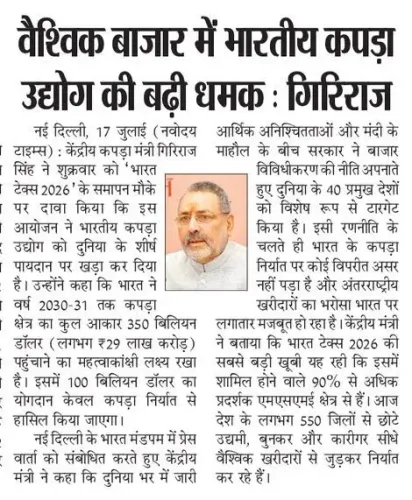
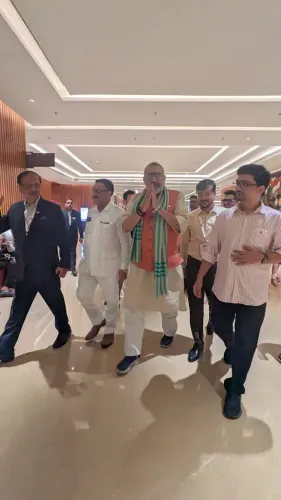
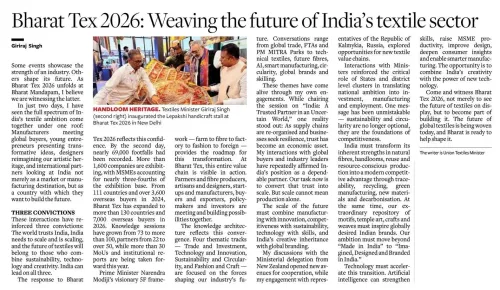
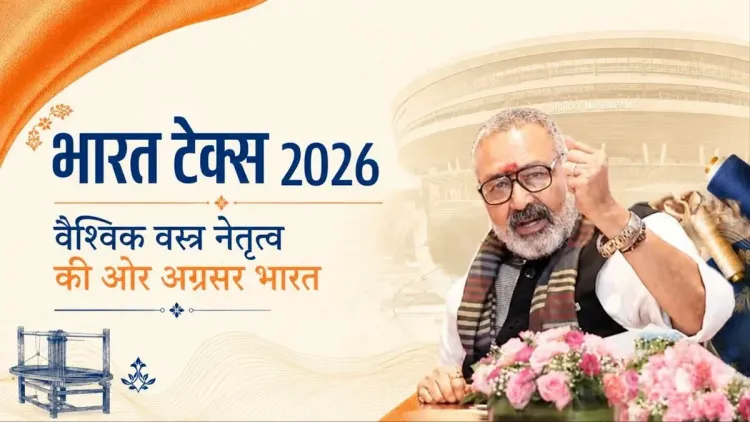
Union Textiles Minister Giriraj Singh on Saturday, 18 July 2026 hailed Bharat Tex 2026 as a defining showcase of India's textile ambitions, saying every conversation, exhibition and innovation at the event carried a single message: the sector is advancing with renewed momentum.
Context
Posting on X, the minister wrote in Hindi: 'भारत टेक्स 2026 में हर संवाद, हर प्रदर्शनी और हर नवाचार एक ही संदेश दे रहा था' — 'Every conversation, every exhibition and every innovation at Bharat Tex 2026 was conveying the same message' — that India's textile industry is moving forward with new energy. He added that India is 'confidently stepping towards becoming a global textile power' by linking tradition with modern technology and creativity. The post was accompanied by a video from the event.
The remarks were tagged #BharatTex2026, #Textiles and #ViksitBharat2047, anchoring the event explicitly within the government's long-term vision of a developed India by 2047, the centenary of independence.
Policy Backdrop
The Ministry of Textiles has pursued a multi-pronged strategy to expand India's share of global apparel and fabric trade. A Production Linked Incentive (PLI) scheme launched in 2022 targets man-made fibre apparel and technical textiles, aiming to scale up domestic manufacturing capacity and attract fresh investment across the value chain.
Earlier, the Amended Technology Upgradation Fund Scheme (ATUFS) of 2016 offered interest reimbursement to modernise textile units, from spinning mills to garment factories. Together, these instruments are designed to help India compete in higher-value segments of global supply chains — precisely the positioning Bharat Tex 2026 was meant to project.
Stakeholders and Impact
India's textile sector is one of the country's largest employers, encompassing handloom weavers, powerloom operators, MSME garment manufacturers and large-scale textile exporters. Platforms such as Bharat Tex serve as convergence points where domestic producers meet international buyers, policymakers and technology providers.
The minister's framing — tradition fused with modern technology and creativity — speaks directly to two constituencies: artisan communities whose craft heritage underpins India's soft-power appeal in global markets, and industrial players seeking scale through automation and synthetic fibre innovation. Both groups stand to benefit from the policy momentum the event is intended to signal.
What's Next
Attention will now turn to whether the enthusiasm on display at Bharat Tex 2026 translates into concrete policy announcements, particularly around the extension of the textile PLI scheme and the continuation of the Remission of Duties and Taxes on Exported Products (RoSCTL) mechanism, both of which are critical to export competitiveness. Upcoming Union Budget allocations for the textiles sector will be a key indicator of how firmly the government intends to back its 'global textile power' narrative with fiscal resources.
With the Viksit Bharat 2047 framework providing a long political horizon, the Ministry of Textiles is expected to keep positioning India's textile story — blending heritage crafts with industrial scale — as a flagship element of the country's broader manufacturing and export ambitions.
Point of View
Electorally resonant story of national transformation. By emphasising the tradition-meets-technology theme, the minister is also carefully bridging two constituencies — artisan communities with deep rural electoral weight and industrial exporters seeking policy continuity. The messaging pattern mirrors what other export-oriented ministries have deployed, suggesting a coordinated communications strategy across the cabinet rather than a standalone statement.
NationPress
18 Jul 2026
Frequently Asked Questions
What is Bharat Tex 2026?
Bharat Tex 2026 is a major textile trade and exhibition event in India where domestic producers, international buyers, policymakers and technology providers converge to showcase innovations and forge business connections across the textile value chain.
What did Giriraj Singh say about Bharat Tex 2026?
Union Textiles Minister Giriraj Singh said every conversation, exhibition and innovation at Bharat Tex 2026 conveyed one message: India's textile industry is advancing with new momentum, confidently moving toward becoming a global textile power by blending tradition with modern technology.
What is the Viksit Bharat 2047 vision for textiles?
Viksit Bharat 2047 is the government's overarching vision for a developed India by the centenary of independence. For the textile sector, it implies raising India's global market share, boosting exports and generating large-scale employment through a mix of traditional crafts and industrial-scale manufacturing.
What schemes support India's textile industry growth?
Key schemes include the Production Linked Incentive scheme launched in 2022 for man-made fibre apparel and technical textiles, and the Amended Technology Upgradation Fund Scheme of 2016 that offered interest reimbursement to modernise textile units across the value chain.
Who benefits from India's textile policy push?
The primary beneficiaries are handloom weavers, powerloom operators, MSME garment manufacturers and large textile exporters — sectors that together represent one of India's largest employment bases and a significant share of merchandise export earnings.