Giriraj Singh Hits Back Over Perceived Slight to Bihar
Synopsis
Union Textiles Minister Giriraj Singh rebuked unnamed political rivals on November 8, 2026, for remarks he said insulted Bihar, invoking the legacies of Buddha, Chanakya, and Aryabhata and demanding a public correction.
Key Takeaways
Giriraj Singh , Union Textiles Minister and BJP Lok Sabha MP from Begusarai, Bihar , posted a sharp rebuttal on November 8, 2026 .
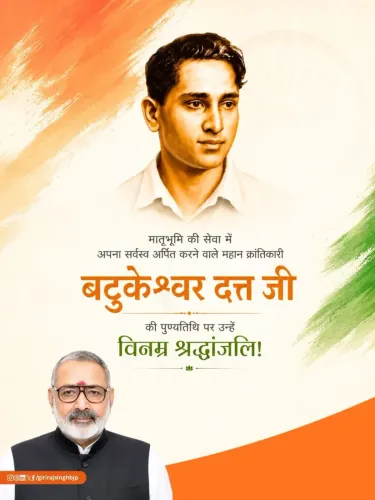
He described Bihar as the 'sacred land' of Gautama Buddha, Chanakya, and Aryabhata — three figures representing spirituality, statecraft, and science.
Singh alleged that political language had been lowered to the point of insulting residents of Bihar and demanded the offending party 'correct the mistake.' No specific individual or remark was named in the post, leaving the target unnamed.
The defence follows a recognisable pattern in Indian politics where Bihar's ancient intellectual legacy is mobilised as a counter to perceived slights against the state.
When a minister invokes Buddha, Chanakya, and Aryabhata in a single breath, something has clearly stung. Union Textiles Minister Giriraj Singh took to X on Sunday, November 8, 2026, firing a sharp rebuke at unnamed political opponents who, he alleged, had dragged the standard of political language low enough to insult the people of Bihar.
Singh's post in Hindi reads: 'Bihar buddh, Chanakya aur Aryabhatt jaisi mahan vibhutiyon ki pavan bhoomi hai' — 'Bihar is the sacred land of great luminaries like Buddha, Chanakya, and Aryabhata. Knowledge, intellect, and self-respect are the identity of this soil.' He then turned combative: 'Do not lower the standard of political language to the point where people of this rich and historic state are insulted. Respect public sentiment and correct your mistake.'
Three Names That Carry a Civilisational Argument
The three figures Singh invokes are not rhetorical ornament — each carries specific weight. Gautama Buddha attained enlightenment at Bodh Gaya in present-day Bihar, making the state a global pilgrimage destination and the cradle of one of the world's major religions. Chanakya, the author of the Arthashastra, is synonymous with the Magadha kingdom that once held dominion over much of the subcontinent — his name has become shorthand for strategic brilliance in Indian political culture. Aryabhata, the fifth-century mathematician and astronomer credited with concepts that underpinned modern algebra and astronomy, is traditionally associated with the same Bihar heartland.
Invoking all three in one sentence is a deliberate move: it frames any criticism of Bihar not as political commentary but as an assault on India's intellectual heritage itself.
A Familiar Bihar-Defence Playbook — With a Demand to 'Correct the Mistake'
Indian political discourse has a well-worn groove here. When Bihar is perceived as the target of a slight — whether from rivals questioning governance, economic data, or social indicators — politicians from the state, across party lines, reach for its civilisational legacy as a shield and a sword. What makes Singh's post structurally notable is its closing demand: not just wounded pride, but an explicit call to 'correct your mistake.' That phrasing implies a specific individual or group was addressed, and that an apology or retraction is expected.
Singh himself represents Begusarai, a Lok Sabha constituency in Bihar, lending personal electoral stakes to his defence of the state's honour. As a senior BJP leader at the Centre, his intervention also signals that the party intends to make the alleged remark a political liability for whoever made it — particularly consequential with Bihar remaining a pivotal state in coalition arithmetic.
Who Was Targeted — and What Comes Next
Singh's post conspicuously names no adversary. The specific remark that triggered this defence was not publicly identified at the time of writing. That silence is itself a tactic: it keeps the high ground of historical pride visible while inviting the person or party concerned to either double down or retreat.
Responses from opposition leaders — and any clarification or escalation from whoever the remark originated with — will determine whether this remains a one-day flash point or becomes a sustained campaign issue in the state's political calendar.
Bihar's pride in its ancient legacy is not up for debate. What is up for debate, it seems, is exactly who crossed a line — and whether they will walk it back.
Point of View
Chanakya, and Aryabhata, he elevates a local political skirmish into a civilisational narrative, forcing any opponent to either apologise or appear anti-Bihar. The deliberate omission of the offender's name keeps Singh on the moral high ground while generating pressure for a response. Ahead of any state-level political cycle, such interventions help consolidate the party's identity as defenders of Bihari dignity — a message that resonates well beyond the immediate controversy.
NationPress
8 Nov 2026
Frequently Asked Questions
Why did Giriraj Singh post about Bihar's heritage on November 8, 2026?
Singh posted in response to what he described as insulting political language directed at Bihar, though he did not name the specific individual or remark. He invoked the legacies of Buddha, Chanakya, and Aryabhata to highlight the state's historical significance.
What did Giriraj Singh say about Bihar's historical figures?
Singh described Bihar as the 'sacred land of great luminaries like Buddha, Chanakya, and Aryabhata,' calling knowledge, intellect, and self-respect the defining identity of the state.
Who is Giriraj Singh?
Giriraj Singh is a senior BJP leader, Union Minister of Textiles, and Lok Sabha MP representing the Begusarai constituency in Bihar.
What is the significance of Chanakya and Aryabhata being associated with Bihar?
Chanakya, author of the Arthashastra, is linked to the ancient Magadha kingdom in present-day Bihar. Aryabhata, the fifth-century mathematician and astronomer, is also traditionally associated with the Bihar region. Both figures represent Bihar's contribution to India's intellectual heritage.
What did Giriraj Singh demand from his political opponents?
Singh demanded that his unnamed opponents respect public sentiment and 'correct the mistake,' implying he expected an apology or retraction for the alleged insult to Bihar and its people.