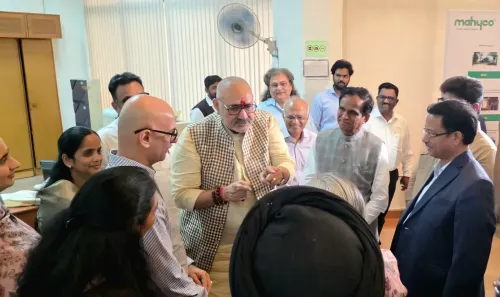
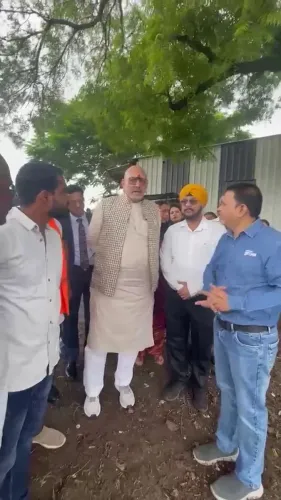
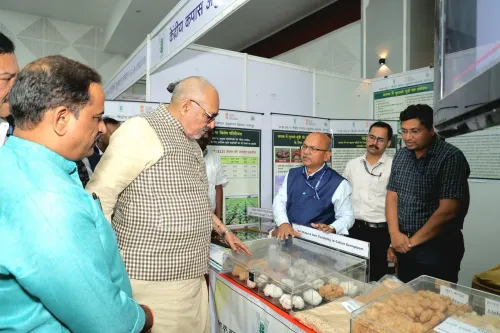
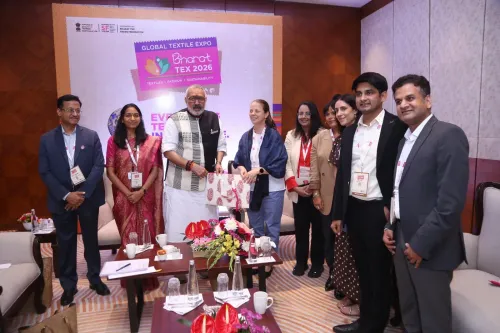
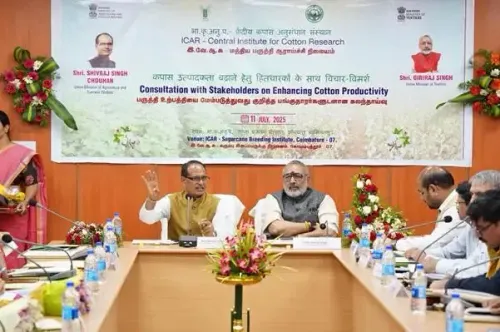
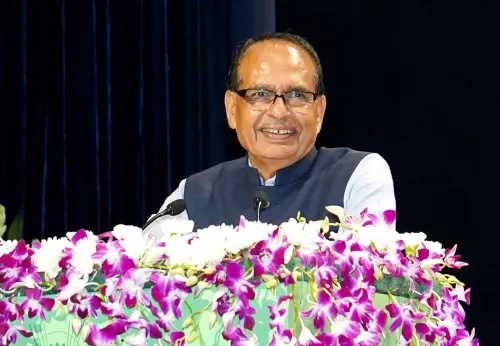
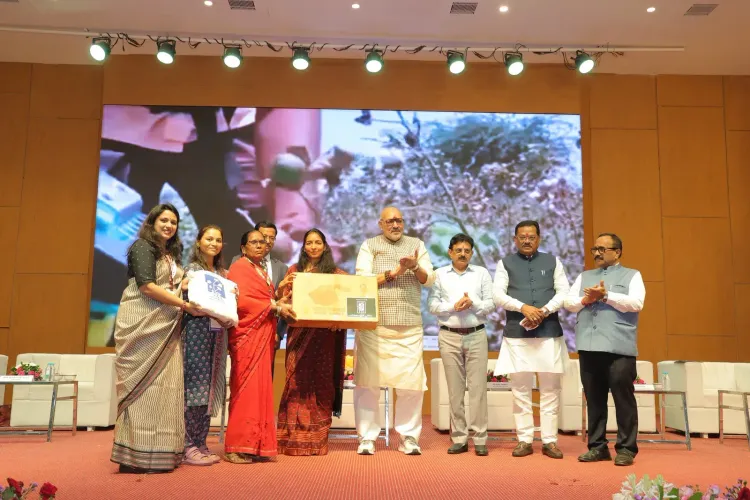
Giriraj Singh distributes farm machines at CCI's 56th Foundation Day
Synopsis
Union Textiles Minister Giriraj Singh marked the Cotton Corporation of India's 56th Foundation Day in Chhatrapati Sambhajinagar by distributing cotton plucking machines, stalk shredder machines, and contamination control kits to farmers and FPOs, targeting farm-level quality improvement and global competitiveness.
Key Takeaways
The Cotton Corporation of India celebrated its 56th Foundation Day on 1 August 2026 in Chhatrapati Sambhajinagar, Maharashtra .
Union Textiles Minister Giriraj Singh oversaw distribution of cotton plucking machines, cotton stalk shredder machines, and contamination control kits to farmers and FPOs.
CCI is a Miniratna Category-I PSU under the Ministry of Textiles, established in 1970 for MSP procurement and cotton market stabilisation.
Contamination in hand-picked Indian cotton has historically caused price discounts in global markets; the kits target this directly at the farm level.
Farmer Producer Organisations (FPOs) were included as distribution channels, enabling shared mechanisation access for small and marginal growers.
The initiative aligns with the long-running Technology Mission on Cotton (launched 2000 ) and the broader goal of making Indian cotton globally competitive.
Cotton farmers in Chhatrapati Sambhajinagar, Maharashtra got a tangible government push on Saturday, 1 August 2026, when Union Textiles Minister Giriraj Singh marked the Cotton Corporation of India's 56th Foundation Day by putting mechanisation tools directly in the hands of growers and farmer collectives — a signal that India's cotton-quality war is moving from policy papers to paddy fields.
Machines on the ground in Maharashtra's cotton belt
At the foundation-day ceremony, farmers and Farmer Producer Organisations (FPOs) received cotton plucking machines, cotton stalk shredder machines, and contamination control kits. The distribution, Singh said, is aimed at improving fibre quality at the farm level, reducing contamination, and securing better prices for growers — three problems that have dogged Indian cotton for decades.
Chhatrapati Sambhajinagar — formerly Aurangabad — sits at the heart of Maharashtra's cotton ginning and trading corridor, making it a symbolically and practically fitting venue. The minister framed the initiative in his post as a step toward 'vaigyanik evam sustainable kapas utpadan' (scientific and sustainable cotton production).
Why contamination has cost Indian cotton its premium
India is one of the world's largest cotton producers, yet its fibre has historically attracted a discount in global markets. The culprit: contamination — synthetic fibres, polythene, dust — introduced during hand-picking and handling. Global textile buyers, increasingly bound by traceability and sustainability mandates, have been pressing suppliers hard on this front.
The contamination control kits distributed on Saturday address exactly this chokepoint. Stalk shredder machines, meanwhile, help manage post-harvest residue — reducing pest carry-over and improving next-season soil health. Together, these tools form a farm-level quality-control stack that no amount of downstream mill technology can substitute.
This push traces a direct line to the Technology Mission on Cotton launched in 2000, which first codified contamination reduction and productivity improvement as national priorities. The Cotton Corporation of India, a Miniratna Category-I PSU under the Ministry of Textiles incorporated in 1970, has since been the primary vehicle for MSP procurement and buffer stocking — and increasingly, for technology transfer to growers.
FPOs as the multiplier in the cotton value chain
The inclusion of FPOs in the distribution is the strategic detail worth watching. Farmer Producer Organisations aggregate small and marginal growers, giving them collective bargaining power and shared access to machinery that no individual farmer could justify buying alone. Routing machines through FPOs means one kit can serve dozens of farms — multiplying reach without multiplying cost.
Singh's post closed with a pointed framing: 'Sashakt kisan aur majboot kapas value chain hi Bharatiya kapas ki gunavatta aur vaishvik pratispardhatmakta ko nayi mazbooti denge' — 'Empowered farmers and a strong cotton value chain alone will give new strength to the quality and global competitiveness of Indian cotton.' That is not ceremonial language. It is the benchmark against which this distribution drive will eventually be measured.
Point of View
Where contamination damage actually occurs. By routing equipment through producer collectives rather than individual farmers, the Ministry of Textiles is trying to solve the scale problem that has stalled earlier technology-transfer efforts. The move fits a broader pattern of the BJP government using PSU anniversaries as policy-delivery moments, combining optics with on-ground rollout. Whether the kits translate into measurable contamination reduction and price premiums for growers will depend on follow-through monitoring — the gap where similar schemes have faltered before.
NationPress
1 Aug 2026
Frequently Asked Questions
What is the Cotton Corporation of India and what does it do?
The Cotton Corporation of India (CCI) is a Miniratna Category-I public sector undertaking under the Ministry of Textiles, established in 1970. It procures cotton at Minimum Support Price (MSP) during market downturns, manages buffer stocks, and markets cotton to textile mills, stabilising prices for both farmers and the industry.
What machines were distributed at CCI's 56th Foundation Day?
Cotton plucking machines, cotton stalk shredder machines, and contamination control kits were distributed to farmers and Farmer Producer Organisations (FPOs) at the event in Chhatrapati Sambhajinagar on 1 August 2026.
Why is cotton contamination a problem for Indian farmers?
Contamination — synthetic fibres, polythene, and dust introduced during hand-picking and storage — causes Indian cotton to attract a price discount in global markets. International textile buyers increasingly demand clean, traceable fibre, so contamination directly reduces the income farmers can earn from their crop.
What is the role of FPOs in the cotton sector?
Farmer Producer Organisations (FPOs) are government-promoted collectives that aggregate small and marginal farmers, giving them shared access to inputs, technology, and markets. In the cotton sector, routing mechanisation equipment through FPOs allows a single machine to serve many farms, improving cost-effectiveness and reach.
What is the Technology Mission on Cotton?
The Technology Mission on Cotton was launched by the central government in 2000 to raise cotton productivity, improve fibre quality, and reduce contamination levels across India's cotton-growing states. It remains the foundational policy framework under which subsequent mechanisation and quality-control interventions, including the current distribution drive, are pursued.