Giriraj Singh Flags India's Cotton Sector as Global Force
Synopsis
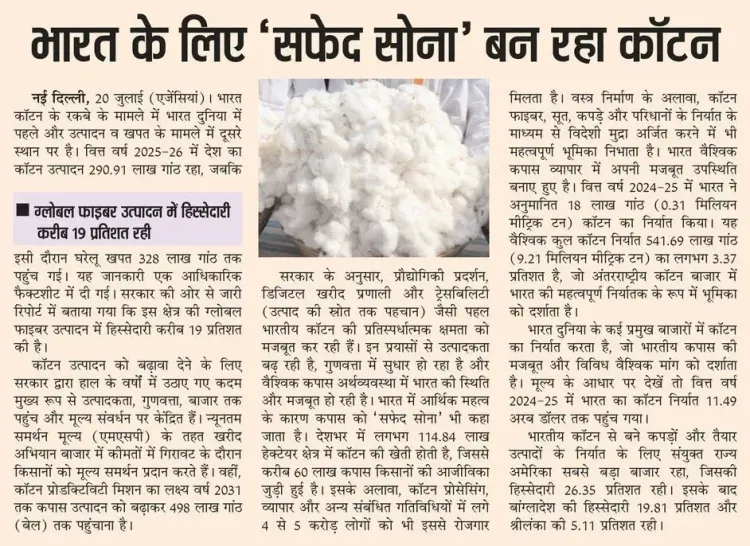
Union Textiles Minister Giriraj Singh on 21 July 2026 underscored India's position as the world's top cotton-cultivating nation and second-largest producer, citing a 19% global fibre share and government schemes aimed at boosting farmer income and international market identity.
Key Takeaways
India ranks first globally in area under cotton cultivation and second in both production and consumption, according to Giriraj Singh .
India accounts for approximately 19% of global cotton fibre production.
The government is running multiple schemes to raise farmer incomes , improve productivity, and enhance fibre quality.
The Technology Mission on Cotton (2000) and Bt cotton approval (2002) form the policy foundation for India's output growth.
Cotton is positioned under the Atmanirbhar Bharat framework as a bridge between agricultural livelihoods and industrial textile employment.
Upcoming 2026-27 area and production estimates and any MSP or CCI procurement revisions will be key indicators to watch.
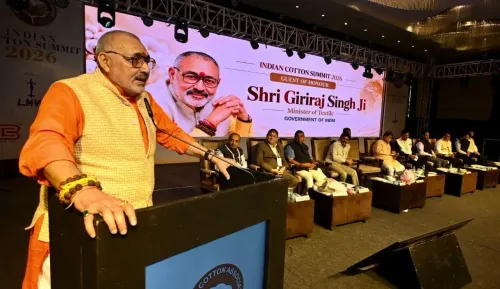
Union Textiles Minister Giriraj Singh on Tuesday, 21 July 2026, highlighted India's dominant position in global cotton cultivation, stating that the country ranks first in area under cotton farming and second in both production and consumption worldwide. The minister credited ongoing government schemes with strengthening farmer incomes, raising productivity, and building the identity of Indian cotton in international markets.
Context
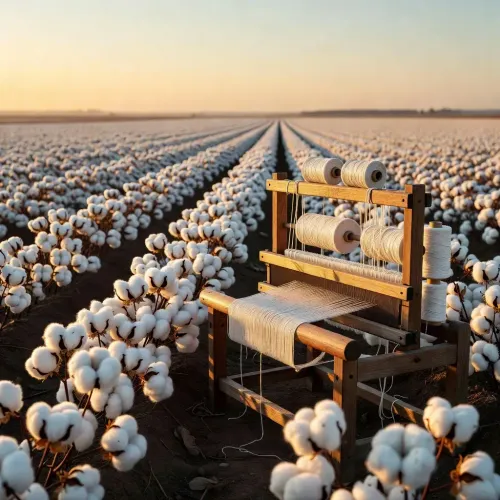
Posting in Hindi on X, Giriraj Singh wrote: 'कपास केवल एक फसल नहीं, बल्कि करोड़ों किसानों की आजीविका, देश के वस्त्र उद्योग और अर्थव्यवस्था की मजबूत नींव है' — 'Cotton is not merely a crop; it is the livelihood of crores of farmers, and the strong foundation of the country's textile industry and economy.' He added that India now holds approximately 19% of global cotton fibre production, describing the crop as India's 'white gold' carving a new identity in world markets.
The post was accompanied by an image and carried hashtags including #AtmanirbharBharat and #VocalForLocal, signalling the government's framing of cotton as central to its self-reliance agenda.
Policy Backdrop
India's cotton sector has been shaped by successive policy interventions over more than two decades. The Technology Mission on Cotton, launched in 2000, targeted productivity improvements, fibre quality upgradation, and contamination reduction across major producing states. The approval of Bt cotton hybrids in 2002 accelerated national output and helped India become a net exporter of raw cotton within a decade.
The National Textile Policy 2000 and subsequent production-linked incentive schemes sought to modernise spinning, weaving, and garment units that depend on domestic cotton as their primary raw material. Under the Atmanirbhar Bharat campaign, the government has sought to deepen the cotton-to-textile value chain, reducing import dependence and capturing greater value at each stage of processing.
Stakeholders and Impact
Cotton cultivation supports the livelihoods of crores of farmers across states including Gujarat, Maharashtra, Telangana, Andhra Pradesh, and Punjab. The crop also anchors the downstream textile industry, which is among India's largest employers and a significant source of export earnings.
Textile mills, spinning units, and garment exporters are directly affected by the quality and volume of domestic cotton supply. Improvements in fibre quality and reductions in contamination — long-standing challenges for Indian cotton — are critical to these units' ability to compete in premium export markets. The minister's emphasis on global market identity speaks directly to this industrial constituency.
What's Next
Attention will now turn to the release of 2026-27 cotton area and production estimates by the Ministry of Agriculture, which will test whether India's acreage leadership translates into yield gains. Any revision to the Minimum Support Price (MSP) for cotton or changes in procurement targets by the Cotton Corporation of India (CCI) will be closely watched by farmer groups and mill owners alike.
The minister's framing of cotton as 'white gold' with a strengthening global footprint sets an expectation for concrete export and quality benchmarks in the coming season, putting the spotlight on whether policy momentum will be matched by on-ground outcomes for farmers and the broader textile value chain.
Point of View
The minister aligns the sector with the government's broader Atmanirbhar Bharat branding ahead of what is likely a policy announcement or budget cycle. The emphasis on global market identity also signals a pivot toward export competitiveness and premium positioning, a consistent theme in BJP economic communication since 2020. Whether this translates into measurable MSP hikes or quality-linked procurement reforms will determine how farmers and industry respond to the framing.
NationPress
20 Oct 2026
Frequently Asked Questions
What is India's rank in global cotton production?
India ranks second in global cotton production and consumption, and first in the area under cotton cultivation, according to Union Textiles Minister Giriraj Singh.
What is India's share in global cotton fibre production?
India accounts for approximately 19% of global cotton fibre production, as stated by Textiles Minister Giriraj Singh in July 2026.
What government schemes support Indian cotton farmers?
Key schemes include the Technology Mission on Cotton (launched 2000), production-linked incentive schemes for textile units, and the broader Atmanirbhar Bharat initiative that aims to strengthen the domestic cotton-to-textile value chain.
Why is Indian cotton called 'white gold'?
'White gold' is a longstanding phrase used to describe cotton's dual importance as a major source of farmer income and a critical raw material for India's large textile and garment export industry.
What is the Cotton Corporation of India and what role does it play?
The Cotton Corporation of India (CCI) is a government body that procures cotton at the Minimum Support Price (MSP) to protect farmers from price distress and stabilise the domestic supply available to textile mills.