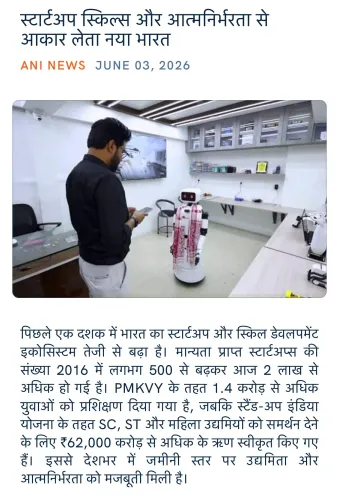
Giriraj Singh shares piece on Kashmir youth shift to startups
Synopsis
Union Textiles Minister Giriraj Singh amplified an opinion piece on June 5, 2026, framing Kashmiri youth as shifting from stone-pelting to startups — a narrative the BJP has anchored to post-2019 policy changes including the abrogation of Article 370 and the extension of Startup India to J&K.
Key Takeaways
Giriraj Singh shared an opinion piece on June 5, 2026 via the NaMo App highlighting changing youth aspirations in Jammu and Kashmir .
The piece contrasts the era of stone-pelting protests with a growing startup and entrepreneurship culture among Kashmiri youth .
The abrogation of Article 370 in August 2019 enabled uniform application of central schemes, including Startup India , across J&K .
The Startup India initiative, launched in 2016 , has been leveraged in J&K to promote entrepreneurship as an alternative to unrest.
The government's post- 2019 approach in J&K has combined security normalisation with economic integration through national flagship programmes.
Youth employment metrics and new J&K startup policies remain key indicators to watch as the government seeks to validate its development narrative.
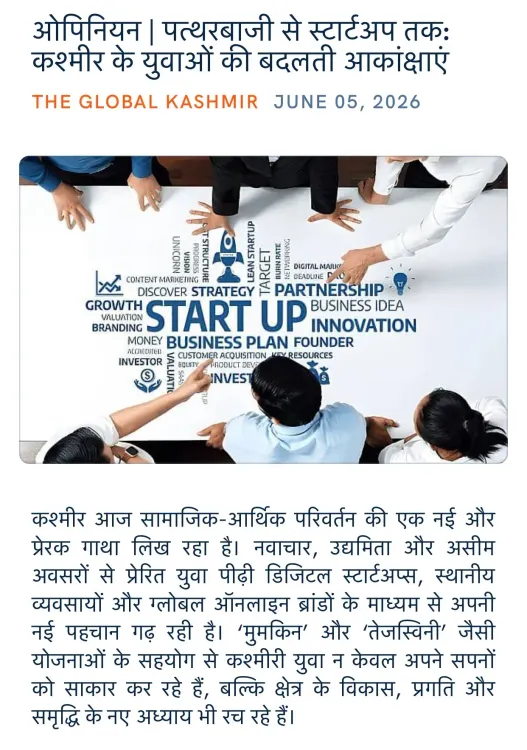
Union Textiles Minister Giriraj Singh on Friday, June 5, 2026, shared an opinion piece via the NaMo App highlighting the changing aspirations of Kashmiri youth — from stone-pelting to entrepreneurship and startups — drawing attention to what the government frames as a generational transformation in the Union Territory of Jammu and Kashmir.
Context
The opinion piece, titled 'Pattharbaazi se startup tak: Kashmir ke yuvaon ki badlti aakankshaen' ('From stones to startups: the changing aspirations of Kashmir's youth'), was amplified by Giriraj Singh through the NaMo App, a platform closely associated with the BJP's digital outreach. By sharing the piece, the senior minister signalled the ruling party's continued effort to project Jammu and Kashmir as a region undergoing a fundamental social and economic shift since August 2019.
The framing — contrasting stone-pelting with startup culture — is a recurring motif in the government's narrative around post-abrogation J&K, positioning youth entrepreneurship as evidence of normalisation on the ground.
Policy Backdrop
The transformation being described is rooted in two major policy interventions. First, the abrogation of Article 370 in August 2019 removed Jammu and Kashmir's special status and enabled the uniform application of central government schemes across the Union Territory. Second, the Startup India initiative — launched in 2016 — was extended more aggressively into J&K as a tool to channel youth energy toward formal entrepreneurship rather than unrest.
Post-2019, the central government has prioritised a twin-track approach: security normalisation alongside economic integration. National flagship programmes covering skill development, digital access, and business incubation have been deployed in J&K with the explicit goal of creating alternatives to protest movements for the region's young population.
Stakeholders and Impact
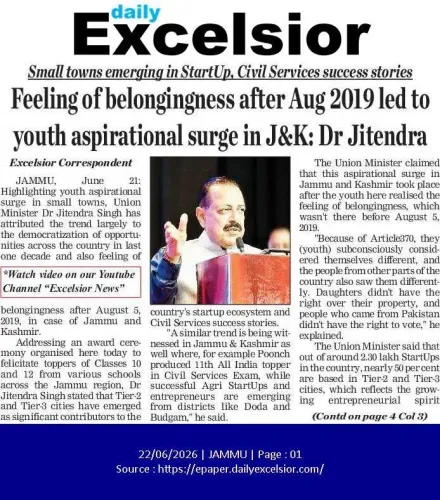
Kashmiri youth are the central stakeholders in this narrative. The government's argument is that access to central schemes — previously unavailable under the special status framework — has opened pathways in technology, trade, and services for a generation that had limited formal economic opportunity. J&K-based startups have reportedly seen increased registration and funding activity since 2019, though specific figures from the linked opinion article have not been independently verified.
Critics of this framing have argued that political and civil liberties questions in the region remain unresolved, and that economic metrics alone do not capture the full picture of youth sentiment in Jammu and Kashmir. The debate reflects a broader tension between development-centric and rights-centric assessments of post-abrogation J&K.
What's Next
The rollout of new J&K startup policies and skill development programmes will be closely watched as a measure of whether the entrepreneurship narrative translates into sustained employment and income gains for young people in the Union Territory. Parliamentary and legislative discussions on youth employment metrics in J&K are also expected to intensify as the government seeks to consolidate its development-first message ahead of future electoral cycles.
If the startup ecosystem in Jammu and Kashmir continues to scale, it could become a flagship data point in the BJP's broader argument that Article 370's abrogation delivered tangible dividends — making the region's youth economy a politically significant indicator to watch through 2026 and beyond.
Point of View
Giriraj Singh is doing targeted political messaging — reinforcing the BJP's core post-2019 argument that Article 370's abrogation unlocked tangible change for ordinary Kashmiris, particularly youth. The 'stones to startups' framing is a deliberate counter-narrative to opposition and civil society voices that foreground political and civil liberties concerns in the region. Sharing the piece via the NaMo App rather than a conventional press statement keeps the tone aspirational rather than administrative, targeting a digitally engaged, younger BJP base. As J&K's economic data becomes more available, this narrative will face increasing scrutiny — making the actual performance of the startup ecosystem a litmus test for the government's broader J&K legacy claims.
NationPress
21 Oct 2026
Frequently Asked Questions
What did Giriraj Singh say about Kashmir youth and startups?
Giriraj Singh shared an opinion piece on June 5, 2026 arguing that Kashmiri youth are shifting their aspirations from stone-pelting protests toward entrepreneurship and startups, framing this as a positive transformation since 2019 .
How has Article 370 abrogation affected Kashmir's startup ecosystem?
The abrogation of Article 370 in August 2019 enabled the uniform application of central schemes like Startup India in Jammu and Kashmir , opening formal business and entrepreneurship pathways that were previously limited under the special status framework.
What is the Startup India scheme and how does it apply to J&K?
Startup India is a central government initiative launched in 2016 to promote entrepreneurship across India. Post- 2019 , it has been actively extended to Jammu and Kashmir as part of the government's effort to redirect youth energy toward formal economic activity.
Is Kashmir's youth really moving away from protests toward business?
The government and its supporters cite rising startup registrations and entrepreneurship activity in J&K as evidence of this shift. However, critics argue that political and civil liberties concerns in the region remain unaddressed and that economic data alone does not fully represent youth sentiment.
Why did Giriraj Singh share this article via the NaMo App?
The NaMo App is a BJP-linked digital platform used by party leaders to amplify content aligned with the government's narrative. Sharing the piece there signals the party's intent to highlight J&K 's development story to its digitally active base.