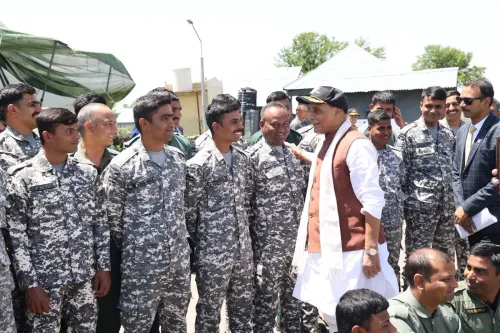
Giriraj Singh hails IAF IL-76MD's historic Ladakh landing
Synopsis
Union Textiles Minister Giriraj Singh on 16 November 2026 celebrated the Indian Air Force's historic landing of an IL-76MD heavy transport aircraft at 13,629 feet in Ladakh, calling it a proud demonstration of the nation's technical mastery and the IAF's courage and skill.
Key Takeaways
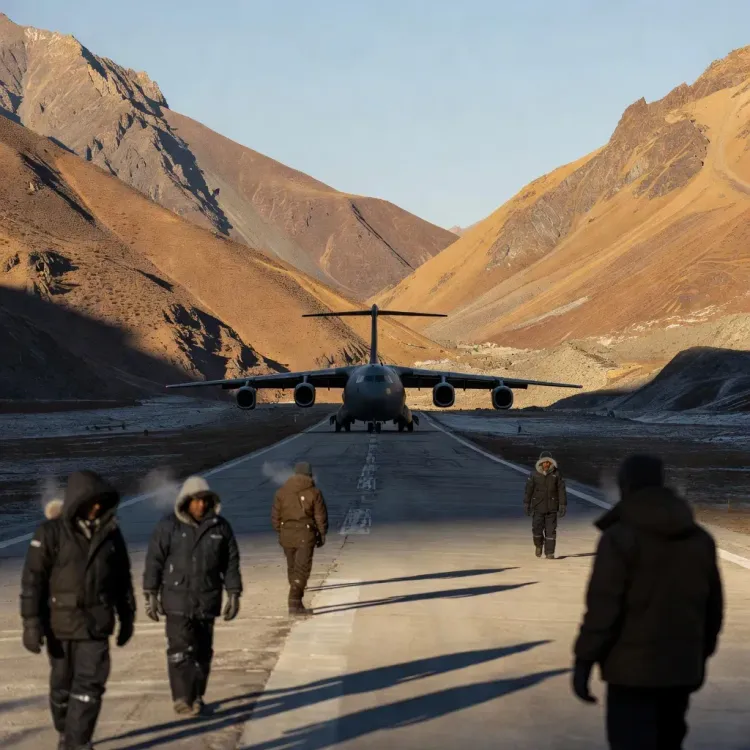
An Indian Air Force IL-76MD heavy transport aircraft completed a historic landing at 13,629 feet in Ladakh .
Union Textiles Minister Giriraj Singh hailed the feat as a 'magnificent example of India's strength and technical proficiency' in a post on 16 November 2026 .
The IL-76MD is a large four-engine strategic airlifter; operating it at extreme Himalayan altitude demands exceptional crew skill and pushes the aircraft's performance envelope.
Ladakh 's Advanced Landing Grounds are central to India's northern defence logistics along borders with China and Pakistan .
Singh praised the IAF aviators for their 'courage, skill, and indomitable resolve' in achieving the milestone.
At 13,629 feet above sea level, in the razor-thin air of Ladakh's forbidding high-altitude terrain, the Indian Air Force just wrote a new chapter in heavy-lift aviation history — and Union Textiles Minister Giriraj Singh marked the moment on Monday, 16 November 2026, saluting the feat on X as a demonstration of the nation's capability and technical mastery.
Singh's post celebrated the historic landing of an IAF IL-76MD heavy transport aircraft in Ladakh's formidable mountain passes, calling it 'desh ke saamarthya aur takniki dakshata ka shaanadaar udaaharan' — 'a magnificent example of the country's strength and technical proficiency.' He added that the entire nation takes pride in this achievement of the Air Force's brave aviators.
What makes the IL-76MD feat at 13,629 feet remarkable
The IL-76MD is a large, four-engine strategic airlifter — not a nimble mountain-hopper. Landing a heavy-lift jet of its class at extreme altitude demands exceptional crew skill: thinner air means longer take-off rolls, reduced engine thrust, and far less margin for error on approach. At 13,629 feet, every instrument reading and pilot instinct is working harder than it would at sea level.
The Indian Air Force has long maintained a network of Advanced Landing Grounds across the Ladakh sector, airstrips carved into terrain that most air forces in the world would not attempt. These strips have been central to India's northern defence logistics, ensuring rapid troop and material deployment along sensitive borders with both China and Pakistan. What sets this landing apart is the sheer class of aircraft involved — a wide-body strategic lifter operating at altitudes that push the outer limits of what such platforms are designed to do.
Ladakh's airstrips and India's northern defence posture
The Ladakh Union Territory sits at the crossroads of two of India's most strategically sensitive frontiers. Keeping those frontiers stocked and defended in winter — when road connectivity through mountain passes becomes unreliable or impossible — depends entirely on air logistics. The IAF's ability to land heavy transport aircraft here is not just a technical milestone; it is a force-multiplier for the entire northern sector.
Operational validation exercises of this nature — landing heavier and heavier aircraft at higher and higher altitudes — form part of the IAF's systematic effort to expand what is achievable in Himalayan conditions. Every new benchmark raised here translates directly into faster mobilisation, larger payloads, and greater strategic depth for India's mountain-warfare capability.
Pride across ranks — and beyond
Singh's tribute reflects a sentiment that runs well beyond political circles. The crew that executed this landing — navigating sudden weather shifts, reduced visibility corridors, and the unforgiving geometry of mountain airstrips — did so with the kind of precision that earns quiet reverence inside the defence establishment. As Singh put it, their achievement reflects 'sahas, kaushal aur adamya sankalp' — courage, skill, and indomitable resolve.
India's strategic aviation story is being written, one altitude record at a time. The IL-76MD touchdown at 13,629 feet in Ladakh is the latest line — and it lands hard.
Point of View
Which remains geopolitically charged. The IL-76MD feat fits into a broader pattern of the IAF systematically validating heavier platforms at extreme altitudes, raising the logistical ceiling for the northern sector. Each such benchmark, when publicly celebrated, also serves a soft-power function: reinforcing domestic confidence in military readiness without requiring a formal Ministry of Defence announcement. It is routine validation elevated, through political endorsement, into a national pride moment.
NationPress
16 Nov 2026
Frequently Asked Questions
What is the IL-76MD aircraft used by the Indian Air Force?
The IL-76MD is a large, four-engine Soviet-designed strategic airlifter operated by the Indian Air Force for heavy-lift transport missions, including logistics support in high-altitude and remote terrain.
Why is landing at 13,629 feet in Ladakh significant?
At 13,629 feet, the air is significantly thinner, reducing engine thrust and aerodynamic lift, which makes landing a heavy aircraft far more demanding and dangerous — placing this feat at the outer limits of operational aviation.
What are Advanced Landing Grounds in Ladakh?
Advanced Landing Grounds are airstrips built in remote, high-altitude areas of Ladakh maintained by the Indian Air Force to enable rapid troop and logistics deployment along India's northern borders with China and Pakistan.
Why did Union Minister Giriraj Singh comment on an IAF operation?
Cabinet ministers frequently express public pride in military achievements as a reflection of national capability; Singh's post on X celebrated the IAF feat as a moment of national honour and tribute to the aviators involved.
How does IAF heavy-lift capability in Ladakh affect India's border defence?
The ability to land heavy transport aircraft at extreme altitude allows India to rapidly move larger quantities of troops, equipment and supplies to the northern frontier even when mountain road routes are blocked, strengthening the overall defence posture.